
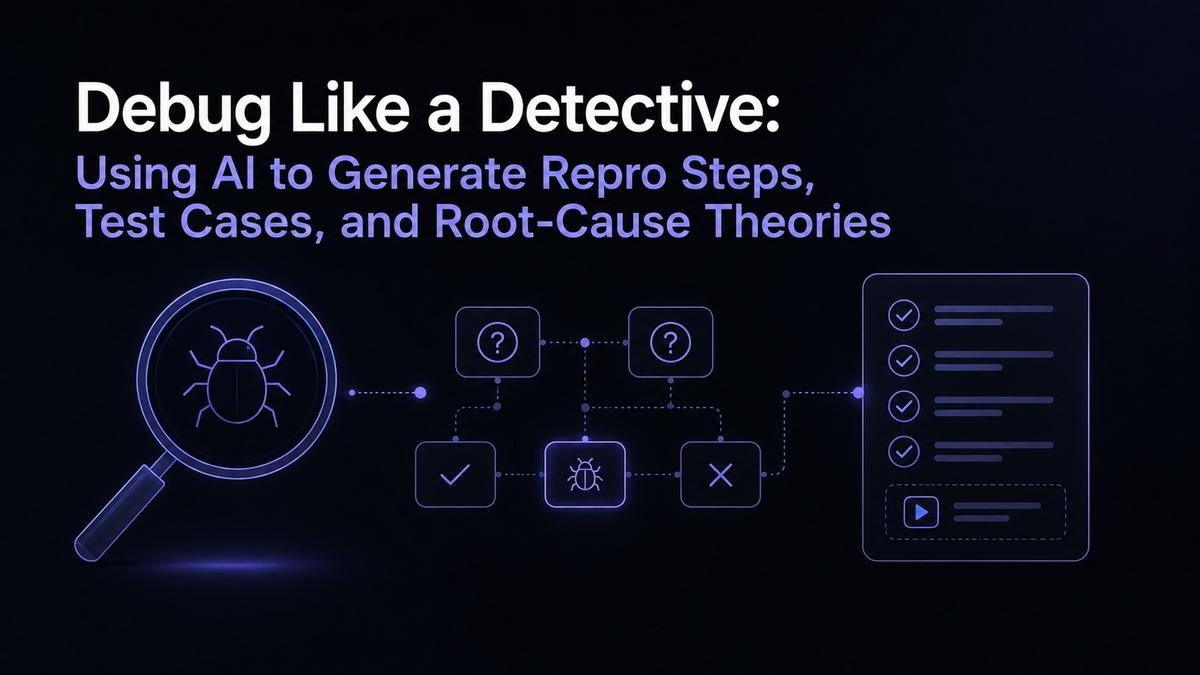
Debug Like a Detective: Using AI to Generate Repro Steps, Test Cases, and Root-Cause Theories
Debugging rarely takes hours because the fix is hard. It takes hours because the situation is unclear. This post gives you a repeatable, AI assisted debugging method built around case files, reproduction steps, ranked hypotheses, and tests that actually lock the bug down for good.
Debugging rarely takes hours because the actual fix is difficult. It takes hours because the situation is unclear, the signals are noisy, and you have not separated what you actually observed from what you simply assumed.
If you have ever opened a ticket that says it broke on someone else's machine, then spent half a day trying to reproduce it yourself, you already know the real battle is not code. The real battle is certainty. Every hour lost to a vague bug report is an hour spent guessing instead of investigating.
This post gives you a repeatable method for debugging with AI as an assistant, not a replacement for your judgment. You will get a five step process, the exact prompts to use at each stage, and the rule that keeps AI from turning your codebase into a pile of unreviewed changes you cannot explain later. This is for developers, freelancers, and small teams who want debugging to feel less like guesswork and more like an investigation with a clear finish line.
What This Debugging Method Actually Is
Think of this process like a detective story rather than a coding task. You build a case file, collect evidence, recreate the incident, narrow down your suspects, and test hypotheses until one explanation survives every attempt to break it.
AI helps most when you treat it as an assistant investigator, improving your artifacts and sharpening your thinking. It hurts when you treat it as a ghost fixer that sprays code changes across your codebase and leaves you holding a large diff you cannot actually defend to a teammate or reviewer.
In practice, the highest value outputs from AI during debugging are clear reproduction protocols anyone on your team could follow, minimal reproducible examples that isolate the actual trigger, ranked hypotheses paired with fast experiments, and test cases that lock the failure mode down so the same regression does not quietly come back later.
Why This Approach Actually Matters
Most debugging time does not go toward writing the fix itself. It goes toward the uncertainty before the fix, chasing vague symptoms, guessing at causes, and testing changes that turn out to be irrelevant to the actual problem.
This matters because that uncertainty compounds under pressure. A bug that takes thirty minutes to fix once you understand it can easily consume an entire day when the reproduction steps are unclear and the root cause is still a guess rather than a confirmed fact.
There is also a trust dimension worth mentioning. A fix backed by a clear case file, a reliable reproduction, and a tested hypothesis is something you can explain confidently in a code review. A fix that came from trial and error with an AI tool, without that same evidence trail, is much harder to stand behind when someone asks why it works.
The Rule That Keeps AI From Polluting Your Repo
Use AI to generate debugging artifacts such as reproduction steps, hypothesis lists, test matrices, and logging plans, then keep your actual code changes small, deliberate, and verified with real evidence before you commit them.
If you treat the model the same way you would treat a teammate's suggestion, meaning you listen carefully and then you prove it yourself, you get real speed without losing control over what actually changes in your codebase. This single rule is what separates a genuinely useful debugging assistant from a tool that quietly makes your codebase harder to trust.
How the Five Step Process Works
Step 1: Open a Case File in Two Minutes
Before you touch any code, write a compact case file that makes the problem easy to hand off and easy to reason about, since vague bug descriptions are exactly where time quietly disappears. Your case file should capture the expected behavior, the actual behavior, environment details like OS, browser, device, version, and feature flags, the frequency of the issue, the impact, relevant timestamps and identifiers, and the last known good point if you have one.
Act as a senior engineer helping me debug.

Here is my bug report or symptom dump:
[paste what you know]

Task:
1) Rewrite this as a crisp bug case file with expected behavior, actual behavior, environment, frequency, and impact.
2) List the top 10 missing details that would reduce uncertainty the most.
3) Suggest 3 quick experiments that would gather those details in under 15 minutes.

Do not suggest code changes yet.
Step 2: Make the Bug Reproducible, or Admit It Is Not Yet
A bug you cannot reproduce wastes days, because you cannot actually own it, you can only hope it eventually goes away on its own. Your job here is to turn a rough report into one of three outcomes, a reliable reproduction, a bounded reproduction that only happens under a specific known condition, or an honest statement that more instrumentation is required before you can move forward at all.
You are my debugging assistant.

Bug case file:
[paste]

Current rough reproduction steps:
[paste]

Task:
1) Rewrite into an exact reproduction protocol with numbered steps.
2) Add preconditions such as accounts, data, flags, and starting state.
3) Identify ambiguous steps and propose precise wording.
4) Add 5 variations to try that would help isolate the trigger.

Output only the protocol.
Once you have a clearer protocol, it often helps to isolate the smallest possible version of the failure.
Act as a software engineer focused on minimal reproducible examples.

Context:
- Language and framework: [for example, React 18 plus Vite]
- What I expected:
- What happened:
- Constraints: keep it under about 60 lines if possible.

Task:
Propose a minimal reproducible example that could trigger this class of bug.
Include the smallest code skeleton, the smallest data input that causes failure, how to run it, and what I should observe.

Do not invent dependencies I did not mention.
Step 3: Generate Ranked Root Cause Hypotheses
Most debugging becomes expensive the moment you start searching too broadly, so what you actually want is a short list of plausible explanations that are specific, testable, and paired with quick experiments you can run right away.
A good hypothesis should sound like something you could falsify within an hour. A race condition between two requests under slow network conditions, a timezone conversion error from parsing local time as UTC, or a cache key missing a segment like locale are all examples of hypotheses specific enough to actually test.
Act as a principal engineer debugging with hypotheses.

Bug case file:
[paste]

System context:
- Architecture: [monolith, microservices, or client only]
- Data store: [Postgres, Redis, and so on]
- Known recent changes: [deploys, config, feature flags]

Task:
1) Generate 10 plausible root cause hypotheses.
2) For each, list why it fits the symptoms, what evidence would confirm it, and the fastest experiment to test it.
3) Rank them by expected value, using likelihood times impact times speed to test.

Do not propose final code fixes.
Once you have the ranked list, pick the top two or three hypotheses and run the fastest experiments against them. If nothing moves your uncertainty forward, go back and improve the case file rather than start changing code blindly on a guess.
Step 4: Generate Test Cases That Force the Bug to Reveal Itself
Once you finally understand the failure mode, your next goal shifts to preventing a repeat. This is genuinely where AI shines, since it can enumerate edge cases you might easily miss when you are tired, rushed, or simply too close to the problem to see it clearly.
Act as a QA minded engineer.

Feature or bug:
[paste case file]

Task:
1) Create a test matrix with input variants, environment variants, and state variants.
2) Include at least 15 tests that cover boundary values, invalid inputs, concurrency, retries, and timeouts.
3) Mark which tests fit best as unit tests, integration tests, or end to end tests.
4) Identify the smallest set of tests that would catch this regression forever.

Output as a markdown table.
Once your test matrix is ready, you can draft the actual executable tests directly from it.
Act as a senior engineer writing tests.

Constraints:
- Repo stack: [Jest, Vitest, Playwright, and so on]
- Style rules: [your conventions]

Here is the failing behavior and the key test cases:
[paste]

Task:
Draft the tests with short intent comments, and list any assumptions at the top.
Step 5: Add Surgical Logging You Can Remove Later
When reproduction is genuinely hard, logging becomes your witness statement. The goal is capturing the minimum evidence required to prove or disprove your top hypotheses, without spamming your production logs in the process.
Act as an observability focused engineer.

Bug case file:
[paste]

Current logging and tracing:
[paste what exists]

Task:
1) Propose a minimal logging and tracing plan to prove or disprove the top 5 hypotheses.
2) For each event, specify location, fields, sampling strategy, and privacy concerns.
3) Suggest correlation keys such as request IDs and trace IDs.

Keep it minimal and production safe.
While reviewing logs and structured output during this step, small utilities can save real time too. Our free developer tools include a JSON formatter for messy log payloads and a regex tester for validating the exact patterns your logging plan depends on, both useful while you are still narrowing down a hypothesis.
Benefits of This Method
The biggest benefit is that debugging stops feeling like guesswork. Every stage produces a concrete artifact, a case file, a reproduction protocol, a ranked hypothesis list, or a test matrix, which means you always know exactly where you stand in the investigation.
It also makes your fixes far easier to defend later. A pull request backed by a clear case file and a passing regression test is something a reviewer can trust immediately, compared to a fix with no documented reasoning behind it.
This process also builds genuinely useful documentation as a side effect. The case file and reproduction steps you create while debugging often become the exact material future engineers need when a similar bug shows up again months later.
Honest Limitations to Keep in Mind
This method takes more upfront structure than just diving straight into the code, and for very simple, obvious bugs that extra structure can feel like overkill. Use your judgment about when the full five step process is actually necessary.
AI generated hypotheses are only as good as the case file and system context you provide. Vague or incomplete input at any stage produces vague, low value hypotheses further down the process, so the quality of your inputs really does determine the quality of your results here.
This approach also will not replace the deep, contextual knowledge a senior engineer builds up over years of working inside one specific codebase. AI can generate a strong starting list of hypotheses, but confirming which one is actually correct still depends on your understanding of the system.
Best Use Cases for This Method
This approach works especially well for hard to reproduce bugs, intermittent failures, and issues reported vaguely by users or teammates who cannot fully describe what went wrong. The structure exists specifically to turn that vagueness into something testable.
It also works well for freelance developers and consultants who need to explain their debugging process clearly to a client. If you bill for your time, being able to show a documented case file and hypothesis list makes that time far easier to justify. Our freelance developer offer and pricing kit pairs well here if you are structuring debugging or maintenance work into a client proposal.
Small teams without a dedicated QA process benefit strongly too, since the test matrix and executable test steps in this method effectively fill that gap without requiring a separate role.
Practical Tips for Getting Started
Start every debugging session by writing the case file first, even when you feel confident you already understand the bug. This habit alone prevents a huge amount of wasted time chasing the wrong root cause based on an assumption that was never actually verified.
Keep your AI generated code changes small and reviewable at every stage. If a suggested fix touches more files than you can explain in a sentence or two, that is usually a sign to slow down and verify your hypothesis further before committing anything.
If you enjoyed this structured, prompt driven approach, our companion post on going from idea to a deployed app in a single weekend using AI pair programming applies a very similar discipline to building rather than debugging.
Common Mistakes to Avoid
The most common mistake is skipping the case file entirely and jumping straight into changing code based on a guess. This almost always costs more time in the long run than the two minutes it takes to write a proper case file upfront.
Another mistake is accepting an AI generated fix without verifying it against a real hypothesis. A fix that happens to make the symptom disappear is not the same as a fix that addresses the actual root cause, and the difference usually shows up again later as a repeat bug.
People also tend to let AI generate large, sweeping code changes across a codebase without reviewing each part carefully. This is exactly the ghost fixer pattern this method is designed to avoid, since a diff you cannot fully explain is a diff you cannot really trust.
Where This Approach Is Heading
AI tools are likely to get better at connecting directly to logging and monitoring systems, which could eventually let a debugging assistant pull relevant evidence automatically instead of relying entirely on what you manually paste into a prompt. That shift would make the case file and hypothesis stages even faster to complete.
At the same time, the core discipline behind this method will likely matter more, not less, as AI generated suggestions get faster and more convincing sounding. The ability to demand evidence before trusting a hypothesis becomes more valuable exactly as it becomes easier to accept an AI's confident sounding explanation without checking it.
Expect more debugging tools to build structured, stage based workflows like this one directly into their interfaces, rather than leaving developers to build the discipline manually through prompts, since the pattern clearly produces better and more trustworthy outcomes.
FINAL THOUGHTS
Debugging speed comes from reducing uncertainty quickly, not from typing faster or guessing more confidently. AI becomes a genuinely strong assistant the moment you use it to clarify your case file, tighten your reproduction steps, generate testable hypotheses, and strengthen your tests and logging.
What never changes is who stays responsible for the actual decisions. You own the code changes, you own the proof behind them, and you own the judgment about which hypothesis actually explains the bug, no matter how convincingly an AI tool phrases its suggestion.
The next time you open a vague bug report, resist the urge to start guessing at code changes immediately. Spend the first two minutes writing a proper case file instead, and let that single habit change how the rest of your debugging session actually goes.
FREQUENTLY ASKED QUESTIONS
Why does writing a case file first actually save time?
A case file forces you to separate what you actually observed from what you are assuming, which prevents you from chasing the wrong root cause based on a guess. The two minutes it takes upfront typically saves far more time later in the debugging process.
Is it safe to let AI generate code fixes directly during debugging?
It is safer to use AI for generating debugging artifacts, like hypotheses and test cases, rather than letting it directly write and apply fixes across your codebase. Keep your actual code changes small, deliberate, and verified against a confirmed hypothesis before committing them.
What should I do if a bug is genuinely not reproducible?
Be honest about that instead of guessing at a fix. Either narrow the reproduction to a specific bounded condition, or add the minimal logging needed to gather more evidence before attempting any code change.
How many root cause hypotheses should I actually test?
Focus on your top two or three ranked hypotheses rather than trying to test all ten at once. If none of them move your uncertainty forward, improve your case file and system context before generating a new list.
Does this method work for freelance or client debugging work?
Yes, and it works particularly well there, since a documented case file and hypothesis list make your billed debugging time far easier to explain and justify to a client. It also gives you clear evidence of the actual work performed.
What is the single biggest mistake developers make when using AI to debug?
Accepting a fix that makes the symptom disappear without confirming it addresses the actual root cause. That gap is exactly how the same bug quietly returns later, sometimes in a slightly different form that takes even longer to trace back.
Comments (0)
Sign in to post a comment.
- Be the first to comment.