UK regulators force Google to offer publisher opt-outs from AI Search
Google must now give publishers a way to keep their content out of AI Overviews and AI Mode without losing their spot in regular search results. UK regulators say the move gives content creators real bargaining power as AI search reshapes how people find information online.
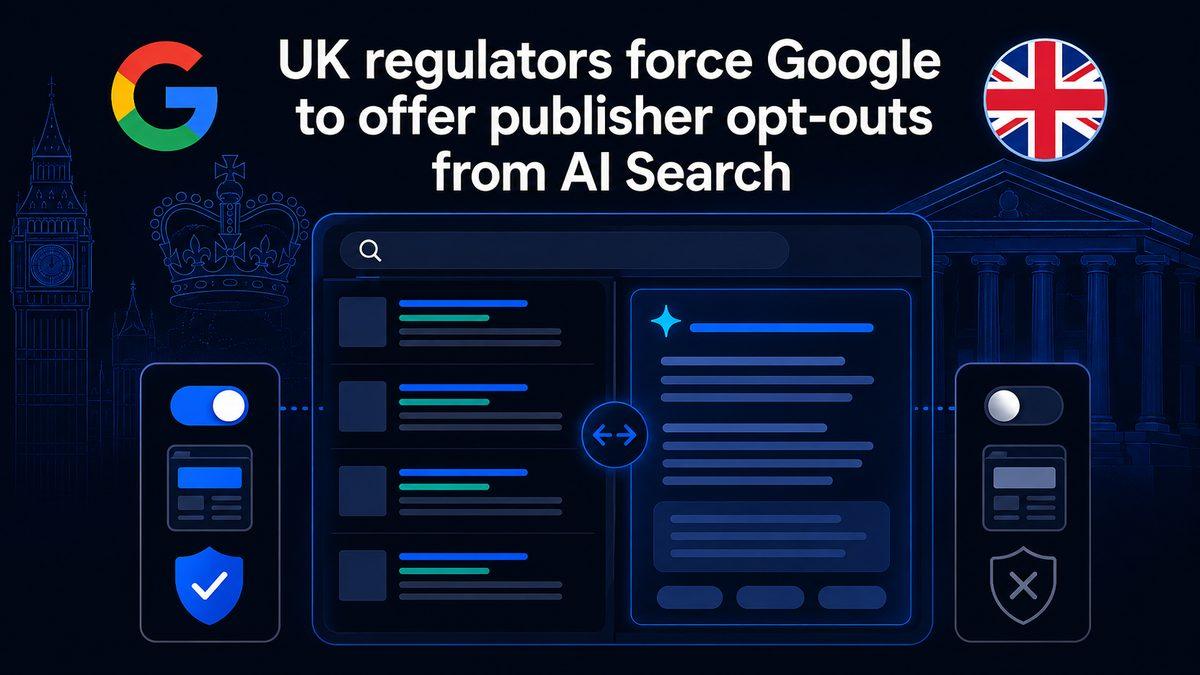
Google must now let publishers stop their content from feeding AI Overviews and AI Mode, without losing their place in ordinary search results. The UK Competition and Markets Authority announced the requirement on June 3, 2026, calling it a world first for regulating AI search. Until now, publishers faced an all or nothing choice. Block Google's crawlers entirely and vanish from search, or accept that articles get pulled into AI generated answers with no guarantee of a click, a mention, or any revenue. This affects anyone who runs a website that depends on Google traffic, which in practice means most news outlets, bloggers, small businesses, and independent creators. It also affects everyday searchers, since Google will now show more information about where an AI answer's content actually came from. For students, developers, content creators, and entrepreneurs building anything online, this ruling signals that the rules governing AI and content ownership are starting to catch up with the technology, and more countries are expected to follow.
What Happened
On June 3, 2026, the UK's Competition and Markets Authority (CMA) ordered Google to give website publishers a new way to control how their content appears inside the company's AI powered search features. The order covers AI Overviews, the AI generated summary panel that often sits above normal search listings, along with the newer AI Mode and the AI Overviews shown inside Google Discover.
The regulator's chief executive, Sarah Cardell, described the measures as a step toward fair dealing and said publishers deserved meaningful bargaining power now that AI Overviews are reshaping how people search online.
Google confirmed it will comply. The company said it is already testing a new toggle inside Search Console, the free tool website owners already use to manage how their pages show up in Google Search.
Site owners will be able to switch off their content's use in generative AI features while keeping their normal search listing fully intact. Google said it plans to test this first with a smaller group of UK publishers before expanding the option worldwide.
Why It Matters
Search traffic has been the financial backbone of the open web for two decades. Publishers write articles, optimize them, and rely on Google sending readers their way. Those readers then generate ad views, subscription signups, and other revenue.
AI Overviews changed that arrangement. Instead of scanning a results page and clicking through, many users now get a complete answer directly on the search page, pulled together from multiple sources including the publisher's own reporting or writing.
The click, and the revenue attached to it, often never happens. Publishers have been raising this exact complaint for well over a year, arguing that their work was being used to build Google's AI answers with no consent process and no real payment.
This ruling is the first time a major regulator has forced a specific, enforceable fix rather than simply opening an investigation. That matters because it creates a template other regulators can copy, and because it directly affects how much control any website owner has over their own published work.
The Details
The CMA built this requirement using its power to designate a company as having Strategic Market Status under the UK's Digital Markets, Competition and Consumers Act. Google was given that designation for its general search service, which the regulator says accounts for more than 90 percent of general search usage in the UK.
That status lets the CMA impose specific conduct requirements rather than just issuing fines after the fact. In this case, the requirements include several distinct obligations.
This ruling lands at a moment when Google is pushing hard on AI in every direction at once, not just search. The company's recent bet on Gemini 3.5 Flash and autonomous AI agents shows how central generative AI has become to its product strategy, which is exactly why regulators are paying closer attention to how that AI gets built and fed.
The Opt Out Toggle
Publishers get a new setting inside Search Console. Turning it off means a site's content will not be used to generate answers inside AI Overviews, AI Mode, or the AI Overviews shown in Discover.
No Ranking Penalty
Google has confirmed that opting out will not be used as a signal that lowers a site's position in ordinary search results. Previously, many publishers assumed or feared that stepping away from AI features would quietly hurt their regular rankings too.
Clearer Attribution
Google must also make sure that when a publisher's content is used in an AI generated answer, that source is clearly attributed with a visible link. Google says it has already increased the number of inline links shown inside AI responses and added website preview cards to encourage users to click through.
New Reporting Tools
Google will add new metrics inside Search Console showing publishers when and where their content is appearing inside AI search features, including which countries those impressions are coming from.
A Nine Month Compliance Window
Google has nine months to fully roll out these changes, starting in the UK before expanding globally. The CMA will review compliance every six months during the first year.
Some advocacy voices argue this timeline is too slow. Tim Cowan, co-founder of the Movement for an Open Web, said the reporting requirements were less frequent than in some of the CMA's earlier tech cases, and worried that independent publishers could shut down before the remedy is fully enforced.
Who Is Affected
News organizations and independent publishers are the most directly affected group. Sites that rely heavily on search traffic for ad revenue or subscriptions can now separate their AI exposure from their core search visibility, giving them a genuine choice for the first time.
Content creators and bloggers, including smaller sites that don't have the leverage to negotiate directly with Google, gain the same toggle as major news outlets. This is one of the few protections in this space that does not depend on the size of the publisher.
Developers and platform builders working on search, content distribution, or AI training tools should expect more scrutiny of how they source and attribute content going forward. This ruling adds pressure toward building consent and attribution into products from the start rather than retrofitting it later.
Entrepreneurs and small business owners who depend on organic search for customers get more visibility into whether AI features are pulling from their site, plus a way to test whether opting in or out changes their traffic and conversions.
Everyday searchers benefit indirectly. Clearer attribution and more inline links mean it should become easier to trace an AI generated answer back to its original source.
What People Are Saying
Sarah Cardell framed the ruling as necessary given how quickly AI Overviews are changing search behavior, and said the goal was to give businesses and consumers real choice.
Publisher advocates welcomed the direction of the ruling while pushing back on its pace. Tim Cowan said the obligations were a considerable improvement on earlier proposals but argued that a nine month rollout, followed by six monthly reviews, leaves harm unresolved for far too long given how long publishers have already been affected.
International reaction has been swift. News Media Canada's chief executive Paul Deegan said the UK had shown the rest of the world a path forward, according to reporting from Press Gazette.
This isn't the only sign that the AI industry is facing louder calls for oversight. Anthropic has separately called for coordinated pauses in AI development if frontier risks escalate, a reminder that regulatory pressure on AI companies is coming from more than one direction and more than one country.
What Comes Next
Google is expected to begin testing the Search Console toggle with a limited group of UK publishers before expanding to the full market and then globally. The company has not committed to a specific timeline for markets outside the UK.
Regulators in the European Union, Canada, Australia, and several US states are reportedly watching the UK's rollout closely. Japan's Fair Trade Commission has already raised concerns about similar practices, and the Japan Newspaper Publishers and Editors Association has called for its own legal framework governing AI search.
Expect ongoing six month compliance reviews from the CMA over the next year, along with continued pressure from publisher groups who want faster enforcement and clearer penalties if Google falls short of the requirements.
Regulatory and compliance pressure has already reshaped AI products elsewhere this year. Anthropic's own suspension of Claude Fable 5 over export control requirements showed how quickly a government rule can force a major AI company to change course, which is the same dynamic now playing out with Google and UK publishers.
How to Take Action
If you run a website, start checking your Google Search Console account now so you are ready when the opt out toggle becomes available in your market. Review your current AI Overviews impression data if it's visible, since this will help you judge whether opting out makes sense for your traffic and revenue model.
If you create content professionally, consider documenting how much of your traffic already comes through AI generated answers versus traditional listings. That baseline will make it much easier to measure the real impact once the toggle rolls out.
If you build tools or platforms that rely on search traffic, start thinking now about how you would adapt if a meaningful share of your traffic sources choose to opt out of AI features. Diversifying beyond search dependent traffic is a reasonable hedge regardless of how this plays out.
FINAL THOUGHTS
This ruling marks the first time a regulator has forced a specific, enforceable opt out mechanism onto a major AI search product rather than simply investigating or fining after damage is already done. Publishers finally get a real choice instead of an all or nothing tradeoff between visibility and control over their own content.
The rollout will take time, and critics are right to point out that nine months plus six month review cycles is a slow pace given how much traffic publishers say they have already lost. Still, the structural fix, separating AI participation from core search rankings, is the part most likely to matter once it's fully in place.
The practical takeaway is simple. If your business depends on search traffic, get familiar with Search Console's new reporting tools as soon as they reach your market, and use the data to make an informed decision about opting in or out rather than guessing.
FREQUENTLY ASKED QUESTIONS
What is the UK CMA and why can it order Google around? The Competition and Markets Authority is the UK's antitrust regulator. Because it designated Google's search service as having Strategic Market Status, it can impose specific enforceable conduct requirements rather than only issuing fines after problems occur.
Will opting out of AI search hurt my normal Google ranking? No. Google has confirmed that a publisher's decision to opt out of AI Overviews and AI Mode will not be used as a signal in traditional search rankings.
Where do I find the opt out toggle? The setting is being added inside Google Search Console, the free tool website owners already use to monitor how their site performs in Google Search. Google is testing it first with a small group of UK publishers before wider release.
Does this apply outside the UK? Not yet. Google plans to test the feature in the UK first, then expand it globally, though it hasn't given a specific timeline for other countries.
What happens if Google doesn't comply? Under the Digital Markets, Competition and Consumers Act, Google can be fined up to 10 percent of its annual global turnover if it's found to have abused its dominant market position.
Does opting out remove my site from Google entirely? No. Opting out only affects whether your content is used inside AI generated features like AI Overviews and AI Mode. Your site can remain fully indexed and visible in standard search results.
Should every publisher opt out? Not necessarily. Some publishers may find that AI Overviews still drive some brand visibility even without direct clicks. The new Search Console reporting tools are meant to help each site make that decision based on its own data.
Comments (0)
Sign in to post a comment.
- Be the first to comment.