What Is Agentic Coding? Why Developers Are Talking About It
Agentic coding is one of the most discussed shifts in software development right now. It moves AI beyond simple code suggestions and into something that can plan, execute, and debug entire programming tasks on its own. This guide explains what it is, how it works, and whether it is worth paying attention to.
Something interesting is happening in software development right now, and it goes well beyond autocomplete suggestions and AI-generated boilerplate code.
Developers who have been using tools like GitHub Copilot for the past few years are now moving into a fundamentally different way of working with AI, one where the AI does not just suggest the next line of code but actively plans, writes, tests, and revises entire sections of a project with minimal instruction.
This is what the industry is calling agentic coding, and the conversations around it have grown significantly louder in 2025 and into 2026.
If you have seen the term appearing in developer forums, YouTube channels, or LinkedIn posts and wondered what it actually means in practice, this article will answer that question clearly. You will understand what agentic coding is, how it differs from what most developers are already doing with AI, which tools are leading this space, and what the honest advantages and limitations look like for someone considering adopting this approach.
What Agentic Coding Actually Means
To understand agentic coding, it helps to first think about how most developers currently use AI in their workflow.
The most common approach today is what you might call assisted coding. A developer is writing code, they get stuck or want to move faster, so they ask an AI tool to generate a function, explain an error message, or suggest how to structure something. The developer stays in control of every decision. The AI responds to individual requests and the developer decides what to keep, what to change, and what to throw away.
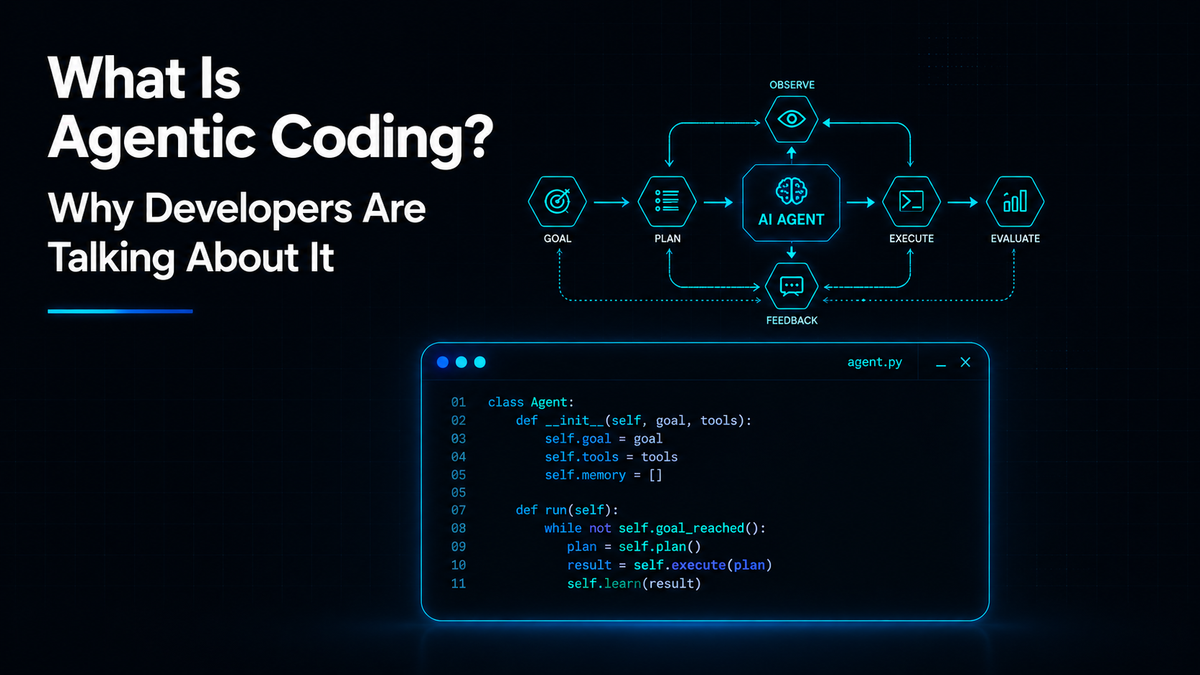
Agentic coding works differently. In an agentic setup, the developer gives the AI a higher-level goal rather than a specific instruction. Instead of asking the AI to write a single function, the developer describes what they want to build and the AI takes responsibility for planning the steps, writing the code, running tests, identifying what broke, revising the approach, and continuing until the goal is achieved or a genuine blocker is reached.
The word agentic comes from the idea of an AI agent, which is a system that can perceive its environment, make decisions, take actions, and adjust based on the results of those actions. An agentic coding tool is not waiting for you to tell it each step. It is operating with enough autonomy to move through a multi-step programming task while checking in with you when it needs to make a significant decision or when something is unclear.
The simplest way to think about the difference is this. Assisted coding is like having an AI answer questions while you drive. Agentic coding is like having an AI that can drive portions of the journey while you set the destination and supervise the route.
How Agentic Coding Works in Practice
When a developer uses an agentic coding tool on a real task, the experience typically unfolds in a few distinct phases.
The developer starts by describing the goal in natural language. This might be something like building a REST API endpoint that handles user authentication, or refactoring a particular module to improve performance and add error handling. The more context the developer provides, the better the agent can plan.
The agent then breaks the goal down into a sequence of smaller steps and begins executing them one by one. It writes code files, edits existing files, runs terminal commands, reads the output of those commands, and adjusts its approach based on what it finds. If a test fails, it examines the error, identifies the likely cause, updates the relevant code, and runs the test again. This loop continues until the tests pass or until the agent concludes it needs human input to proceed.
Throughout this process, the developer is not completely removed from the picture. Good agentic coding tools will pause to ask for confirmation before making significant changes, present their plan before executing it, and surface meaningful decisions to the developer rather than making every choice silently.
The degree of autonomy varies between tools and between tasks. Some tasks are well-suited to a high level of autonomy because the requirements are clear and the scope is contained. Others require much more frequent check-ins because the decisions involved carry more risk or depend on context only the developer has.
The Tools That Are Driving This Shift
Several tools have emerged as the early leaders in agentic coding, and each takes a slightly different approach to the same fundamental problem of giving AI enough context and capability to work through complex programming tasks independently.
Claude Code from Anthropic is a command-line tool that runs in a developer's terminal and has deep access to the entire codebase. It can read files, write files, run tests, execute shell commands, and navigate a project's structure in the same way a developer would. Claude Code is widely regarded as one of the most capable options for tasks that require understanding a large, complex codebase.
Cursor is a code editor built on top of VS Code that integrates agentic AI capabilities directly into the development environment. It has become popular because it feels familiar to developers already using VS Code while adding significantly more powerful AI features than what most editor plugins offer.
GitHub Copilot Workspace is GitHub's attempt to bring agentic workflows into its existing platform. It allows developers to describe a task in natural language and generates a plan before writing any code, which gives developers a chance to review the approach before execution begins.
Devin, built by Cognition, was one of the early tools to attract significant attention for its ability to handle longer, more complex engineering tasks with very limited human input. It operates more like an autonomous software engineer than a coding assistant.
Windsurf from Codeium is another editor-based tool that has gained a following for its agentic capabilities and its ability to maintain context across large projects.
Each of these tools represents a different philosophy about how much autonomy the AI should have, how it should communicate with the developer, and what kinds of tasks it is optimized for.
Pros
The advantages of agentic coding are real and worth understanding clearly.
The most immediate benefit is speed on repetitive or well-defined tasks. Writing boilerplate code, setting up project structures, adding standard error handling, writing tests for existing functions, and implementing straightforward features are all tasks where an agentic tool can save significant amounts of time compared to doing the work manually or even using assisted AI.
Agentic coding also reduces context switching. When a developer is deep in solving a difficult problem, being able to hand off a related but separate task to an AI agent, and then return to find it completed, keeps the developer's focus on the harder work.
For developers learning a new language or framework, agentic tools can accelerate the process considerably. The agent can handle implementation details that a less experienced developer would need to spend hours researching, while the developer learns by reviewing the agent's work and asking questions about the decisions it made.
There is also a legitimate productivity argument for solo developers and small teams who need to cover a lot of technical ground without the resources to hire additional people. An agentic coding workflow effectively increases the output of a single developer in ways that were not realistic before these tools existed.
Cons
The limitations are equally important to understand before adopting an agentic workflow.
The biggest challenge is accuracy on complex tasks. Agentic tools are genuinely impressive on well-scoped tasks with clear requirements. They become much less reliable on tasks that require deep understanding of architectural decisions, business logic that is not obvious from the code alone, or problems that require creative problem-solving rather than straightforward implementation.
Over-reliance is a risk that several senior developers have written about honestly. When you stop writing code yourself and start primarily reviewing code that an AI wrote, your own skills can atrophy in ways that are not immediately obvious. The developers who get the most value from agentic tools tend to be those who are already skilled enough to critically evaluate everything the agent produces.
Cost is a practical consideration. The most capable agentic coding tools operate on a subscription model or charge based on usage, and heavy usage of high-context AI models can become expensive. Developers and teams need to evaluate whether the time saved justifies the cost at their level of usage.
Security and intellectual property concerns are real for developers working in professional environments. Sending proprietary code to external AI services creates risks that need to be understood and addressed before adopting these tools in a commercial setting.
Best Use Cases
Agentic coding delivers the best results in specific situations.
It works well for building new features in an existing codebase when the requirements are clear and the feature is relatively self-contained. It is particularly good at writing tests, both generating tests for existing code and writing code to make failing tests pass. It handles migrations and refactoring tasks well when the goal is clearly defined. It is also effective for debugging, particularly for tracking down errors with clear error messages that point to specific parts of the code.
It is less well-suited for early-stage architecture decisions, for tasks that require deep knowledge of a company's internal systems and business logic, and for anything where the requirements are genuinely ambiguous and need to be worked out through the process of building.
Practical Tips
If you want to start experimenting with agentic coding tools without disrupting your existing workflow, a few approaches work well.
Start with a small, self-contained project or a branch of an existing project that you would not mind rebuilding from scratch. This gives you a low-risk environment to understand how the tool works before relying on it for anything critical.
Write clear, specific prompts. The quality of an agent's output is heavily influenced by how clearly you describe the task. Vague instructions produce vague results. Concrete descriptions of the goal, the constraints, and the expected output produce much better work.
Review every file the agent changes before committing anything. Agentic tools can make confident-sounding changes that are subtly wrong, and the developer's job in an agentic workflow shifts significantly toward critical review rather than original creation.
Learn the tool's context limitations. Every agentic coding tool has limits on how much of a codebase it can hold in its working context at once. Understanding those limits helps you structure your requests in ways that give the tool the best chance of succeeding.
Common Mistakes
The most common mistake developers make when first using agentic coding tools is treating them as fully autonomous systems that do not require supervision. Even the best tools currently available make mistakes, miss edge cases, and occasionally make changes that seem reasonable in isolation but create problems elsewhere in the codebase.
Another frequent mistake is giving the agent too much scope in a single request. Asking an agent to build an entire complex feature in one instruction tends to produce worse results than breaking that feature into smaller, clearer sub-tasks and handling them one at a time.
Developers also sometimes forget to give the agent enough context. If your codebase has specific conventions, if there are architectural decisions that are not obvious from reading the code, or if there are known limitations you are working around, including that context in your prompt will significantly improve the output.
Finally, many developers skip the step of reviewing the agent's plan before letting it execute. Most good agentic tools will present a plan before beginning work. Taking a few minutes to review that plan often catches misunderstandings early and saves considerably more time than it costs.
Future Outlook
The trajectory of agentic coding points toward AI systems that can handle increasingly larger and more complex portions of the software development process over time.
The immediate near-term development is better context handling. Current tools are limited by how much of a codebase they can work with effectively at once. As context windows expand and retrieval systems improve, agents will be able to understand and work across much larger codebases more reliably.
Specialization is another direction the field is moving. Rather than general-purpose agents that can work on any codebase, there will likely be agents trained or fine-tuned for specific languages, frameworks, or domains that perform significantly better than general tools for their particular specialty.
The question of how the developer's role evolves is one that the industry is actively discussing. The most credible perspective seems to be that agentic coding shifts the developer's primary work toward higher-level thinking, system design, requirements clarification, and quality oversight rather than replacing developers entirely. The skills that become more valuable are those that AI cannot replicate easily, including deep understanding of business requirements, architectural judgment, and the ability to evaluate code quality critically.
Final Thoughts
Agentic coding is a genuine shift in how software gets built, not a marketing term for the same AI features with a new name.
The developers getting the most value from these tools right now are those who understand both their capabilities and their limitations clearly. They use agents to move faster on well-defined tasks while keeping their own judgment at the center of every significant decision. They review agent output critically, stay engaged with the codebase, and use agentic tools to multiply their own capabilities rather than to replace their own thinking.
If you are a developer who has been using AI primarily for code suggestions and autocomplete, experimenting with agentic coding tools is worth your time. Start small, stay engaged, and pay attention to which types of tasks the tools handle well versus where they need significant supervision.
The developers who develop strong judgment about how and when to use agentic tools effectively will have a real advantage as this technology continues to mature.
Frequently Asked Questions
What is the difference between agentic coding and using GitHub Copilot?
GitHub Copilot is primarily an assisted coding tool that suggests code as you type or responds to specific requests. Agentic coding tools take a higher-level goal and execute multiple steps toward it independently, including writing files, running commands, and fixing errors, without needing instruction at each step.
Do I need to be an experienced developer to use agentic coding tools?
Some experience helps significantly. Agentic tools can accelerate learning for newer developers, but you need enough understanding to review the code they produce and catch mistakes. Using these tools without any development knowledge is risky because you would have no way to evaluate the quality or correctness of the output.
Which agentic coding tool should I start with?
For developers comfortable with the command line, Claude Code is a strong starting point. For those who prefer staying in a familiar editor environment, Cursor is widely used and has a good balance of capability and usability.
Is agentic coding safe to use for professional projects?
It depends on the tool and your organization's policies. Many professional teams are using these tools successfully, but you need to understand the data handling policies of any tool you use and ensure that sharing code with an external service is permitted in your context.
Will agentic coding replace software developers?
The honest answer is that it will change what developers do more than it will eliminate the need for developers. Tasks that are routine and well-defined will increasingly be handled by agents. The work that requires genuine judgment, creativity, and deep domain understanding will remain human-led for the foreseeable future.
How much do agentic coding tools cost?
Pricing varies significantly between tools. Some are free with limited usage, others operate on monthly subscriptions ranging from around ten to forty dollars per month for individual developers, and some charge based on the amount of AI processing used.
Can agentic coding tools work with any programming language?
Most of the leading tools support a wide range of popular languages including Python, JavaScript, TypeScript, Go, Rust, Java, and others. Performance tends to be better for languages that are heavily represented in the training data of the underlying AI models.
What happens when an agentic tool makes a mistake in my codebase?
This is why version control matters. Always work in a branch when using agentic tools, commit frequently, and review changes before merging. If an agent makes a mistake, you should be able to roll back to a clean state without losing any work.
Comments (0)
Sign in to post a comment.
- Be the first to comment.