Sam Altman Pushes Back on Mandatory AI Model Approval, Urging Testing Over Preclearance
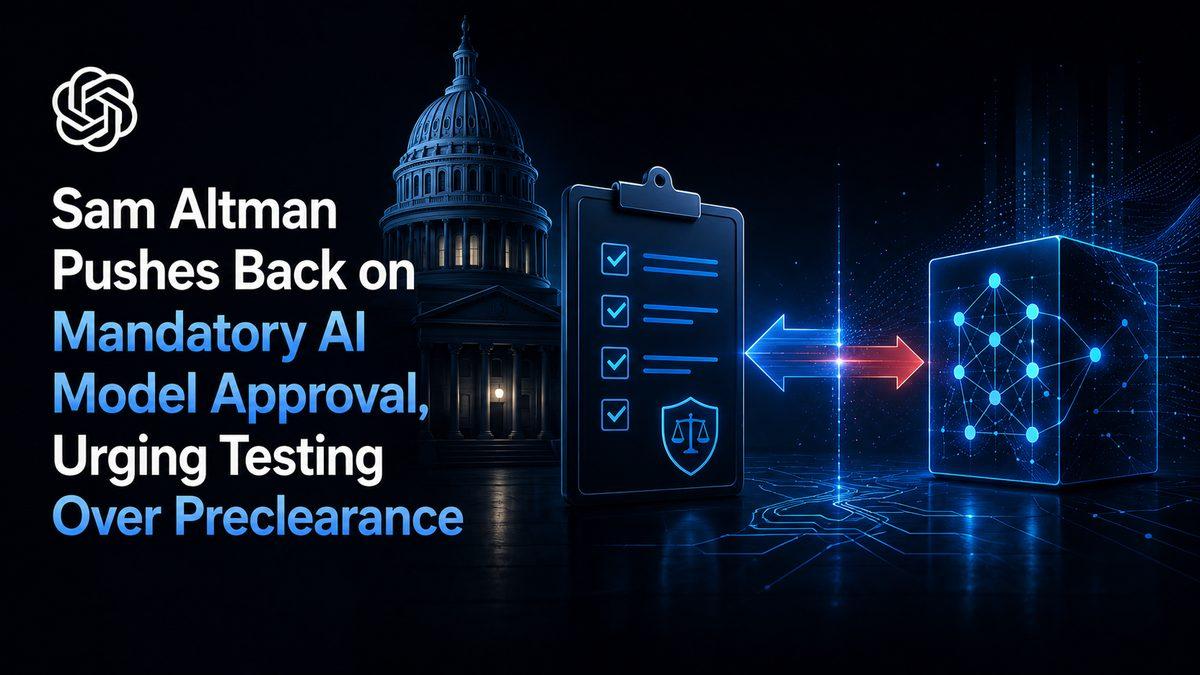
OpenAI CEO Sam Altman is lobbying Washington to reject proposals that would require government approval before AI companies can release new models. He wants more funding for testing instead, setting up a defining fight over how frontier AI gets regulated in the United States.
Updated: This article was originally published on June 7, 2026, and was updated on July 12, 2026, to include subsequent developments, including the government gated rollout of GPT 5.6.
OpenAI CEO Sam Altman spent the week of June 5, 2026, in Washington urging lawmakers to reject proposals that would require AI companies to get government approval before releasing new models. Instead, he asked Congress to fund more testing capacity at the Department of Commerce, arguing that evaluation and accountability work better than a formal approval gate.
This matters immediately because it marks one of the clearest lines drawn yet in the fight over how the United States will regulate frontier AI. Altman is not arguing against oversight itself. He is arguing against a specific model of oversight, one that would put a government office between a finished AI system and the public before it ever reaches users.
Developers, businesses, and anyone who relies on AI tools have a stake in how this plays out, since the outcome could shape how quickly new models reach the market and who gets to decide when they are ready. Here is what Altman actually proposed and why the debate is far from settled.
What Happened
Sam Altman met with members of Congress in Washington during the week of June 5, 2026, making the case against mandatory government preclearance for AI model releases. Among those he met was House Speaker Mike Johnson, who described the conversation as productive and centered on what a lighter touch regulatory framework might look like.
Altman's position drew a clear distinction between two different types of oversight. He asked lawmakers to increase funding for AI testing at the Department of Commerce, including bringing in experts in cybersecurity, biological weapons, and national security to strengthen that evaluation work. At the same time, he urged Congress not to require companies to obtain formal government sign off before launching a new model publicly.
According to people familiar with his message, Altman framed this as a request for government capacity to evaluate models, not authority to block them. He compared the approval based approach unfavorably to how pharmaceuticals, aircraft, and nuclear systems are regulated, arguing that AI should not follow the same preclearance model.
Why It Matters
This debate is about more than paperwork. If a government approval requirement became law, it would fundamentally change how quickly AI companies could bring new models to market, and who ultimately decides when a model is safe enough for public release.
Altman's position also carries real financial and competitive weight. He argued that requiring government approval before every release could slow down American AI companies and hand an advantage to international rivals, a framing that has significant political traction in Washington given ongoing concerns about competition with China.
The stakes became more concrete just weeks later. The Trump administration signed an executive order on June 2, 2026, that explicitly avoided creating a mandatory preclearance system, but in practice asked OpenAI to limit the release of its next model, GPT 5.6, to a small group of government approved partners before wider availability. That outcome closely mirrors the kind of gatekeeping Altman had been lobbying against just days earlier.
The Details
The executive order Altman was responding to, titled Promoting Advanced Artificial Intelligence Innovation and Security, established a process for frontier AI developers to voluntarily share their most powerful models with the government for review before public release. The order specifically states that nothing in the framework should be read as authorizing mandatory licensing or permitting.
Despite that voluntary language, the practical outcome has looked different. The White House's Office of the National Cyber Director and Office of Science and Technology Policy asked OpenAI to restrict GPT 5.6 to individually approved partners, with Commerce Secretary Howard Lutnick personally discussing the model with Altman before the arrangement was finalized.
This was not the first time a frontier model faced this kind of restriction. Anthropic had already voluntarily limited access to its most capable model earlier in the year, and later faced a formal Commerce Department order that pulled the model from users entirely, a sequence of events detailed in coverage of why Anthropic suspended Claude Fable 5. That episode set an early precedent that appears to have shaped how the government approached OpenAI's next release just weeks later.
Altman has acknowledged the tension in his own position publicly, saying a preview period allowing extended safety testing before release is not necessarily a bad idea, while adding he does not support the idea of government officials choosing which customers get early access.
A Broader Pattern in AI Regulation
This debate is unfolding against a backdrop of increasing government involvement in how AI products reach the public, not just in the United States. Regulators in other regions have already taken direct action shaping how AI companies operate, as seen in how UK regulators forced Google to offer publisher opt outs from AI search, showing that AI governance questions are producing real enforcement actions well beyond just proposed legislation.
Who Is Affected
Developers building on frontier AI models have the most direct stake in this debate, since any formal approval requirement could affect how predictably new models and features become available for production use.
Businesses relying on AI tools for daily operations should watch this closely, since a shift toward mandatory government review could introduce delays or uncertainty around when new capabilities reach the market.
Students and everyday users are unlikely to feel immediate effects, though the outcome of this regulatory debate will shape how quickly future AI improvements reach the tools they already use.
AI companies themselves face perhaps the highest stakes, since the difference between a testing focused framework and a formal approval system could reshape competitive dynamics across the entire industry.
What People Are Saying
House Speaker Mike Johnson described his meeting with Altman as productive, referencing ongoing discussions about what a light touch regulatory framework should look like to address potential harms without slowing innovation.
Not everyone views Altman's position as consistent. Some critics have pointed out that Altman previously told Congress in 2023 that AI companies should require a government license to release powerful models, a position that appears to have shifted now that OpenAI itself would be subject to that kind of approval process.
Industry observers have also noted the irony in how events unfolded. Despite Altman's public opposition to mandatory preclearance, OpenAI ultimately agreed to restrict GPT 5.6's release to a government approved list of partners just weeks after his Washington visit, a outcome he described as not the company's preferred long term approach.
What Comes Next
The executive order Altman was responding to set an August 1, 2026 deadline, sixty days after signing, for a multi agency group to publish a formal framework governing how frontier model reviews will work going forward. That framework will determine whether the informal arrangements seen with both Anthropic and OpenAI become a standardized, predictable process or continue on a case by case basis.
GPT 5.6 itself became broadly available after roughly twelve days behind the government review process, suggesting these preview periods may not stretch on indefinitely once a model completes evaluation. How future frontier model releases are handled will likely depend heavily on what the August framework actually specifies.
Congress remains an open front in this debate as well. Whether lawmakers ultimately pursue formal legislation requiring approval, or instead follow Altman's preferred path of funding more testing capacity without a hard approval gate, remains unresolved.
How to Take Action
Businesses building products on top of frontier AI models should treat regulatory uncertainty as a real planning consideration, since recent events show that even voluntary government review processes can functionally delay a model's public availability.
Developers should stay alert to announcements from the Department of Commerce and the agencies involved in implementing the June 2026 executive order, since the upcoming framework deadline could materially change how future model releases are handled.
Anyone following AI policy should watch how Congress responds to Altman's testing versus approval framing in the coming months, since that distinction is likely to define the shape of US AI regulation going forward.
FINAL THOUGHTS
Sam Altman's pitch to Washington draws a careful line between funding more AI testing and requiring formal government approval before a model launches. It is a distinction that matters enormously in practice, since one path keeps decision making with AI companies while the other hands real gatekeeping power to government agencies.
What makes this moment particularly interesting is how quickly reality complicated Altman's argument. Within weeks of his Washington visit, OpenAI found itself agreeing to a government approved rollout for its own next model, an outcome that looked a great deal like the kind of preclearance Altman had just finished arguing against.
The clearest takeaway for readers is that this debate is far from settled, and the gap between official policy language and how things actually play out in practice may end up mattering more than the formal rules on paper. Anyone building on frontier AI should watch how the government's August framework deadline unfolds, since it will likely set the tone for how these decisions get made going forward.
FREQUENTLY ASKED QUESTIONS
What is Sam Altman actually asking Congress for? Altman is asking lawmakers to increase funding for AI testing at the Department of Commerce, including hiring more experts in cybersecurity and national security, while asking Congress not to require formal government approval before AI companies can release new models.
What is the difference between testing and preclearance? Testing means the government evaluates a model's risks and capabilities, similar to an inspection. Preclearance would require a company to receive formal government approval before it is legally allowed to release a model publicly, similar to how drugs or aircraft are regulated.
Did Altman get what he wanted? Not entirely. Despite his public opposition to mandatory approval, OpenAI later agreed to restrict its GPT 5.6 model to a small group of government approved partners before a wider release, an outcome that functioned similarly to the preclearance system he had argued against.
Has this happened to other AI companies before? Yes. Anthropic previously restricted access to its own most capable model and later faced a formal government order affecting its availability, setting an earlier precedent for this kind of government involvement in AI model releases.
Is there a law requiring AI model approval right now? No. The executive order behind this debate explicitly describes its review process as voluntary and states it does not create mandatory licensing or preclearance, though in practice some model releases have still been shaped by government requests.
When will more clarity come on how this will work going forward? A formal framework is expected by August 1, 2026, sixty days after the relevant executive order was signed, which should clarify how frontier model reviews will be handled going forward.
Why does this debate matter for competitiveness with other countries? Industry leaders including Altman argue that requiring lengthy government approval before releases could slow down American AI companies relative to international competitors, a concern that carries significant weight in ongoing policy discussions.
Comments (0)
Sign in to post a comment.
- Be the first to comment.