
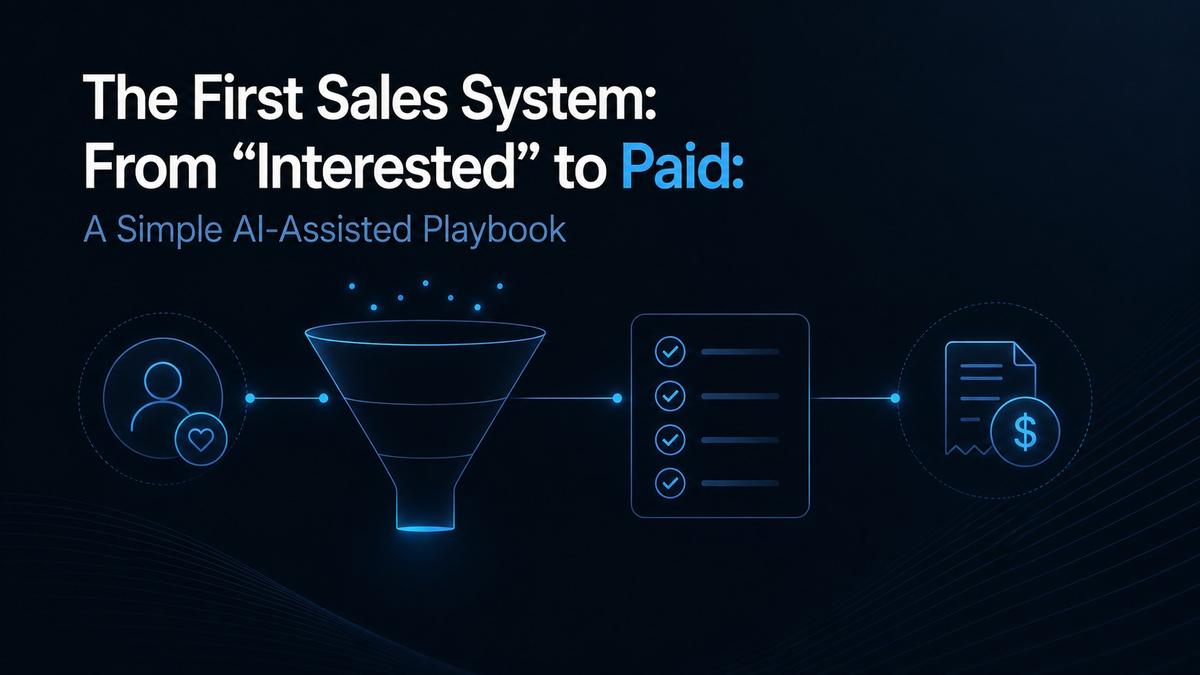
The First Sales System: From “Interested” to Paid—A Simple AI-Assisted Playbook
Interest is common. Payment is rarer, and the gap between the two is usually not a persuasion problem. This post gives you a simple four stage sales system for solo founders and freelancers, with AI supporting speed and clarity at every step.
If you have ever heard a prospect say they are interested in your product, then watched the conversation fade into silence, you already know the uncomfortable truth about early selling. Interest is common. Payment is rarer. The difference is usually not persuasion, it is a system that removes ambiguity, reduces friction, and keeps momentum alive without you chasing people like a debt collector.
This post gives you a first sales system built for a solo founder, freelancer, or small team. It is simple enough that you will actually use it, and structured enough that you stop improvising every single lead from scratch. AI shows up here as an assistant for speed and clarity, not as a replacement for your own judgment about the deal.
You will get a clear four stage pipeline, the exact prompts to use with AI at each stage, and the small tool stack that keeps everything consistent without adding complexity. By the end, you will have a repeatable path that moves people from curiosity to commitment, instead of hoping interest turns into payment on its own.
What a Sales System Actually Is
A sales system is a repeatable path that moves a person from curiosity to commitment. It is not a fancy CRM, and it is not a set of motivational scripts. It is simply a sequence of decisions you guide the prospect through, one clear step at a time.
Without a system, three things tend to happen. You rely on memory for follow ups, and memory is unreliable under a busy week. You talk too much about features, because you never built a clean discovery method. And you send proposals that feel like guesses, because the actual offer was never properly clarified before you wrote it.
The goal of a sales system is not to sound like a sales expert. The goal is to make the next step obvious at every single stage, for both you and the person on the other side of the conversation.
Why This Matters More Than Most People Think
Most freelancers and small business owners lose deals not because their offer is weak, but because the path from interest to payment is genuinely unclear. A prospect who does not know what happens next will usually do nothing because momentum quietly died somewhere in the silence.
This matters because chasing leads without a system is exhausting and inconsistent. Some weeks you follow up well, other weeks you forget entirely, and the results end up depending more on your energy that week than on the actual strength of your offer.
A clear system also changes how prospects experience working with you. Even before any money changes hands, a structured process signals competence, which is exactly the impression you want to leave with someone deciding whether to trust you with their problem.
How the Four Stage Pipeline Works
You only need four stages to get started. Interested means someone raised a hand. Qualified means you understand their problem and they genuinely fit what you offer. Proposed means you sent a clear offer with an obvious next step. Paid means money has arrived and delivery begins. Everything you do should push a lead forward one stage, or politely close the loop when it is clearly not a fit.
Stage 1: Turn Interested Into a Real Conversation
The job of your first message is not to sell. It is to earn a short call or a short structured chat where you can properly diagnose the situation. What helps most here is a short response time, since momentum is fragile, a single call to action, since multiple options tend to create delay, and a small number of questions, since long forms usually get ignored entirely.
A simple message framework works across both DMs and email. Acknowledge their interest, confirm what they want in one sentence, ask one simple question, and offer exactly one next step.
Act as a sales assistant for my business.

Business: [what you sell]
Audience: [who you serve]
Offer: [what you deliver]
Tone: practical, direct, not salesy

Lead message:
[paste what they said]

Write 3 reply options.
Each reply must:
1) Confirm what they want in one sentence.
2) Ask exactly one clarifying question.
3) Offer exactly one next step, either a short call or a short form.
Keep it human, short, and confident.
If your outreach happens over email, the subject line tester can help you check whether your first message is actually likely to get opened before it ever reaches this stage.
Stage 2: Qualify With a Short Discovery That Produces a Decision
Discovery is where most people either oversell or undersell, mainly because they never gather clean information in the first place. Your real job here is to answer three questions, what the problem actually is in plain language, what happens if they do nothing about it, and what outcome would genuinely make this worth paying for.
A simple discovery call can run just fifteen minutes if you keep it structured. Five questions tend to qualify most offers well. What are you trying to achieve right now. What is stopping you today. What have you already tried. What would a good result look like in thirty days. And if we solve this, what happens next. Notice there is no pricing question in that list, since pricing becomes far easier once you have agreed on value and scope together.
Act as a note taker and deal analyst.

Here are my raw discovery notes:
[paste notes]

Return:
1) The problem statement in one sentence.
2) The desired outcome in one sentence.
3) The constraints and risks.
4) The recommended offer scope in 5 bullet points.
5) The next step I should propose.
Keep it specific and avoid generic business language.
Stage 3: Propose an Offer That Is Impossible to Misunderstand
A proposal is not a document. It is a decision tool. The proposals that actually close tend to have four clear parts, the outcome you will deliver, the scope stated as what is included and what is not, the timeline and how you will work together, and the price along with the payment method.
A proposal fails the moment a prospect cannot quickly answer four questions. What am I buying. When will I get it. What do I need to do. And what happens if I do not move now. That last question is not about manipulation, it is about reality, since projects carry real opportunity cost, and without a reason to act, most people will simply delay.
Act as a proposal writer.

Context:
Business: [what I do]
Audience: [who this is for]
Offer type: [service, template, coaching, product]

Discovery summary:
[paste the problem and outcome]

Write a one page proposal with these sections:
1) Summary of what you want.
2) What we will deliver.
3) What is not included.
4) Timeline and process.
5) Price and payment.
6) Next step.

Use short paragraphs and bullets where clarity improves.
Keep it confident and not salesy.
Do not invent results or guarantees.
Stage 4: Get Paid With a Single Clear Next Step
Payment should feel like the easiest part of the entire journey, not a new negotiation. Three rules help here. Send one payment link or one invoice, not three separate options. Confirm exactly what happens immediately after payment, so any lingering anxiety drops. And start delivery fast, so buyers feel confident their decision was the right one.
If you do those three things consistently, you reduce buyer hesitation and you noticeably increase referrals. There is an invoice number generator worth keeping handy for sequential, year stamped invoice IDs as you move more leads through this final stage.
Benefits of Running This System
The biggest benefit is that you stop losing deals to silence. Since every stage has a clear next step, prospects rarely get stuck wondering what happens next, and neither do you, which keeps momentum alive without constant manual chasing.
This system also removes a lot of emotional weight from selling. Instead of wondering whether you sounded persuasive enough, you can simply check which stage a lead is sitting in and take the one obvious action that moves them forward.
Using AI for the mechanical parts, drafting replies, summarizing discovery notes, and writing proposals, saves real time without sacrificing quality, since you still review and adjust everything before it goes out under your name.
Honest Limitations to Keep in Mind
This system will not fix a genuinely weak offer. If your actual product or service does not solve a real problem people are willing to pay for, no amount of process improvement in this pipeline will change that underlying issue.
AI generated replies and proposals are only as good as the context you provide. Vague or incomplete discovery notes produce vague, generic proposals, so the quality of your inputs directly determines how strong the final output actually is.
This approach also assumes a reasonable level of consistency from you. If you skip stages or let leads sit untouched for weeks, the pipeline structure alone cannot compensate for that lack of follow through on your end.
Best Use Cases for This System
This approach works especially well for solo founders and freelancers who are getting real interest but struggling to convert it into paid work. If your inbox has several conversations that quietly went cold, this system directly targets that specific problem.
It also works well for small teams without a dedicated sales role, since the four stage structure is simple enough for anyone on the team to follow consistently, without requiring formal sales training. If you want to explore automating parts of this pipeline further, AI agents for small businesses covers additional ways AI can support day to day operations beyond just sales conversations.
Service providers with a clear, well defined offer benefit the most in relative terms, since the qualify and propose stages depend on being able to scope work clearly. Highly custom or undefined offers will need more adaptation to fit neatly into this structure.
Practical Tips for Getting Started
Start by mapping your current leads into the four stages this week, even before changing anything else about how you sell. Simply seeing where each conversation actually sits often reveals which stage is genuinely losing you the most deals.
Keep your first response time short wherever possible, since momentum fades quickly once a lead goes cold. If your outreach and follow up happen mostly by email, writing emails that do not sound like a bot pairs well with the prompts in this post for keeping your messages human and specific.
You do not need a complex tool stack to run this system. One place to track leads and stages, one place to store discovery notes and proposals, and one way to send invoices or payment links is genuinely enough. If you already use Notion, a simple database with the four stages built in is more than sufficient to run this entire playbook.
Common Mistakes to Avoid
The most common mistake is skipping discovery and jumping straight from interest to a full proposal. Without clean discovery notes, your proposal ends up feeling like a guess, which is exactly the kind of ambiguity this system is designed to remove in the first place.
Another mistake is offering too many options at the payment stage, since multiple payment paths quietly create decision fatigue right when momentum matters most. One clear payment link almost always converts better than three separate choices.
People also tend to let follow ups feel vague and apologetic, sending messages that just say checking in with no real content behind them. A good follow up always includes the next decision, a short summary of what the prospect said they wanted, and a question that is genuinely easy to answer either way.
Where This Approach Is Heading
Expect AI assistants to take on more of the mechanical work across this pipeline over time, from drafting first responses to summarizing discovery calls and generating proposal drafts automatically from raw notes. That shift is already visible in how much faster these stages move compared to a fully manual process from just a year ago.
As this automation grows, the role of the founder or freelancer shifts more toward judgment, deciding which leads genuinely fit, reviewing AI generated drafts before they go out, and making the final call on scope and pricing. There is a deeper look at this broader shift in the rise of AI employees, including how far this kind of support is likely to go over the next few years.
Customer facing communication after the sale is also becoming a bigger focus area. The free-resources on customer support upgrade pack covers macros, escalation handling, and tone guidance for once a deal closes and delivery actually begins.
FINAL THOUGHTS
Selling gets easier the moment every stage has a clear job, and every job ends with an obvious next step. You do not need a complicated funnel to get started, and you certainly do not need to sound like a trained sales expert to make this work.
What you actually need is a small pipeline, a clean discovery method, a proposal that removes ambiguity, and follow ups that keep momentum alive without feeling desperate. AI can genuinely speed up every one of those stages, but the judgment behind each decision still needs to stay yours.
This week, take your current leads and sort them into the four stages, interested, qualified, proposed, and paid. That one exercise alone will likely show you exactly where your process is quietly losing deals, and that is the clearest starting point for fixing it.
FREQUENTLY ASKED QUESTIONS
Do I need a CRM to run this sales system?
No, a simple spreadsheet or a basic Notion database with four columns for the stages is genuinely enough to get started. The system depends on the structure and consistency you bring to it, not on expensive software.
How do I know if my offer is the actual problem, not my sales process?
If you are getting real interest but rarely converting it into payment, run through a quick self audit. Check whether you are attracting the wrong people, qualifying clearly, keeping your offer specific, making the next step obvious, and following up consistently before assuming the offer itself is weak.
Should I include pricing in my first discovery questions?
No, pricing becomes much easier to discuss once you have clearly agreed on the value and scope of the work together. Leading with price too early often creates resistance before the prospect fully understands what they are actually buying.
How many payment options should I offer at the final stage?
Stick to one clear payment link or invoice rather than offering several choices. Multiple payment paths tend to create hesitation exactly when momentum matters most for closing the deal.
What makes a follow up message effective instead of desperate?
An effective follow up includes the next decision, a short summary of what the prospect said they wanted, and a question that is easy to answer either way. Avoid vague messages that simply say you are checking in with no real content attached.
Can this system work if I am not naturally good at selling?
Yes, that is actually the entire point of building a system in the first place. A clear structure with an obvious next step at every stage removes much of the pressure to sound persuasive, since the process itself does most of the heavy lifting.
Comments (0)
Sign in to post a comment.
- Be the first to comment.