
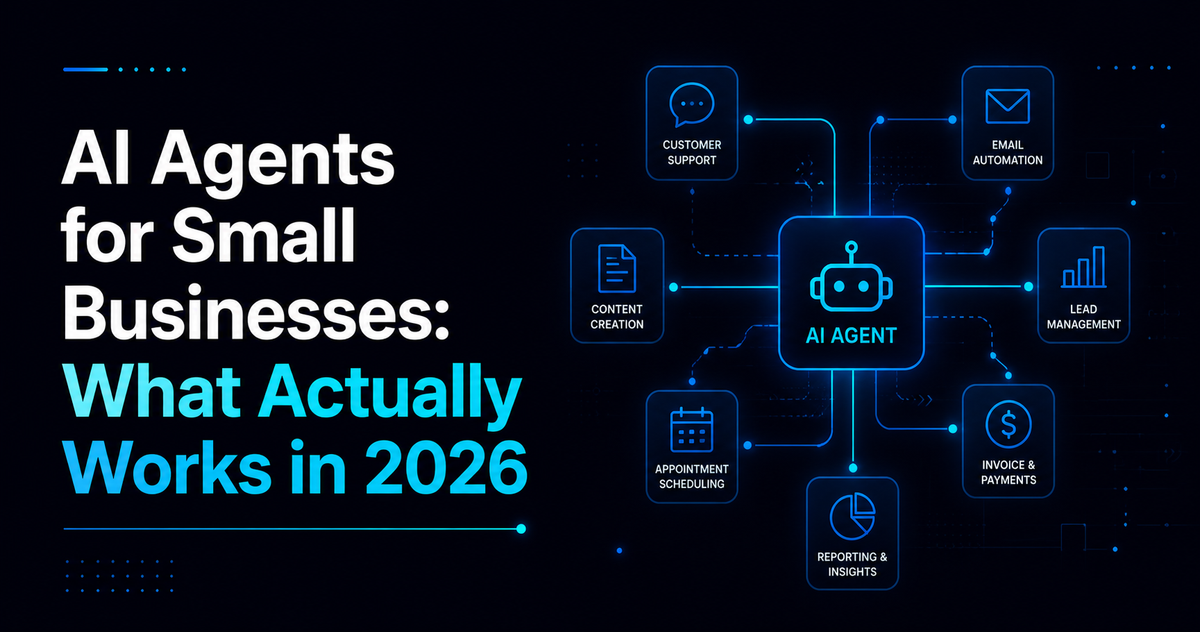
AI Agents for Small Businesses: What Actually Works in 2026
AI agents promise to save small business owners time, but not every use case delivers. This guide breaks down what actually works in 2026, from customer support to content and sales, along with practical steps to get started without wasting money.
Running a small business means wearing too many hats at once. One minute you are answering a customer message, the next you are drafting a newsletter, and somewhere in between you still need to keep the actual product or service moving. AI agents have become one of the most talked about ways to lighten that load, but a lot of what gets said about them online is either overhyped or too vague to actually act on. In this guide, you will learn what AI agents actually do, which use cases genuinely work for small teams in 2026, and how to start using one without wasting time or money on the wrong setup. If you have ever wondered whether these tools are worth the hype or just another trend, or whether they can realistically fit into a business with a small team and a tight budget, this breakdown will give you a clear, honest answer either way.
What AI Agents Actually Are
An AI agent is software that can carry out a task with little ongoing human input. Unlike a basic tool that only responds to one command at a time, an agent can understand a goal, work across different apps, and complete several steps on its own before checking back in.
For a small business, this might look like a chatbot that answers a customer question and books a follow up call in the same conversation, or a tool that reads a spreadsheet of leads and drafts a personalized email for each one. The agent is not just generating text, it is completing a piece of actual work.
This concept has grown fast enough that some people now describe these systems as digital team members rather than software features. If you want a deeper look at that framing, this piece on the rise of AI employees breaks down how that shift is playing out across different industries.
Why This Matters for Small Businesses Right Now
Small businesses run on tight budgets and small teams, which means every hour spent on repetitive work is an hour not spent on growth. AI agents matter because they let a small team do work that used to require hiring, without the overhead of an extra salary.
This is not a future trend anymore. Adoption has moved past the experimental phase, and businesses that are still doing everything manually are increasingly working harder than they need to for the same results.
The businesses seeing real gains are not necessarily the ones using the most tools. They are the ones that picked one or two high impact tasks and automated them properly, rather than adding AI everywhere at once without a clear plan.
How AI Agents Actually Work in Practice
Most AI agents follow a similar pattern. They receive a goal, break it into smaller steps, use whatever tools or data they are connected to, and complete each step before moving to the next one.
A customer support agent, for example, might read an incoming message, check an order database, and either answer directly or hand the conversation to a person if it is too complex. A content agent might pull recent performance data, draft a caption based on what has worked before, and queue it for review.
Some agents also pull live information from the web to make better decisions in real time, rather than relying only on data that was true when they were built. This kind of research capability is becoming more common across everyday business tools. If you want to see a real example of how that works, this breakdown of Perplexity Labs explained shows how a research focused AI system operates behind the scenes.
Real Benefits Small Businesses Are Seeing
Time savings show up first and fastest. Tasks that used to eat up an afternoon, like drafting a week of social captions or replying to routine emails, can often be done in minutes with the right setup.
Lower costs follow closely behind. Automating a task instead of hiring for it lets a small team grow output without growing payroll at the same rate.
Faster decision making is a quieter but real benefit. AI tools can review data and surface patterns much faster than a person scanning a spreadsheet manually, which speeds up everything from pricing decisions to campaign adjustments.
Better customer support rounds things out. A basic AI agent can answer common questions at any hour, which means customers are not waiting until the next business day for a simple answer.
Where AI Agents Still Fall Short
AI agents are not a complete replacement for judgment. They still struggle with situations that need emotional awareness, ethical calls, or reading the subtext of a difficult customer conversation.
Accuracy is a real concern too. Agents can produce confident, well written answers that are simply wrong, so anything customer facing or financially sensitive still needs a human checking the output.
Setup takes more effort than the marketing usually suggests. Connecting an agent to your actual tools and data takes real configuration, not just signing up and flipping a switch.
Security also deserves attention. Giving an AI tool access to customer data or business systems means thinking through permissions and data handling before rolling anything out widely.
Best Use Cases for Small Businesses
Customer support is one of the clearest wins. Routine questions get handled instantly, while anything complicated still reaches a person, which keeps service quality high without adding headcount.
Content creation is another strong fit, covering blog posts, email newsletters, social captions, and product descriptions. Human review still matters, but the first draft no longer has to start from a blank page.
Sales is a growing use case as more businesses connect agents to their pipeline instead of relying purely on manual follow up. This playbook on building a first sales system that moves leads from interested to paid walks through exactly how that setup looks for a growing business.
Administrative work rounds out the list well, covering scheduling, data entry, document handling, and routine reporting, tasks that eat time without needing much creative judgment.
Practical Tips for Getting Started
Pick one task that already eats a noticeable chunk of your week, and start there instead of trying to automate everything at once. A focused pilot is far easier to evaluate than a sweeping rollout.
Test more than one tool before committing. Different AI agents are built for different strengths, and the one your competitor swears by may not fit how your business actually operates.
Keep a human reviewing anything customer facing, at least until the tool has proven itself reliable over a real stretch of time.
Write down your current process before automating it. An agent can only follow a workflow that is clear enough to hand off in the first place.
Common Mistakes to Avoid
One common mistake is trying to automate too much too soon, which usually creates more confusion than value and makes it hard to tell what is actually working.
Another mistake is trusting AI output without review. Even strong tools make mistakes, and skipping review on anything customer facing can quietly damage trust with the people who matter most.
Many businesses also underestimate setup time, treating an AI agent like a plug and play product instead of a real project that needs planning and testing.
Finally, some owners roll out a new tool without telling their team why it matters, which leads to quiet resistance instead of genuine adoption.
Where AI Agents Are Headed
AI agents are improving quickly at reasoning, planning, and working across multiple tools at once, which means the gap between simple automation and genuinely useful digital teammates keeps narrowing.
Small businesses that learn to use these tools well now are likely to hold a real advantage as adoption becomes standard rather than optional across their industry.
The goal was never to replace people. It is to free up time for the parts of the business that still need a human, like relationships, strategy, and the judgment calls no tool can fully replicate yet.
Final Thoughts
AI agents are no longer a novelty for small businesses. They are becoming a normal part of how lean teams handle customer support, content, sales follow up, and the administrative work that used to eat into every week.
The businesses getting real value are not the ones chasing every new tool that launches. They are the ones picking one clear task, automating it properly, keeping a person involved where judgment still matters, and expanding only once the results actually prove themselves.
If you take one action from this, pick the single task on your plate that feels the most repetitive right now, and spend this week testing one AI agent against it before adding anything else to your workflow.
Frequently Asked Questions
What exactly is an AI agent? It is software built to complete a task with little ongoing human input, often by working across multiple steps and tools rather than just answering one question. Think customer support bots, content drafting tools, or scheduling assistants that mostly run on their own.
Are AI agents affordable for a small business? Yes, in most cases. Many popular tools offer free plans or low cost subscriptions that work well for small teams, and you rarely need to invest in anything expensive to test whether an agent fits your workflow.
Will AI agents replace my employees? Probably not entirely. Most experts believe AI reshapes roles rather than eliminating them, automating repetitive tasks while people continue handling creativity, leadership, and relationship building.
Which AI tools work best for small businesses right now? Popular options include ChatGPT for writing and research, Claude for long form writing and document analysis, Zapier AI for connecting workflows, and Notion AI for documentation and team knowledge management.
How do I know which task to automate first? Look for something repetitive, well documented, and low risk if it goes wrong at first. Email replies, content drafts, and meeting scheduling are common starting points for a reason.
Is it safe to give an AI agent access to customer data? It can be, as long as you choose trusted tools, set clear permissions, and stay mindful of privacy requirements before connecting anything sensitive to customer or business data.
Comments (0)
Sign in to post a comment.
- Be the first to comment.