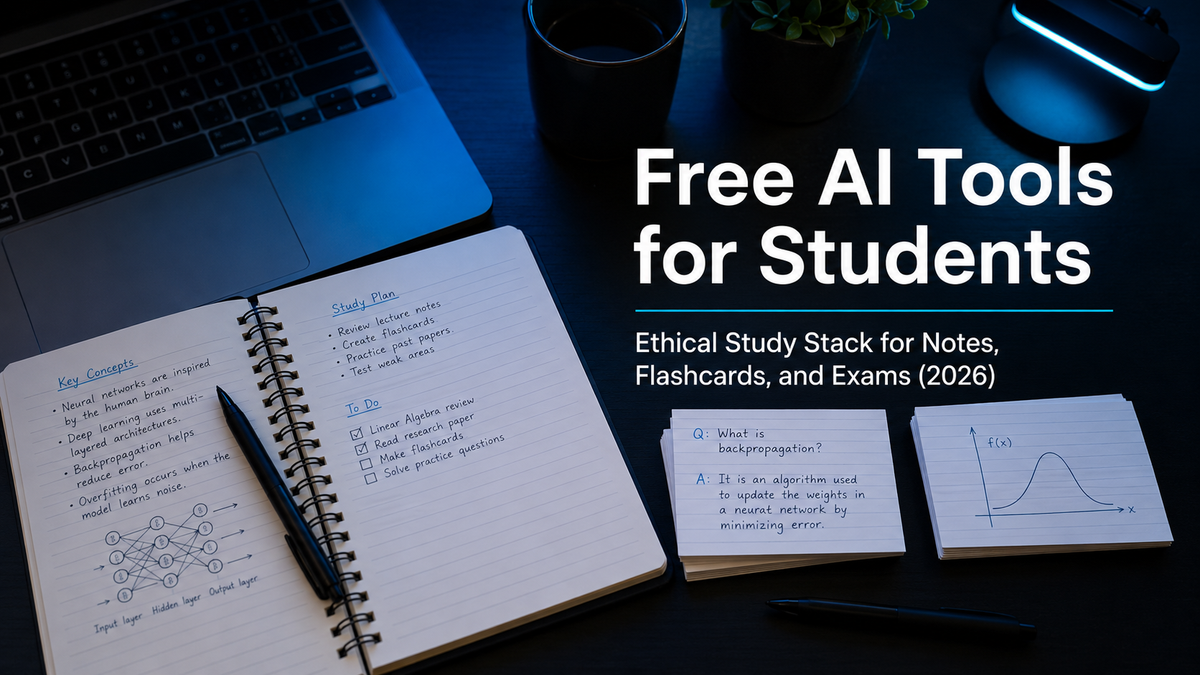
Free AI Tools for Students: The Study Stack for Notes, Flashcards, and Exams (2026)
You can study for three hours and still walk away with fog, because most studying is built around exposure, not recall. This post gives you a free AI study stack with four layers, notes, tutoring, flashcards, and a revision plan, so your effort actually turns into memory.
You can spend three hours reading and still walk away with fog, and the frustrating part is that you did not do nothing. You showed up, you tried, you turned pages. The real issue is that most studying is built around exposure rather than recall, and exposure feels productive even when it does not actually stick.
A good study stack fixes this by doing three jobs reliably. It helps you understand material faster, it forces practice that proves what you actually know, and it schedules review before your memory starts to fade. AI can genuinely help with each of these steps, and the whole system can run on a completely free budget.
This post is for students preparing for exams, certifications, or any serious test of knowledge. You will get a full four layer study stack, the exact prompts to use with an AI assistant at each stage, and a seven day revision plan you can adapt to any exam timeline. By the end, you will have a repeatable system instead of another exhausting night of rereading the same page.
What This Study Stack Actually Is
This stack has four layers, and while you can mix and match tools freely, the jobs each layer does should stay the same. The layers are a capture and notes home, a tutor and question generator, a flashcard and spaced repetition engine, and a planning layer that stops last minute panic from taking over.
Once you set these four layers up a single time, you stop rebuilding your entire study system every time a new topic or exam comes around. The tools change less than people expect, since the structure underneath is what actually does the work.
Free tools work perfectly well here. This is not about spending money on premium software, it is about using free tools correctly and consistently, which matters far more than which specific app you happen to choose.
Why This Approach Actually Matters
Most failed studying is not a failure of effort. It is a failure of method, since rereading and highlighting feel like real work while actually producing very little lasting memory.
This matters because exams test recall under pressure, not familiarity with a page you have looked at five times. A study method built around active testing, rather than passive review, is what actually prepares you for the moment you need to remember something without your notes in front of you.
There is also a calm factor worth mentioning. Students without a system tend to discover what they do not understand the night before an exam, which is the worst possible time to find out. A structured stack surfaces those gaps early, while there is still time to fix them.
How the Four Layer Stack Works
Layer 1: Notes That Are Built for Recall, Not Decoration
Your notes should make self testing easy, since self testing is what actually turns reading into learning. Free tools that work well here include Google Docs for speed and simplicity, Notion for structure and cross topic organization, and Obsidian for offline notes with strong linking between topics.
What matters far more than the app you choose is the structure of the page itself. Use this format for every topic you study. Start with the topic name, then explain it in your own words in one paragraph, then list five to ten key terms you keep confusing, then include one worked example or scenario, then note common mistakes and why they happen, then write ten to fifteen self test questions, and finally note what still feels unclear.
That single page structure forces real understanding, exposes gaps honestly, and gives you a ready made place to add practice questions as you go.
Layer 2: A Tutor Mode Prompt That Makes You Learn, Not Copy
This is the layer most students misuse. The fastest way to get in trouble here is asking an AI tool for finished work. The safer and far more useful approach is asking for teaching, questions, and feedback, since that still forces you to do the actual thinking yourself.
You can use any AI assistant you already have access to, including free tiers, since the prompt matters far more than the specific brand behind it.
Act as a strict tutor.

Topic: [topic]
Level: [high school, university, professional exam]
Goal: I want to understand this well enough to answer exam questions.

Rules:
1) Ask me 12 questions from easy to hard.
2) After each answer, correct me briefly, then give a hint, then give the full explanation.
3) Add one trick question that targets a common student mistake.
4) Keep explanations short and use one example.

Do not write an essay or assignment for me.
This approach creates real active recall instead of quietly turning the tool into a ghostwriter for your assignments.
Layer 3: Flashcards That Actually Build Memory
Flashcards work well when they stay small and specific. They fail the moment you turn them into mini essays that take thirty seconds to read through. Free tools that work well here include Anki on desktop, AnkiDroid on Android, and Quizlet on its free tier if you want something lighter.
A flashcard should test exactly one idea, and the answer should be short enough to say out loud in one breath. A bad card asks you to explain everything about photosynthesis. A good card asks what the two main stages of photosynthesis are. A better card asks specifically where the light dependent reactions happen inside the chloroplast.
Act as an exam prep coach.

Here are my notes:
[paste your notes]

Task:
1) Create 20 flashcards that each test one idea.
2) Make the front a question and the back a short answer.
3) Include 5 cards that target common mistakes.
4) Do not invent facts that are not in my notes.

Return as:
Front: ...
Back: ...
If you want faster improvement, only create new flashcards for what you consistently get wrong, not for material you already know well.
Layer 4: A Revision Plan That Keeps You Calm
A good revision plan does not need to be complicated. It just needs to be visible and repeatable, so you always know what today's session is actually for.
A simple seven day exam sprint looks like this. Day one, map the syllabus and list your weak topics. Day two, work through weak topic A with questions and flashcards. Day three, work through weak topic B the same way. Day four, mixed practice with a review of your mistakes. Day five, past questions under real time pressure, then review your errors. Day six, teach the hardest topics back out loud as if explaining them to someone else. Day seven, light review, confidence building, and proper sleep.
If your exam is not exactly seven days away, stretch the cycle to fit your actual timeline while keeping the same underlying pattern intact.
Benefits of Using This Stack
The biggest benefit is that studying stops feeling like fog. Since every layer forces active recall instead of passive review, you actually know in real time whether material is sticking, rather than finding out for the first time during the exam itself.
The stack also removes decision fatigue. Once the four layers are set up, you are not deciding what to do each study session, you are simply moving through a loop that already works, which saves real mental energy for the actual learning.
Because every part of this stack runs on free tools, there is no financial barrier to trying it properly. If you want to explore other free tools that pair well with this system, our roundup of 15 best free AI tools for students in 2026 covers additional options worth testing.
Honest Limitations to Keep in Mind
This stack requires more upfront effort than simply rereading a textbook, and some students find that friction discouraging in the first week or two. The payoff comes from consistency, not from the very first session.
AI tutor mode also depends heavily on how well you phrase the prompt and how honestly you answer the practice questions. If you skip questions or let the tool do too much of the explaining, you lose most of the actual benefit this layer is designed to provide.
Flashcards can also become a time sink if you create too many for concepts you already understand well. The discipline of only making cards for genuine weak points is what keeps this layer efficient rather than becoming its own form of procrastination.
Best Use Cases for This Stack
This approach works especially well for students preparing for exams with a clear, defined syllabus, since the structure depends on being able to map out topics and weak points in advance. Certification exams, university finals, and structured professional tests are all strong fits.
It also works well for students who have tried rereading and highlighting without real results, since this stack directly replaces that passive approach with active recall at every stage. If your current method feels like effort without progress, this is built specifically for that problem.
Students with limited budgets benefit particularly well here, since every tool in this stack has a genuinely useful free tier. You do not need a paid subscription to run this system properly from day one.
Practical Tips for Getting Started
Set up your first one topic page today, even before your next study session begins. Having the template ready removes friction the moment you actually sit down to study, which matters more than it sounds like it would.
Be strict with yourself in tutor mode. If you catch yourself skipping ahead to the explanation without genuinely attempting an answer first, you are quietly turning a active recall tool into a passive reading tool, which defeats the entire purpose of that layer.
If your studying regularly includes essays, reports, or long form writing, our Better Draft prompt pack can help you tighten that writing without losing your own voice or understanding of the material. And if you want a broader set of ready to use prompts across your entire study routine, our 300+ ChatGPT prompts for students, developers, and content creators covers far more than just the ones in this post.
Common Mistakes to Avoid
The most common mistake is rereading the same page five or six times without ever testing yourself on it. Rereading feels productive because it is familiar, but familiarity is not the same thing as actual recall.
Another mistake is highlighting everything and calling it studying. If most of a page is highlighted, nothing on that page is actually flagged as important, and the highlighting itself has done almost no real work for your memory.
People also tend to create hundreds of flashcards for concepts they already know well, which wastes review time that should be going toward genuine weak points. And a particularly costly mistake is waiting until the night before an exam to discover what you actually do not understand, since that is the worst possible moment to find any real gap in your knowledge.
Where This Approach Is Heading
AI tutoring tools are likely to get noticeably better at adapting to individual weak points over time, moving beyond generic question sets toward genuinely personalized practice based on what a specific student keeps getting wrong. That shift is already visible in how quickly tutor mode prompts can be refined today compared to a year ago.
Spaced repetition tools are also likely to integrate more directly with AI generated content, reducing the manual work of turning notes into flashcards in the first place. The mechanical parts of this stack will keep getting faster, even as the underlying structure, notes, tutoring, flashcards, and planning, stays largely the same.
If you are just getting started with AI tools for studying more broadly, our beginner AI starter pack is a good companion resource for setting up your first workflow over a single weekend.
FINAL THOUGHTS
You do not need expensive tools to study well. You need a system that turns information into questions, and questions into memory, and every layer of that system can run on a completely free budget if you set it up correctly.
The real shift this stack asks for is moving away from passive exposure and toward active recall at every single stage, from your notes through your tutor sessions to your flashcards and your revision plan. That shift is what actually closes the gap between studying and remembering.
Start this week by building one topic page using the structure in this post, then run it through tutor mode before you create a single flashcard. That small sequence, done consistently, will do more for your exam results than another long night of rereading the same chapter.
FREQUENTLY ASKED QUESTIONS
Can I really build an effective study system without paying for anything?
Yes, every tool mentioned in this stack has a genuinely useful free tier, including Google Docs, Anki, and most AI assistants. The system works because of the structure and consistency you bring to it, not because of expensive software.
How is tutor mode different from just asking an AI tool to explain a topic?
Tutor mode specifically asks the AI to question you and give feedback, rather than simply explaining material to you passively. This forces active recall, which is far more effective for actual exam performance than passive reading or listening.
How many flashcards should I realistically make per topic?
Focus on creating flashcards only for what you consistently get wrong, rather than covering every fact from your notes. A smaller deck of genuinely useful cards beats a huge deck full of things you already know well.
What if my exam is not exactly seven days away?
Stretch or compress the seven day sprint to match your actual timeline while keeping the same underlying pattern, mapping weak topics first, then working through them, then mixed practice, then review. The specific number of days matters less than the order of the stages.
Is it okay to use AI tools to help with essays or assignments using this stack?
Yes, as long as you are using AI to strengthen your own understanding and writing rather than submitting AI generated work as your own. Tools like a prompt pack focused on clearer drafting can help you communicate what you already understand more effectively.
What is the single biggest change I can make to how I study right now?
Replace passive rereading with active self testing at every stage, starting with your very next study session. That one shift, more than any tool or app, is what actually turns studying into lasting memory.
Comments (0)
Sign in to post a comment.
- Be the first to comment.