Perplexity vs Google Search: Best for Research in 2026
Perplexity and Google Search both start with a question, but they answer it in very different ways. This guide breaks down where each tool genuinely wins for research in 2026, so you know exactly which one to reach for depending on what you are looking for.
Typing a question into Google used to be the automatic first move for almost any research task. That habit is quietly breaking for a lot of people in 2026, as tools like Perplexity offer a genuinely different way to get an answer, one that reads the sources and hands you a synthesized summary instead of a page of links to click through yourself. But that does not mean Google has fallen behind everywhere, and picking the wrong tool for the wrong question can actually slow you down. In this guide, you will learn exactly how Perplexity and Google Search actually differ, where each one genuinely wins, and how to decide which one to reach for depending on what you are trying to find. This matters whether you are a student writing a paper, a professional researching a market, or just someone tired of clicking through five tabs to answer one question.
What Perplexity and Google Search Actually Are
Google Search is the traditional search engine most people grew up using, built to return a ranked list of links, images, maps, and other results based on a query. In recent years Google has layered AI Overviews and AI Mode on top of that experience, giving users a generated summary at the top of the page alongside the usual links.
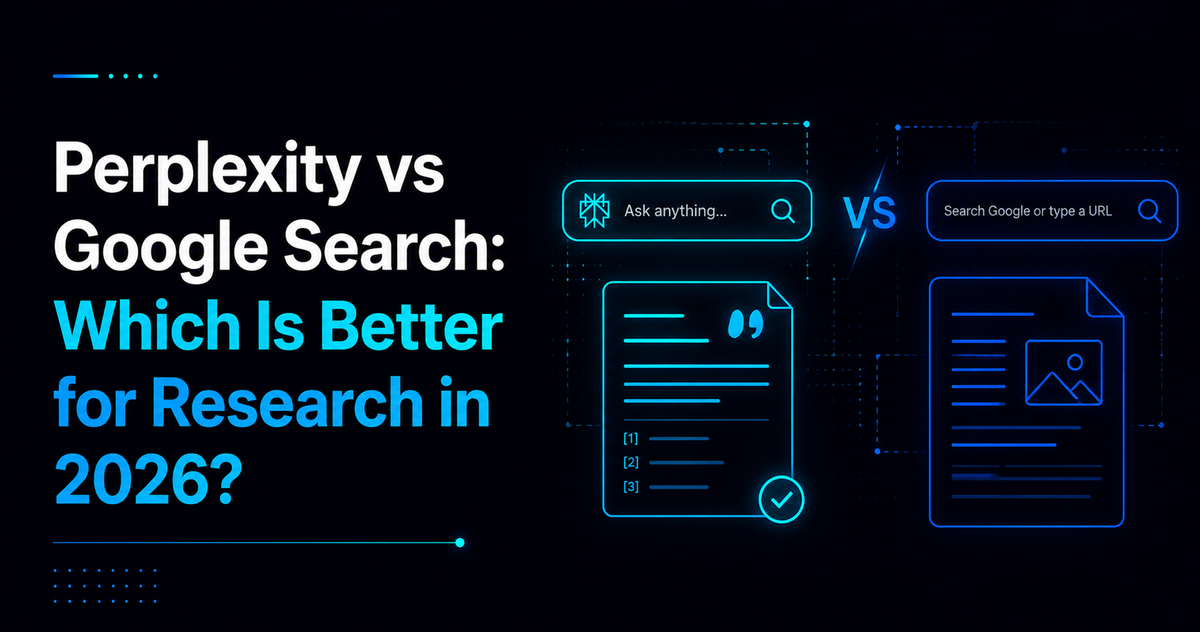
Perplexity works differently from the ground up. Instead of returning a list of links to click through, it searches multiple live sources at once, reads them, and synthesizes a direct answer with numbered citations pointing back to where each piece of information came from. It behaves less like a search engine and more like a research assistant that has already read the sources for you.
Both tools are trying to answer the same basic question, what do you want to know, but they take very different paths to get there. If you want a deeper look at what Perplexity's more advanced research tools can actually do, this breakdown of Perplexity Labs explained, and whether it can replace market research tools covers that in detail.
Why This Comparison Matters in 2026
Search behavior has shifted noticeably over the past couple of years. A growing share of research style questions, the ones that start with how, why, what is, or compare, now go straight to an AI tool instead of a traditional search bar.
This matters because the two approaches genuinely produce different experiences for research work. A synthesized answer with citations can save real time on a complex question, while a list of links still gives you full control over which sources you trust and how deeply you want to dig.
For students, professionals, and anyone doing regular research, picking the right default tool for the right kind of question has become a real productivity decision, not just a matter of preference.
How Each Tool Actually Works
Google Search indexes an enormous portion of the web and ranks results using a complex mix of relevance, authority, and other signals. Its AI Overviews and AI Mode pull from that same index to generate a quick summary, but the underlying goal is still largely to keep users engaged within Google's own ecosystem rather than sending them elsewhere.
Perplexity approaches things differently. A basic query runs a fast search and synthesis pass. Pro Search takes more time to dig deeper and cross reference sources before answering. Deep Research goes further still, running multiple searches across sources and assembling a longer, structured report on a single prompt, closer to what a human researcher might produce after an afternoon of reading.
Citations work differently between the two as well. Perplexity attaches numbered citations directly to specific claims, making it straightforward to click through and verify exactly where a piece of information came from. Google's AI Overviews include source links too, but they tend to be less tightly tied to individual claims within the summary.
Real Strengths of Each Tool
Perplexity's biggest strength is depth on complex, multi part questions. Comparing frameworks, summarizing a technical report, or pulling together current statistics on a fast moving topic all tend to go faster and produce a more organized answer through Perplexity than through a page of separate Google links.
Google's biggest strength is still breadth and everyday usefulness. Local search, maps, shopping, images, and simple navigational queries like finding a specific website remain firmly in Google's territory, and its AI Overviews are genuinely useful for quick factual questions that do not need deep synthesis.
Perplexity also tends to feel less commercially cluttered. Its results are not built around ad placement the way a chunk of a Google results page often is, which matters when the goal is a clean, unbiased answer rather than the first company willing to pay for visibility.
Google's strength in freshness and coverage still matters too. Its index is enormous and constantly updated, which keeps it dependable for breaking news, extremely recent events, and niche topics that a synthesis tool might not weigh correctly.
Where Each Tool Falls Short
Perplexity is not perfect on accuracy. Even with strong source verification, it can occasionally misattribute a claim to the wrong source or present slightly outdated information as current, particularly on complex, multi part questions where several sources need to be reconciled.
Perplexity is also not built for every kind of query. Local searches, shopping, maps, and highly visual queries still feel clunky compared to a tool built specifically for those use cases.
Google's AI Overviews carry their own tradeoffs. Because the summary sits on top of a results page designed to keep users engaged, it can feel less transparent about exactly where each piece of information came from, and the traditional link list below it is increasingly crowded with ads and heavily optimized content rather than original sources.
Neither tool replaces careful human judgment on high stakes information. Both can produce a confident, well formatted answer that still needs a second look before it gets used for something that actually matters.
Best Use Cases for Each Tool
Perplexity is the better default for research heavy questions, comparisons, technical explanations, and anything that would normally require reading and synthesizing several sources by hand. Deep Research mode in particular is well suited to producing a structured report from a single prompt.
Google Search remains the better choice for local searches, shopping, maps, images, and simple navigational queries where you already know roughly what you are looking for and just need the fastest path to it.
For broader research and learning workflows, it also helps to know how these tools fit alongside other AI options built specifically for study and note taking. This comparison of NotebookLM vs ChatGPT for learning and research is a useful next read if you are building out a full research workflow rather than relying on a single tool.
Practical Tips for Choosing Between Them
Match the tool to the question type rather than picking one tool for everything. Reach for Perplexity on synthesis heavy questions, and stick with Google for anything local, transactional, or purely navigational.
Always click through Perplexity's citations on anything important, rather than trusting the synthesized summary at face value. The citation is there specifically so you can verify the claim yourself.
Use Perplexity's Pro Search or Deep Research modes for genuinely complex questions, and save the basic search mode for quick, simple lookups where speed matters more than depth.
Keep both tools in your toolkit rather than treating this as an either or decision. Most people doing regular research end up using each one for what it is actually best at.
Common Mistakes to Avoid
One common mistake is treating an AI synthesized answer as automatically correct simply because it sounds confident and well organized. Confidence in tone is not the same as accuracy in content.
Another mistake is using Perplexity for tasks it was never built for, like local business searches or shopping comparisons, where a tool designed specifically for that purpose will almost always perform better.
Some people also stop clicking through to original sources entirely once they get used to synthesized answers, which makes it harder to catch the occasional misattribution or outdated claim before it causes a real problem.
Finally, choosing a single AI tool for every kind of task, rather than understanding each tool's actual strengths, tends to produce worse results than deliberately matching the right tool to the right question. If you are also comparing broader AI assistants beyond search specifically, this guide on GPT 5 vs Claude vs Gemini in 2026 is a helpful companion for thinking through that wider decision.
Where This Is Headed
The gap between AI powered search and traditional search is likely to keep narrowing, as Google continues investing heavily in its own AI features and Perplexity keeps refining its citation and synthesis models.
Search behavior overall is shifting from typing keywords toward asking full, conversational questions, and both platforms are adapting their interfaces around that shift rather than the old list of ten blue links.
The most effective approach for the near future is not picking a single winner, it is understanding which tool actually earns its place for a given kind of question, and using both deliberately rather than defaulting to habit.
Final Thoughts
Perplexity and Google Search are not really competing for the exact same job anymore, even though they both start with a search bar. Perplexity has carved out real strength in synthesis, research, and citation heavy answers, while Google still holds its ground on local search, shopping, navigation, and sheer breadth of coverage.
The mistake most people make is picking one tool out of habit and sticking with it for everything. The better approach is matching the tool to the question, reaching for Perplexity when you need a synthesized answer with sources you can verify, and sticking with Google when you already know exactly what you are looking for.
If you take one thing from this, try running your next few research heavy questions through Perplexity instead of Google by default, and see how much time it actually saves before deciding which tool earns the permanent spot in your workflow.
Frequent'ly Asked Questions
Is Perplexity actually better than Google for research? For research heavy, multi part questions, many users find Perplexity's synthesized, cited answers faster and more useful than reading through separate Google links. For local, shopping, or navigational searches, Google is still the stronger tool.
Does Perplexity replace Google Search entirely? No, not for most people. Perplexity is strongest for synthesis and research style questions, while Google remains better suited to maps, shopping, images, and simple navigational searches.
How accurate is Perplexity compared to Google's AI Overviews? Both tools can occasionally misattribute information or present outdated details as current, especially on complex questions. Perplexity's citation model tends to make it easier to verify claims directly, since sources are tied to specific statements.
Is Perplexity free to use? Perplexity offers a free tier with a limited number of Pro Searches per day, along with a paid Pro plan that unlocks unlimited Pro Search, Deep Research, and access to additional AI models.
Which tool should students use for research papers? Perplexity tends to work well for gathering and synthesizing sources quickly, but students should always verify citations directly and cross check important claims rather than relying on any single AI tool as a final source.
Can I use Perplexity as my default search engine? Yes, many users set Perplexity as their browser's default search engine and switch to Google specifically for local results, shopping, or image searches when needed.
Comments (0)
Sign in to post a comment.
- Be the first to comment.