
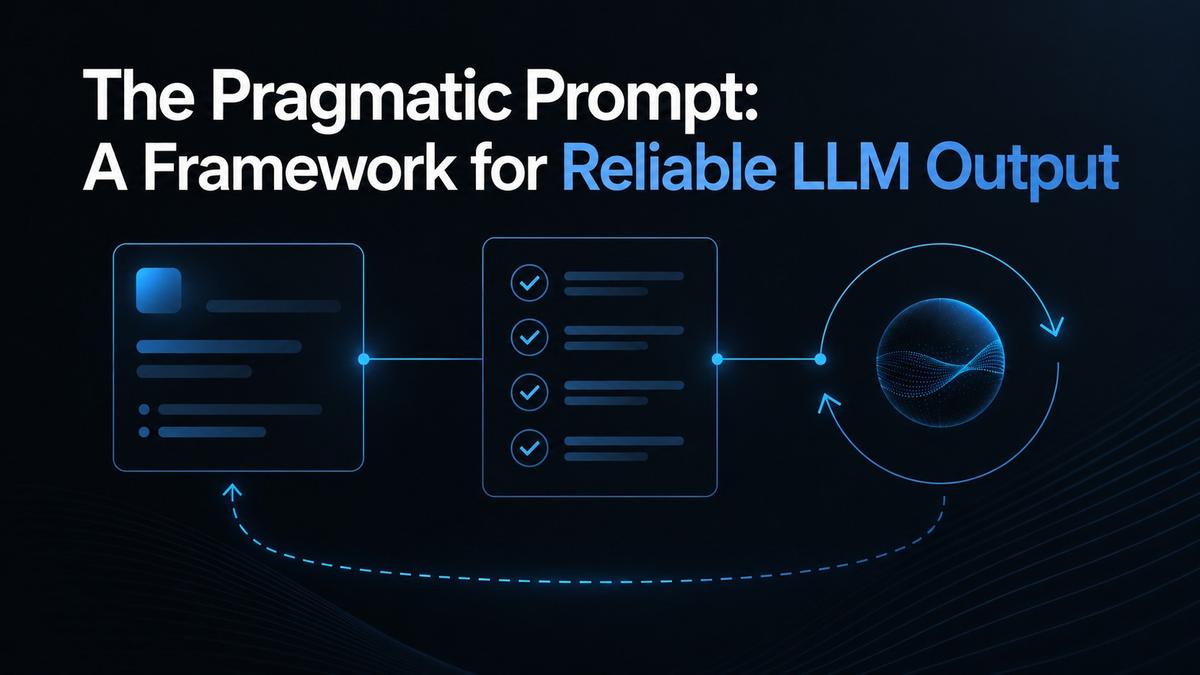
The Pragmatic Prompt: A Framework for Reliable LLM Output
Getting consistent results from an AI model often feels like guesswork, but it does not have to be. This post introduces the Pragmatic Prompt, a simple framework that turns messy prompting into a repeatable process anyone can use.
You ask an AI model the exact same question twice and get two completely different answers. One is exactly what you needed. The other is vague, off topic, or missing half the details you asked for. If that sounds familiar, the problem is rarely the model itself.
Most inconsistent AI output comes down to how the prompt was written, not some random flaw in the tool. Once you understand the pattern behind reliable prompts, you can get consistent, usable results almost every time.
This post introduces the Pragmatic Prompt, a simple framework built around four clear parts that anyone can learn in a few minutes. You will see exactly how it works, why it matters for your daily AI use, and how to start applying it today whether you are a student, developer, content creator, or business owner trying to save time with AI tools.
What the Pragmatic Prompt Actually Is
The Pragmatic Prompt is a straightforward way to structure any request you send to an AI model. Instead of typing a vague question and hoping for the best, you build your prompt around four parts, context, task, format, and constraints.
Context tells the model what situation you are working in. Task tells it exactly what you want done. Format tells it how the answer should look. Constraints tell it what to avoid or what limits to respect. Put those four pieces together, and even a short prompt becomes far more reliable.
This is not a complicated system. It is closer to a checklist than a technical skill, which is exactly why it works so well for people who are not deeply familiar with AI tools yet.
Why This Framework Actually Matters
Inconsistent AI output wastes real time. If you have to rewrite a prompt three or four times to get something usable, you have already lost the time savings that AI was supposed to give you in the first place.
This matters even more for people using AI professionally. A developer debugging code, a student writing an assignment, or a business owner drafting a client proposal cannot afford to gamble on whether the output will be useful. A repeatable framework removes that guesswork.
There is also a confidence factor. Once you know a structure that reliably works, you stop dreading the blank prompt box and start using AI tools the way they were actually meant to be used, as a fast and dependable part of your workflow rather than a slot machine.
How the Pragmatic Prompt Works in Practice
Start with context. This is a short sentence describing your situation, your audience, or your goal. For example, I am a small business owner writing a product description for an online store aimed at busy parents.
Next comes the task, stated clearly and directly such as “Write a 100 word product description for a portable blender”. Avoid vague requests like “write something good”, since the model has no way to know what good means to you specifically.
Then add format, describing exactly how you want the output to look. This might be a numbered list, a short paragraph, a table, or plain text with no headings. Finally, add constraints, which are the boundaries the model should respect, such as keep it under 100 words, avoid technical jargon, or do not mention competitor brands.
Here is the reusable template. Fill in each line for your own task, and you have a complete Pragmatic Prompt ready to use.
Context: [Describe your situation, role, or audience]

Task: [State exactly what you want done]

Format: [Describe how the output should look]

Constraints: [List anything the model should avoid or respect]
Put together, a full Pragmatic Prompt might read like this.
I am a small business owner writing for busy parents.
Write a 100 word product description for a portable blender.
Format it as a short paragraph with no headings.
Avoid technical jargon and do not mention competitor brands.
Here is another example, this time for a developer debugging a piece of code.
I am building a web app using Python and Flask.
Fix the following error: TypeError, NoneType object is not subscriptable.
Format your answer as the corrected code followed by a short explanation.
Do not rewrite the entire function, only fix the broken part.
And one more for a student working on a study guide.
I am a student preparing for a biology exam on cell structure.
Summarize the main functions of the mitochondria and the nucleus.
Format the answer as a short bullet list, no more than five points.
Keep the language simple and avoid technical terms without explaining them.
Benefits of Using This Framework
The biggest benefit is consistency. Once you get used to structuring prompts this way, you stop getting wildly different results from similar requests, since the model has everything it needs upfront instead of guessing at your intent.
It also saves real time. Instead of going back and forth rewriting a vague prompt several times, you get a usable answer on the first or second try far more often. Over weeks of regular AI use, that adds up to hours saved.
The framework also works across almost every AI tool available today, whether you are using ChatGPT, Claude, or Gemini. Since it is based on how you phrase the request rather than a specific tool feature, it travels well between platforms as you switch or compare tools. If you want to refine your prompting skills even further, our guide on better prompts for better AI results covers additional techniques that pair well with this framework.
Honest Limitations to Keep in Mind
The Pragmatic Prompt is not magic, and it will not fix every problem you run into with AI tools. If a model genuinely does not have the knowledge or capability to do something, a better prompt will not create that ability out of nowhere.
It also takes a little practice to feel natural. The first few times you use this structure, it might feel slightly slower than just typing a quick question, since you are consciously thinking through four parts instead of one.
For very simple requests, like a one line translation or a quick fact check, the full framework can feel like overkill. It shines most on tasks with real complexity or specific requirements, not on the smallest everyday questions.
Best Use Cases for This Framework
This framework works especially well for content creation tasks, where tone, length, and audience all matter. Writing blog posts, product descriptions, social captions, or email drafts all benefit from clearly defined context and constraints.
Developers get strong value from it too, particularly when asking an AI tool to write or debug code. Including the programming language, the exact error message, and the expected outcome as constraints leads to far more accurate fixes than a vague description of the problem.
Students preparing essays, study guides, or research summaries will also notice a real difference. Defining the format and audience upfront produces work that needs far less editing afterward, which matters when you are working against a deadline.
Practical Tips for Getting Started
Write your first few Pragmatic Prompts slowly and deliberately, even if it feels a little mechanical at first. Once the four part structure becomes second nature, you will be able to build a strong prompt in seconds without consciously thinking about each piece.
Save prompts that work particularly well for tasks you repeat often, like writing product descriptions or drafting weekly reports. Reusing a proven structure saves even more time than building a new prompt from scratch every time.
If you want a ready made set of prompts built on this exact framework, our 300+ ChatGPT prompts for students, developers, and content creators gives you a large library of pre built examples, so you can skip the blank page entirely and adapt a proven prompt to your task in seconds.
Common Mistakes to Avoid
The most common mistake is skipping context entirely and jumping straight to the task. Without context, the model has to guess at your audience, tone, and purpose, which almost always leads to generic output that needs heavy editing.
Another mistake is being too vague with constraints, or leaving them out altogether. Saying keep it professional means very little compared to saying avoid contractions and keep sentences under twenty words. Specific constraints produce specific results.
People also tend to abandon the framework the moment a prompt does not work perfectly on the first try. Refining one part of the prompt, usually the task or the constraints, almost always fixes the issue faster than starting over with a completely different approach.
Where Prompting Is Heading
As AI models continue improving, some of the manual structure in frameworks like this one may become less necessary, since newer models are getting better at inferring intent from shorter requests. That shift is already visible in how much less prompting effort some tasks require compared to a year ago.
Even so, structured thinking about context, task, format, and constraints will likely remain useful for complex or high stakes work, since clarity always improves output quality regardless of how advanced the underlying model becomes.
We are also seeing more tools build structured prompting directly into their interfaces, offering templates or guided fields instead of a single blank text box. That trend suggests frameworks like the Pragmatic Prompt are shaping how AI tools are designed, not just how people use them today.
FINAL THOUGHTS
Reliable AI output is not about finding a secret trick or a perfect magic phrase. It comes down to giving the model clear context, a specific task, a defined format, and honest constraints, every single time you make a request.
The Pragmatic Prompt turns that idea into something you can actually remember and apply, whether you are drafting an email, debugging code, or writing an essay under a deadline. Once it becomes a habit, you stop wasting time on rewrites and start getting usable answers far more consistently.
Try building your next AI prompt using all four parts, context, task, format, and constraints, even if it feels a little slower than usual. That one small habit will likely save you more time this week than any other prompting tip you have picked up so far.
FREQUENTLY ASKED QUESTIONS
What is the Pragmatic Prompt framework?
It is a simple structure for writing AI prompts using four parts, context, task, format, and constraints. It helps you get clearer and more consistent results without relying on guesswork.
Does this framework work with every AI tool?
Yes, it works across most major AI tools, including ChatGPT, Claude, and Gemini. Since it is based on how you phrase requests rather than a specific feature, it applies no matter which platform you are using.
Is this framework only for advanced users?
Not at all. It is designed to be simple enough for complete beginners, since it works more like a checklist than a technical skill. Anyone can start using it right away with a little practice.
Why do I get inconsistent results from AI tools?
Inconsistent output is usually caused by vague or incomplete prompts, not a flaw in the AI model itself. Adding clear context and specific constraints almost always improves consistency significantly.
How long does it take to write a Pragmatic Prompt?
Once you get used to the four part structure, it only takes a few extra seconds compared to a typical prompt. The time you save from not needing to rewrite your request usually outweighs that small upfront effort.
Can I use this framework for coding tasks?
Yes, and it works particularly well there. Including the programming language, the exact error message, and your expected outcome as constraints leads to noticeably more accurate results from AI coding tools.
Comments (0)
Sign in to post a comment.
- Be the first to comment.