DeepSeek V4.1 Flash Update Adds a Web Search API
DeepSeek V4.1 Flash 1017 is faster, cheaper and better at coding, and ships with new Search and Fetch APIs. What changed and what it means for developers.
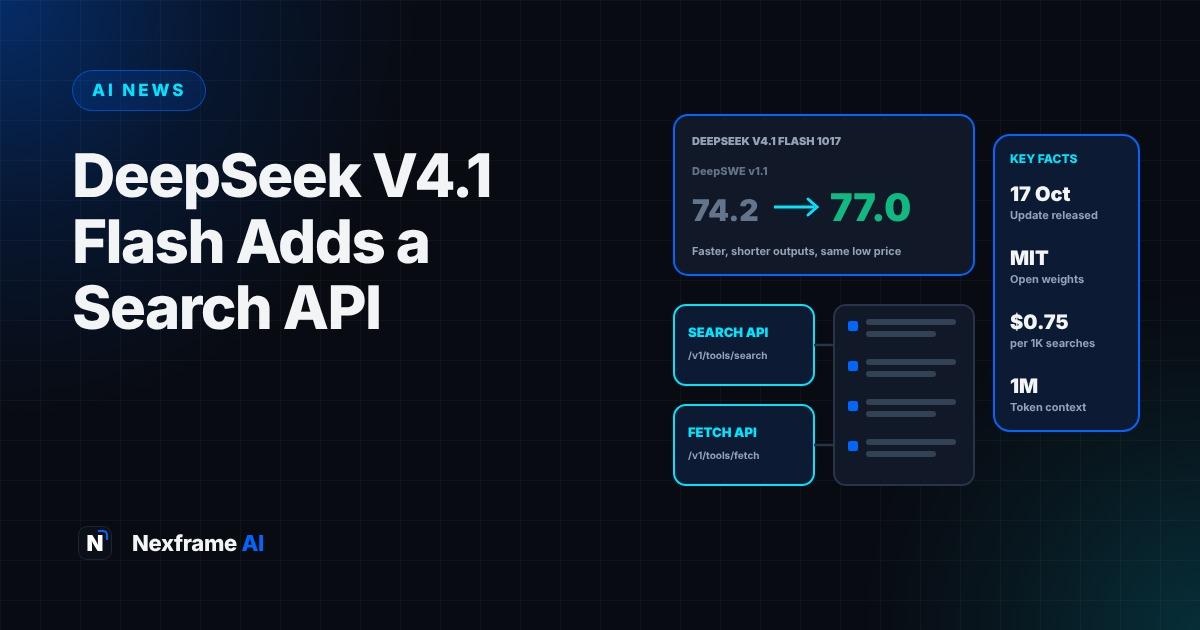
DeepSeek has released an updated version of its V4.1 Flash model, called V4.1-Flash-1017, along with something new for the company: public Search and Fetch APIs that let developers add live web search to their own apps and agents.
The update went live on 17 October 2026 on DeepSeek's website, app and API, and the weights are published under the MIT licence on Hugging Face and ModelScope. DeepSeek describes it as having "stronger benchmark performance, faster task completion, and shorter outputs than the previous version".
For developers in Nigeria and other price-sensitive markets, DeepSeek has long been one of the cheapest ways to get strong AI performance. This update makes it more capable for coding and agent work without raising prices. Here's what changed and how to use it.
What is DeepSeek V4.1 Flash?
DeepSeek V4.1 Flash is DeepSeek's fast, low-cost model. It launched on 10 September 2026, and DeepSeek began routing many requests that used to go to its larger V4 Pro model to Flash instead. The new 1017 version (named after its 17 October release date) is a fresh round of training on the same base model, not a new architecture.
Key specifications:
Design: a large mixture-of-experts model with 552 billion core parameters, of which only about 8 billion are active when reading your input and 16 billion when writing its answer. That's why it's fast and cheap to run.
Context window: 1 million tokens.
Maximum output: up to 384,000 tokens.
Inputs: text and images, with text output.
Memory use: its working memory (the KV cache) is about a quarter the size of the earlier V4 Flash, which helps lower costs on long conversations.
What's better in the 1017 update
DeepSeek says the update was trained to complete whole projects from start to finish, using reinforcement learning with self-feedback. The practical effects are:
Better scores on coding and agent benchmarks.
Faster completion of multi-step tasks.
Shorter outputs, which means fewer tokens and lower bills for the same job.
On DeepSeek's own published figures, the new version beats the September release across its benchmark table:
DeepSWE v1.1 (software engineering): 77.0, up from 74.2
Automation-Bench: 60.5, up from 54.8
Agents' Last Exam: 35.4, up from 31.8
Terminal-Bench 4.0: 42.3, up from 31.2
Humanity's Last Exam (no tools): 42.6, up from 36.8
DeepSeek also compares it with Anthropic's Claude Opus 5. Flash 1017 edges ahead on DeepSWE (77.0 vs 74.0) and on several agent tests, but Opus 5 still leads clearly on Terminal-Bench (51.8) and Humanity's Last Exam (56.3). These are DeepSeek's numbers in DeepSeek's setup, and Opus 5 has since been followed by Opus 5.5, so treat the comparison as a rough guide, not a ranking.
The headline is still significant: a cheap, fast model now competes with expensive flagship models from early this year on real software engineering tasks.
The new Search and Fetch APIs
The bigger long-term news may be DeepSeek opening its web search to developers. There are two tools:
Search: send a query and get back ranked web results, up to 50 at a time, optionally with page content. It supports filters like site:, lang:, after: and before:, and gives each result a relevance score and an authority rating.
Fetch: send a URL and get the page back as clean Markdown, ready to pass to a model.
Pricing is simple: $0.75 per 1,000 successful requests for each tool. Empty results and failed requests are free. The limit is 5 requests per second per account.
DeepSeek is also making server-side search free until 1 November 2026 when it's used through its own DeepSeek Harness or through coding tools such as Claude Code and Codex.
Why this matters: AI agents are only as good as the information they can reach. A model that can search the live web and read pages can answer questions about today's news, check prices or research a topic, instead of relying only on what it learned during training. Until now, developers usually had to pay a separate search provider for this.
How much it costs
DeepSeek remains one of the cheapest strong models available. Reported pricing for its own API at peak times is about $0.30 per million input tokens (when not cached) and $1.20 per million output tokens, with off-peak rates at half price. Some third-party hosts list lower prices. Check DeepSeek's pricing page on the day you build, because rates change often.
In naira at about ₦1,330 to the dollar, that's roughly ₦400 per million input tokens and ₦1,600 per million output tokens at peak. For comparison, Google's Gemini 4 Argon costs $2 and $10 during its introductory offer. For many everyday jobs, such as customer support replies, summaries, extraction and routine coding, that price gap is big enough to change what a small startup can afford to build.
And because the weights are under the MIT licence, you can also host the model yourself or through any provider, with very few restrictions on commercial use.
What this means for developers in Nigeria
Cheaper agents. A strong coding and agent model at low prices makes it practical to build tools that run many steps, such as a bot that reads a codebase and fixes bugs, or an assistant that researches suppliers.
Built-in web research. The Search and Fetch APIs give you live web access without stitching together a separate search service. That's useful for news summaries, price tracking, research assistants and agents that need current information.
Shorter outputs, smaller bills. Because the new version writes less to reach the same result, existing DeepSeek apps may get cheaper automatically.
Data and compliance questions. DeepSeek is a Chinese company, and data sent to its own API is processed under its terms. If you handle sensitive data, such as financial or health records, read its privacy policy carefully, consider a provider hosting the open weights in another region or self-host, and follow Nigeria's data protection rules. Our guide to securing AI features in your app covers what to check.
How to try it
Test the model on your real tasks. Pick 10 to 20 tasks from your product and run them through DeepSeek V4.1 Flash and the model you use now. Compare quality, speed and total cost.
Try it as a coding agent. DeepSeek says the update is tuned for its own DeepSeek Harness and for Tencent's CodeBuddy and WorkBuddy. It also works with popular coding agents. Our guide to choosing an AI coding agent explains the options.
Prototype a search agent. Use the Search API to find sources and Fetch to read them, then have the model summarise with citations. Start with the free server-side search window before 1 November.
Watch your rate limits. At 5 requests per second, the Search API suits small apps and prototypes. Plan for queuing if you expect bursts of traffic.
Check outputs. Even strong models make mistakes. Read our guide on whether agentic coding is safe for production code before letting an agent change live systems.
If you're building a tool that answers questions from your own documents rather than the web, combine the model with retrieval instead. Our guide to RAG for beginners walks through it.
How DeepSeek fits the bigger picture
October has been busy for open-weight models. Meta released Muse Spark Open on 15 October, Moonshot's Kimi K3 is competing hard on coding and Zhipu's GLM 5.3 and Alibaba's Qwen models keep improving. DeepSeek's approach stands out for two reasons: very low prices and a permissive MIT licence.
For developers, this competition is good news. Every strong, cheap model puts pressure on prices across the market, including on closed models from the biggest US labs.
Worked example: what a research agent would cost
Ibrahim is building a price-tracking assistant for small electronics shops in Kano. It searches the web for current prices of popular phones and accessories, reads the product pages and sends each shop a daily summary on WhatsApp.
Here's his monthly cost estimate using DeepSeek V4.1 Flash and the new APIs, at peak prices:
Search: 200 searches a day is about 6,000 a month. At $0.75 per 1,000, that's $4.50.
Fetch: 600 page reads a day is about 18,000 a month, or $13.50.
Model input: 6,000 tasks a month at about 20,000 tokens each is 120 million tokens. At $0.30 per million, that's $36.
Model output: about 2,000 tokens per task is 12 million tokens. At $1.20 per million, that's $14.40.
The total is about $68 a month, or roughly ₦91,000. Running more of the work in off-peak hours, when DeepSeek's prices are half, could bring that down further. Shorter outputs from the 1017 update also help.
Ibrahim checks two more things before launch. At 5 requests per second, his bursts of morning searches need a simple queue so they don't hit the rate limit. And because prices from web pages can be wrong or out of date, his summaries always show the source and the time each price was checked.
The lesson: with low model prices and simple search pricing, a useful research agent can cost less per month than many software subscriptions. Work out your numbers before you build, and design for mistakes.
What to watch next
Keep an eye on independent benchmark results for the 1017 update, any change to Search API pricing after the free server-side window ends on 1 November and DeepSeek's next larger model. Also watch for third-party hosts adding the 1017 weights, which often brings lower prices and more data-region choices.
FAQ
What is DeepSeek V4.1 Flash 1017?
It's an updated version of DeepSeek's fast, low-cost V4.1 Flash model, released on 17 October 2026. It scores higher on coding and agent benchmarks, finishes tasks faster and writes shorter outputs than the September version.
Is DeepSeek V4.1 Flash open source?
The weights are released under the MIT licence on Hugging Face and ModelScope, so you can download, host and use them commercially with very few restrictions.
How much does the DeepSeek Search API cost?
It costs $0.75 per 1,000 successful requests for Search and the same for Fetch. Failed or empty requests are free, and the limit is 5 requests per second per account.
Is DeepSeek V4.1 Flash better than Claude or GPT?
On DeepSeek's own tests, it beats Claude Opus 5 on some coding and agent benchmarks but trails on others. The newest flagships from Anthropic, OpenAI and Google are stronger overall, but DeepSeek is much cheaper.
Is it safe to use DeepSeek for business data?
Read DeepSeek's privacy terms before sending sensitive data to its API. If you need more control, use a provider that hosts the open weights in another region, or host the model yourself.
What's the difference between DeepSeek V4 and V4.1?
V4.1 Flash is a newer model released in September 2026 that replaced many uses of the older V4 models. The 1017 update is an improved version of V4.1 Flash.
Comments (0)
Sign in to post a comment.
- Be the first to comment.