How to Use AI to Study for Exams Without Getting Flagged for Cheating (2026 Guide)
AI can be a powerful study companion without crossing academic integrity lines. This guide breaks down exactly how to use AI tools ethically to prepare for exams in 2026 so you can study smarter, retain more, and never worry about getting flagged.
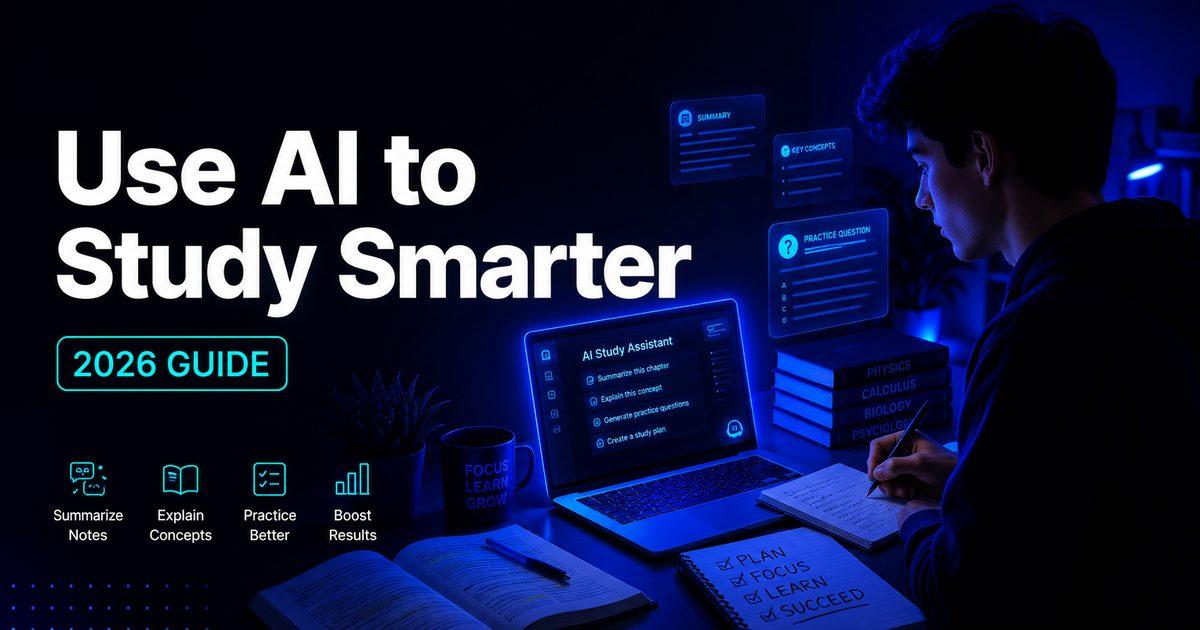
Every student has felt the pressure: a big exam is coming, the syllabus is long, and there are only so many hours in the day. AI tools promise to make studying faster and smarter, but there is a catch. Schools and universities are watching. AI detectors, plagiarism checkers, and updated academic integrity policies have made a lot of students nervous about even touching tools like ChatGPT.
Here is the truth no one says clearly enough: using AI to study is not cheating. Submitting AI-generated work as your own is cheating. That is a significant distinction, and this guide is built around it.
This is a practical, honest breakdown of how to use AI as a study tool in 2026 without putting your academic standing at risk. Whether you are preparing for high school finals, university entrance exams, or professional certifications, these strategies apply to you. Read to the end and you will know exactly how to study with AI the right way.
What It Is
Using AI to study means using artificial intelligence tools to support your learning process, not to replace it. Think of AI as a very patient tutor that is available around the clock, never gets frustrated, and can explain any concept from multiple angles.
The tools that matter most for students in 2026 fall into a few broad categories. Conversational AI assistants like ChatGPT, Claude, and Gemini can explain complex topics, quiz you on material, break down difficult texts, and help you understand concepts you missed in class. Flashcard and memory tools like Anki have started incorporating AI features that adapt to your performance and surface the concepts you are most likely to forget. Document analysis tools can summarize long readings and pull out key arguments so you know what to focus on.
When these tools are used to help you understand and remember material, they are study aids. That is the same category as a highlighter, a study group, or a tutor. The problem only starts when students skip the learning part and ask AI to produce the final work directly.
Why It Matters
The stakes are genuinely high. Academic integrity violations can result in failing a course, suspension, or in serious cases expulsion. Many institutions now use AI detection software alongside traditional plagiarism checkers. Turnitin added AI detection features. GPTZero is used by educators directly. Some schools have moved to oral exams or in-class handwritten assessments specifically because AI-generated text is hard to trace when used carelessly.
But there is another side to this. Students who refuse to use AI at all are putting themselves at a disadvantage. AI literacy is becoming a core professional skill. Employers expect graduates to know how to work alongside these tools. Learning to use AI thoughtfully and ethically is not optional anymore, it is part of being prepared for the world after school.
The students who will thrive in 2026 and beyond are those who learn to use AI as a tool for understanding, not a shortcut around it.
How It Works
Here is a step-by-step look at how ethical AI-powered studying actually works in practice.
Step 1: Use AI to explain, not to write
When you do not understand a concept from your notes or textbook, open an AI assistant and ask it to explain the idea in plain language. Ask for analogies. Ask it to explain it like you are a beginner. Ask follow-up questions until it clicks. You are doing the learning. AI is doing the explaining.
Step 2: Generate your own practice questions
Paste in a topic or paste in your notes and ask the AI to generate a set of practice questions at different difficulty levels. Then close the AI window and answer them yourself. Only return to check and discuss your answers after you have attempted them.
Step 3: Use AI as a quiz partner
Ask the AI to quiz you verbally. Type your answers out. Ask it to critique your answer and point out what you missed. This is active recall, one of the most research-backed study methods available, made more accessible.
Step 4: Summarize complex readings with AI, then read them yourself.
If you have a 60-page paper to review, AI can give you a quick overview of the main arguments and key terms. Use that as orientation before you read, not as a replacement for reading. You will get through the material faster and with better comprehension.
Step 5: Use AI to create study schedules and revision plans
Tell it your exam date, the topics you need to cover, and your daily availability. It will build a realistic study plan. This is pure organization help with zero academic integrity risk.
Step 6: Write everything in your own words
Any notes, essays, or assignments that get submitted must come from your brain. Use AI to understand the material, then close every tab and write from what you actually know.
Benefits
Studying with AI done right comes with real advantages.
Personalized explanations
A textbook explains something one way. If that way does not connect for you, you are stuck. AI can explain the same concept ten different ways until one of them sticks. That flexibility is something even the best human tutor struggles to match at scale.
Available around the clock
Your exam prep does not stop at 11pm, but your classmates and teachers do. AI is there whenever you are ready to study.
Reduces study anxiety
When you have a tool that can answer any question without judgment, it becomes easier to admit what you do not understand. Asking AI a question you feel embarrassed not to know is far easier than asking a professor.
Accelerates comprehension
Active learning with AI, asking questions, generating examples, testing yourself, can compress what might take hours of passive reading into a focused session.
Builds stronger retention
Using AI to run active recall drills is one of the most effective ways to move material from short-term to long-term memory. This translates directly into better exam performance.
For a broader look at which tools to add to your routine, check out the best AI tools for students.
Limitations
AI can be confidently wrong
This is the biggest limitation. AI tools sometimes state incorrect information with total confidence. For anything involving specific dates, statistics, scientific figures, legal definitions, or medical information, always verify against your course materials or a primary source.
AI does not know your specific course
It cannot read your professor's mind. The AI explanation of a concept might differ slightly from how your course frames it. Your notes and textbooks are still the primary source.
Over-reliance can create a false sense of readiness
If you use AI to answer your own practice questions before attempting them yourself, you may feel like you understand material you have not actually learned. Active recall only works if you do the struggling first.
AI detection tools are improving
If you are tempted to paste AI-generated content into your assignments, know that detection technology is getting better every semester. The risk is not worth it.
Some institutions restrict AI use entirely
Know your school policy before you start. Many schools allow AI for study purposes but prohibit it for submitted work. Read the policy.
Best Use Cases
Catching up on missed material
If you fell behind, AI can help you understand key concepts quickly before you return to the full notes.
Understanding abstract or technical concepts
Subjects like calculus, chemistry, economics, and computer science involve concepts that benefit enormously from multiple explanations and real-world analogies. AI excels here.
Exam countdown cramming
With three days before an exam, AI can help you build a targeted revision list, quiz you on weak areas, and help you focus your time on the highest-yield material.
Language and terminology
If a subject has lots of jargon, asking AI to explain terms and how they connect to each other is a fast way to build vocabulary before you read.
Revision across multiple subjects
AI can switch between biology, history, and math in seconds. Students juggling many exams at once can use AI to create a rotating practice session across all subjects.
If you want a curated list of free tools to get started, explore the guide to free AI tools for students in 2026.
Practical Tips
Set a rule: AI explains, you write
After any AI explanation session, close the tool and write out what you learned in your own words. This single habit closes the gap between AI-assisted understanding and genuine knowledge.
Use it in dialogue, not monologue
Do not just ask for a summary and then walk away. Ask follow-up questions. Challenge the answer. Ask for examples. The more you engage, the deeper the learning.
Keep your session logs
Paste important AI explanations into a personal notes document. This gives you a study resource to return to and creates a trail showing how you used the tool for learning, not for generating answers.
Alternate AI sessions with solo study
Study independently for a block of time, then use AI to check your understanding and fill gaps. Do not start with AI every session.
Tell the AI what level you are at
Adding context like "I am a first-year university student studying introductory economics" gets you explanations calibrated to your level rather than generic answers.
Use it for oral practice
Before an oral exam or presentation, have a conversation with an AI about the topic. Talking through your understanding out loud, even by typing, is a powerful rehearsal technique.
Common Mistakes
Submitting AI-generated text directly
This is the line that must never be crossed. Everything submitted in your name must be in your voice, from your understanding. AI-generated text that gets submitted is academic dishonesty, full stop.
Using AI as the first step, not a backup
Many students open AI before they even try to understand something themselves. Always attempt the material first. Your struggle with it is part of learning. AI should come in after you have hit a wall.
Trusting every AI answer
Treating AI responses as authoritative is risky. Cross-reference anything important with your course materials.
Skipping active recall
Using AI to read explanations is passive. Using it to quiz yourself is active. Students who only read AI explanations without testing themselves often feel prepared but underperform on the actual exam.
Ignoring your institution policy
If your school prohibits AI for a specific assignment, that prohibition applies even if you only planned to use it for study notes.
Using AI to write outlines you then fill in
If the AI generates the structure and you just fill in words, the thinking behind the piece is not yours. Build your own outlines from your own understanding.
For a deeper look at what makes AI-assisted writing detectable, read this breakdown of AI mistakes that make content look AI-generated.
Future Outlook
The relationship between AI and academic assessment is changing fast. Universities are actively redesigning exams to account for AI. Open-book and take-home exams are being replaced or supplemented with in-person oral exams, practical demonstrations, and portfolio assessments that are much harder to fake with AI assistance.
On the flip side, some institutions are fully integrating AI into the curriculum. Students at these schools are graded on how thoughtfully they use AI, not on whether they use it at all.
The safest prediction is that AI fluency will be expected, and AI abuse will be caught more reliably. Students who develop genuine AI literacy now will be in the best position regardless of how policies evolve.
AI detection tools will continue to improve. Institutions will get better at identifying AI-generated writing and patterns that suggest submitted work does not match a student's demonstrated understanding. The gap between what you submit and what you actually know will become increasingly visible.
Final Thoughts
Using AI to study for exams is not cheating. It is smart. The students getting the most out of 2026 are the ones who treat AI like a 24-hour tutor they can interrogate without embarrassment, push for better explanations, and use to drill themselves on material they genuinely need to learn.
The students who get in trouble are the ones who skip the learning entirely and let AI do the thinking. That approach produces submitted work that does not match in-class performance, raises red flags for instructors, and ultimately leaves gaps in knowledge that show up at the worst possible moments.
Your takeaway is straightforward: use AI to understand, always write in your own words, know your school policy, and never submit anything you could not explain in detail to your professor without looking at a screen. If you can do those four things, AI becomes one of the best study resources you have ever had.
Frequently Asked Questions
Is it cheating to use ChatGPT to study for an exam?
No, using ChatGPT to understand concepts, generate practice questions, or explain difficult material is not cheating. Cheating happens when you submit AI-generated content as your own original work. Using AI as a study aid is comparable to using a tutor or a study group.
Can schools detect if I used AI for an assignment?
Yes. Tools like Turnitin and GPTZero are used widely to detect AI-generated text. Detection technology improves constantly. If you submit AI-generated content, the risk of being caught increases every semester.
What is the safest way to use AI as a student?
Use AI to understand material, then close it and write everything yourself. Never paste AI-generated text into anything you submit. Keep notes from your AI study sessions so you can demonstrate how you used the tool for learning.
Does using AI to study actually improve exam scores?
When used correctly, yes. Techniques like AI-powered active recall, personalized explanations, and targeted practice quizzes are grounded in well-established learning science. The key is active engagement, not passive reading of AI summaries.
What if my school has a zero-tolerance AI policy?
Read your institution policy carefully. Some schools prohibit AI for assessments but allow it for personal study. Others restrict it more broadly during exam periods. When in doubt, ask your professor directly. Transparency about how you are studying is always safer than guessing.
Will AI study tools become more common in schools?
Very likely. Many institutions are already integrating AI literacy into their curricula. The direction of education is toward teaching students to use AI thoughtfully, not away from it entirely. Building good AI habits now positions you well for where things are going.
Comments (0)
Sign in to post a comment.
- Be the first to comment.