How to Answer "Tell Me About Yourself" With AI: A Workflow
Learn how to answer tell me about yourself in 60 to 90 seconds. Use AI to tailor a present, past, future answer, then practise until it sounds natural.
By the end of this workflow you'll have a 60 to 90 second answer to "Tell me about yourself" that is tailored to a specific job, structured around what you do now, what you've done before and why you want this role, and practised out loud with AI until it sounds like you talking, not you reciting. You'll also get short versions for phone screens and networking.
Time to complete: 60 to 90 minutes for your first answer, 15 minutes for each new job after that
Difficulty: Beginner
Tools needed:
Any AI chatbot (ChatGPT, Claude or Gemini; the free tiers are enough)
The job description for the role you're applying to
Your CV or resume
Your phone's voice recorder or a voice-enabled chatbot app
Optional: our free interview question practice tool
Before You Start
Pick one real job. "Tell me about yourself" changes from role to role. Work with an actual job posting you plan to apply to, not a vague idea of the kind of job you want.
Have your CV open. The AI will draw on your experience, so the facts need to be accurate and current. If your CV is out of date, fix that first.
Know what the question is really asking. Interviewers want to know whether you can explain yourself clearly, whether your background fits and whether you actually want this job. Every sentence should serve one of those.
Keep it honest. AI will happily make you sound more impressive than you are. Don't let it.
Step 1: Pull the Three Things the Job Cares About Most
Before writing a word about yourself, find out what this employer wants to hear. Most job descriptions have 10 to 15 requirements, but only two or three really decide who gets hired.
Here is a job description: [paste the full job description]

Identify the 3 skills or qualities this employer cares about most. For each one:
- quote the exact words from the posting that show it matters
- explain in one sentence why it matters for this role
Then list 2 things the posting suggests about the company's culture or priorities.
Keep it short.
You can also run the posting through our free job description analyser for a quick breakdown.
Checkpoint: You have three priorities written down in plain words, such as "handles customer complaints calmly", "comfortable with Excel and data" and "works well in a small, fast team".
Step 2: Gather Your Raw Material
Now collect the facts you might use. Don't try to sound good yet.
I'm preparing my answer to "Tell me about yourself" for this role: [job title, e.g. Customer Success Associate at a Lagos fintech].

Here is my CV: [paste CV]

The employer's top 3 priorities are: [paste from Step 1]

Ask me 8 short questions, one at a time, to find stories and facts from my background that connect to these priorities. Include questions about results, numbers, things I'm proud of and why I'm interested in this field. Wait for my answer before asking the next question.
Answer in rough notes. The interview-style back-and-forth surfaces details you'd never think to put on a CV, like the time you trained three new staff or built a tracking sheet your whole team adopted.
Checkpoint: You have a list of 5 to 8 facts or mini-stories, each linked to at least one of the employer's priorities.
Step 3: Draft With the Present, Past, Future Formula
The simplest structure that works is present, past, future. Present: who you are professionally right now. Past: the experience that got you here, with one or two specific results. Future: why this role, at this company, is your next step.
Using the facts I've shared, write a "Tell me about yourself" answer for the [job title] role at [company].

Structure:
- Present (2 to 3 sentences): what I do now and my main strength
- Past (3 to 4 sentences): 1 or 2 relevant experiences with a specific result each
- Future (2 to 3 sentences): why this role and this company fit what I want next

Rules:
- 150 to 220 words, so it takes 60 to 90 seconds to say
- Use plain, spoken English, not CV language
- No buzzwords like "passionate", "results-driven" or "dynamic"
- Use only facts I've given you. Do not invent numbers or experiences
- Connect to the employer's top priorities without listing them
Expect the first draft to be too polished; you'll fix that in Step 5. For now, check the structure and the facts.
Checkpoint: You have a draft of 150 to 220 words. Read it once and confirm every fact is true.
Step 4: Adjust for Where You Are in Your Career
The same formula needs a different emphasis depending on your situation. Ask the AI to rework the draft for yours.
Rework my answer for my situation: [choose one: recent graduate / career changer / experienced professional].

- If recent graduate: lean on projects, internships, NYSC or volunteer work, and show how I learn fast. Don't apologise for limited experience.
- If career changer: lead with transferable skills, give one clear reason for the switch, and show what I've already done to prepare (courses, side projects).
- If experienced professional: focus on the last 3 to 5 years only, lead with scope and results, and skip early-career detail.

Here is my current draft: [paste draft]
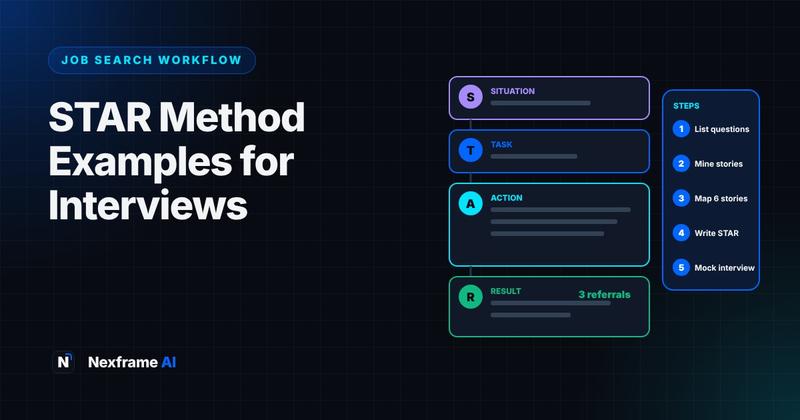
Graduates often waste their 90 seconds on their degree, career changers over-explain why they're leaving, and experienced candidates walk through every job since 2009. If you're short on stories to fill the past section, our STAR method examples workflow helps you build them.
Checkpoint: Your answer reflects your real stage. If you're a graduate, it has at least one concrete project or result. If you're switching careers, the reason for the switch takes one sentence, not five.
Step 5: Make It Sound Like You, Not a Script
This is the step most people skip, and it's why so many AI-written answers sound robotic. Interviewers can hear when someone is reciting.
Rewrite my answer so it sounds natural when spoken by me.
- Use contractions and shorter sentences
- Remove any phrase a real person wouldn't say out loud in an interview
- Keep my own words where I've used them: [paste 2 or 3 phrases you naturally use]
Then turn the final answer into 5 short bullet-point cues (3 to 6 words each) I can memorise instead of the full script.
The bullet cues matter more than the paragraph. Memorise the cues and the order, not the exact words. If you forget a line, you move to the next cue instead of freezing.
Checkpoint: Read the answer aloud. If any sentence makes you stumble or sounds like something you'd never say, rewrite it in your own words.
Step 6: Practise With AI as Your Interviewer
Now rehearse properly. Use a chatbot's voice mode if you have it, or record yourself on your phone and paste a transcript.
Act as a hiring manager interviewing me for [job title] at [company]. Start by asking "Tell me about yourself." After I answer:
1. Tell me roughly how long it would take to say (count the words)
2. Tell me which part was strongest and which was weakest
3. Point out any filler, vague claims or rambling
4. Ask me one natural follow-up question based on what I said, as a real interviewer would
Be direct. Don't just praise me.
Do this at least three times. Time yourself with your phone's stopwatch: under 60 seconds usually feels thin, while over two minutes and you'll lose the room. If you mention a project, expect to be asked about it. For a wider practice session, try our interview question practice tool and if the first round is an automated video screen, prepare with how to pass an AI job interview.
Checkpoint: You can give the answer in 60 to 90 seconds, without notes, and you've prepared responses to the two or three follow-ups the AI kept asking.
Step 7: Build Short Versions and a Reuse Routine
You'll need shorter versions for phone screens, career fairs and networking events.
From my final answer, create:
1. A 30-second version for phone screens
2. A 15-second version for networking (name, what I do, what I'm looking for)
3. A list of the 2 sentences I should change when applying to a different company in the same field
Save all three versions with your core cues in a note. For each new job, repeat Step 1 on the new posting, then swap in the most relevant past example and rewrite the future section.
Checkpoint: You have a full answer, a 30-second version and a 15-second version saved in one place.
Worked Example: Chiamaka, an NYSC Graduate Applying to a Lagos Fintech
Chiamaka is finishing her NYSC service year in Ibadan, where she's been posted to a secondary school. She studied Economics at the University of Nigeria, Nsukka, and she's applying for a Customer Success Associate role at a payments start-up in Yaba, Lagos.
In Step 1, the AI pulled three priorities from the posting: "explaining products clearly to non-technical customers", "comfortable working with data in spreadsheets" and "calm under pressure with a high volume of tickets".
In Step 2, the AI's questions surfaced things Chiamaka had left off her CV. During NYSC she set up a Google Sheet to track exam scores for four classes, which other teachers started using. At university she handled payments and member questions as treasurer of her departmental association, answering dozens of WhatsApp messages a week during dues collection.
Her first AI draft opened with "I am a passionate and results-driven Economics graduate". She deleted that in Step 5. After Step 4 (recent graduate) and Step 5, her answer read:
"I'm finishing my NYSC year at a secondary school in Ibadan, where I teach economics and, honestly, spend a lot of time explaining things in simpler ways until they click. That's the part of the job I enjoy most.
Before NYSC, I studied Economics at UNN, and I was treasurer of my departmental association. That meant collecting dues from about 200 students and answering a lot of anxious WhatsApp messages about payments, sometimes 40 in a day near deadlines. I learned to stay calm and keep records clean. At my PPA, I built a Google Sheet to track results for four classes, and the other teachers ended up adopting it.
I'm applying for this role because it brings those things together: helping people understand a product, working with data, and handling a busy queue. I use your app myself, and I like that you're focused on small businesses. I'd love to help more of them get comfortable with digital payments."
It's about 170 words, roughly 75 seconds spoken. In Step 6, the AI-as-interviewer flagged that "a lot of anxious WhatsApp messages" invited a follow-up, and it duly asked: "Tell me about a difficult payment complaint you handled." Chiamaka prepared a STAR story for it.
She also updated her CV so the Google Sheet project appeared under her NYSC role, using Nexframe Resume, so her CV and her spoken answer told the same story.
Common Mistakes
Reciting your CV in order. The interviewer has already read it. Pick the two or three parts that matter for this job and leave the rest.
Letting AI invent achievements. If the draft contains a number or project you don't recognise, delete it. A follow-up question will expose it within seconds.
Memorising word for word. Scripts break under nerves. Memorise cues and structure instead.
Ending on the past. Always finish with why you want this role. It hands the conversation back to the interviewer on the right note.
Using one answer for every job. A generic answer sounds generic. Step 1 and the future section should change every time.
Going over two minutes. Long answers suggest you can't prioritise. Time yourself.
Next Step
Your opener sets up everything that follows, so prepare the stories it points to. Work through our STAR method examples workflow next, and if you're applying to many roles, our daily AI job search routine helps you tailor applications without burning out. For a stronger skills section, borrow from the AI skills employers want in 2026. If "Where do you see yourself in five years?" worries you, working through these SMART goals examples gives you a ready answer, and a quick job posting to tailored resume workflow keeps your CV matched to the role.
FAQ
How long should my answer to "Tell me about yourself" be?
Aim for 60 to 90 seconds, which is roughly 150 to 220 words spoken at a normal pace. That's long enough to give real detail and short enough to hold attention. For phone screens or networking, have a 30-second and a 15-second version ready.
What is the best structure for "Tell me about yourself"?
Present, past, future works for most people. Start with what you do now, back it up with one or two relevant experiences and results, then finish with why this role is your next step.
Is it okay to use AI to write my interview answer?
Yes, as long as the facts are yours and the final words sound like you. Use AI to find relevant stories, structure them and practise, but rewrite anything that feels unnatural. Interviewers notice polished, generic answers quickly, and they'll test anything that sounds too good with follow-up questions.
Should I mention personal things like hobbies or family?
Usually no, unless a hobby is directly relevant or shows a skill the job needs, such as running a tech community or managing a small business on the side.
How do I answer "Tell me about yourself" with no work experience?
Lead with your current situation (final-year student, NYSC corps member, recent graduate), then use projects, internships, volunteering, campus roles or courses as your past section. Focus on what you did and learned, not on what you lack. Never apologise for limited experience.
How should Nigerian graduates mention NYSC in their answer?
Treat NYSC as real work experience, because it is. Mention your PPA role briefly and highlight one concrete thing you did there that links to the job, such as training others, managing records or handling the public. Interviewers in Nigeria know what NYSC involves, so you don't need to explain the programme itself.
More in Job Search Workflows.