AI Skills Employers Want in 2026 and How to Learn Them
The AI skills employers want in 2026, for non-coders and technical roles, how to learn them free or cheaply from Nigeria, and how to prove them on a resume.

Which AI skills do employers actually want in 2026, and can you learn them without a computer science degree or a big budget? Short answer: yes. Most hiring managers aren't asking every candidate to build models. They want people who can use AI tools to get real work done faster, check what those tools produce, and explain the results to colleagues and clients. A smaller group of technical roles needs deeper skills, such as building with AI APIs, retrieval and evaluation.
The most requested AI skills are learnable in weeks, and much of the training is free. The harder part is proving you have them. Below we cover what the research shows, the non-technical and technical tracks, how to learn cheaply from Nigeria, and how to put AI skills on a resume so a recruiter believes you.
What the Evidence Says About AI Skills Demand
Several large reports from the past 18 months point the same way.
AI skills are growing fast in job posts
The World Economic Forum's Future of Jobs Report 2025, based on a survey of employers worldwide, named "AI and big data" as the fastest-growing skill group to 2030, followed by networks and cybersecurity and technological literacy. The same report said employers expect 39% of workers' core skills to change by 2030.
LinkedIn's labour market research released for Davos in January 2026 said US job postings asking for AI literacy rose 70% year on year, and that AI Engineer was the fastest-growing US job title for the second year running. LinkedIn also said more than 1.3 million new AI-related jobs appeared globally over two years, including roles such as data annotator and forward-deployed engineer.
PwC's 2026 Global AI Jobs Barometer, published in June, reported that jobs requiring specific AI skills grew 69% compared with 9% for the job market overall, and that roles asking for AI skills carried a wage premium of about 62% on average. That premium varies a lot by sector, so treat it as a signal of demand, not a promise of a pay rise.
Human skills matter more, not less
Here's the part people skip: every one of those reports also stresses judgement. LinkedIn said 75% of companies it surveyed believe people skills matter even more because of AI. PwC found that entry-level roles most exposed to AI were far more likely to ask for judgement, creativity and leadership. Microsoft's 2026 Work Trend Index found that the skill AI users ranked most important was quality control of AI output (50%), followed by critical thinking (46%).
So the profile employers want is not "knows every AI tool". It's "uses AI well and can be trusted with the output". That shapes everything below.
The Core AI Skills for Non-Coders
If you work in marketing, admin, HR, finance, customer service, teaching or operations, these are the AI skills that come up most often. None of them need code. If you're still choosing a direction, browse AI careers without coding; this section focuses on the skills themselves.
1. Prompting and briefing
Writing a clear instruction is the base skill. That means giving the AI context, a role, the task, constraints and the format you want, then iterating when the first answer misses. It's closer to briefing a junior colleague than to learning a secret language. The structure is laid out step by step in better prompts for better AI results if you want the detail.
2. Checking and verifying output
This is the skill Microsoft's research flagged as most important, and it's the one most candidates neglect. Can you spot a made-up statistic, a wrong date, a fake citation or advice that doesn't fit your country? Employers worry about AI errors reaching clients. If you can show a habit of verification, you stand out. Our AI fact checker workflow gives you a routine you can describe in interviews.
3. Turning AI into a repeatable workflow
Using ChatGPT once is easy. Building a reliable process, such as "every Monday I turn sales call notes into a summary, a follow-up email and a CRM update", saves a team real hours, especially if you document it so others can repeat it.
4. Working with data through AI
You don't need to be an analyst to ask an AI tool to clean a spreadsheet, build a pivot table, explain a trend or draft a chart. You do need to know enough to sanity-check the numbers. Basic spreadsheet skills plus AI assistance is one of the most practical combinations in office jobs right now.
5. Responsible use and data privacy
Knowing what not to paste into a chatbot matters: customer data, staff records, unreleased financials. Candidates who understand AI policies come across as safe hires.
6. Communicating AI-assisted work
Explaining how you used AI, what you checked and what you changed is a skill in itself, and it matters in presentations too. Speed is the easy part of an AI presentation maker workflow; accuracy is what takes practice.
The AI Skills Technical Roles Need
For developers, data people and anyone moving towards AI engineering, the bar is higher. Job posts for these roles commonly ask for the following.
Building with AI APIs
Calling a model from code, handling responses, managing cost and latency, and dealing with failures. Python or JavaScript is the usual entry point.
Retrieval-augmented generation (RAG)
Connecting a model to company documents so it answers from real sources. This involves embeddings, vector databases and chunking strategies. It's one of the most common practical AI projects inside businesses.
Evaluation and testing
How do you know your AI feature works? Writing test sets, measuring accuracy, catching regressions when you change a prompt or model. Teams increasingly treat this as a core engineering skill rather than an afterthought.
Agents and AI-assisted coding
Using coding agents well, reviewing what they write, and building simple agents that call tools. The hype term here is "vibe coding", and employers have mixed feelings about it. Knowing what vibe coding is is useful here: where it helps, where it creates risk, and how to talk about both in an interview.
Security and governance
Prompt injection, data leakage and access control in AI features: a strong differentiator as AI moves into products.
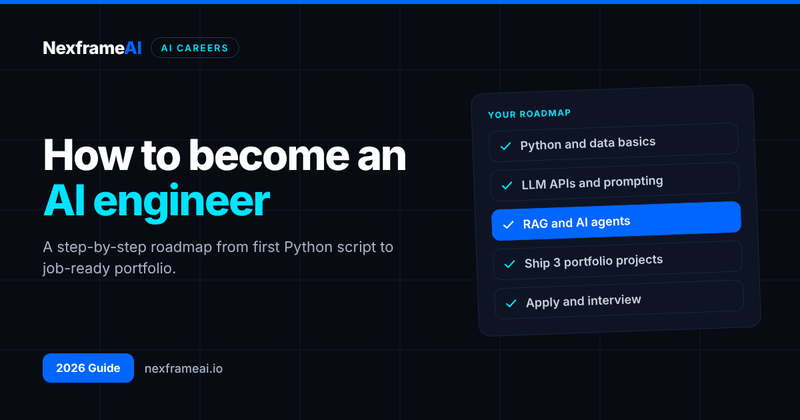
The full path is mapped out in how to become an AI engineer if that's where you're headed.
How to Learn AI Skills Free or Cheaply From Nigeria
You don't need to spend hundreds of thousands of naira. A sensible plan mixes free courses, daily practice on real tasks and one or two visible projects.
Free and low-cost courses worth considering
Course terms change often, so check each provider's page before you enrol. As of late 2026:
Elements of AI: a free, non-technical introduction to what AI is and isn't. Good for building vocabulary.
Anthropic Academy and OpenAI Academy: both companies publish learning material on using their tools, including AI fluency and building with their APIs. Certificate terms vary by course.
Microsoft's Generative AI for Beginners: a free, open course aimed at people who want to build. It's better as portfolio evidence than as a certificate.
Hugging Face Learn: free technical courses on models, agents and related topics, with certificates on some tracks.
Google AI Essentials: a short course on Coursera. It's usually paid, though Coursera has historically offered financial aid. Apply if the price is a barrier.
3MTT: the Federal Government's Three Million Technical Talent programme has run AI and data science tracks with partners. Intakes open and close, so check the official portal and be wary of anyone charging a "registration fee" to get you in.
Our AI knowledge test is a quick way to see where your gaps are before you choose.
Keep data costs down
Video-heavy courses eat data. Download lessons on Wi-Fi where you can, prefer text-based courses, and practise on free tiers first. If you do decide to pay for one tool, a single subscription such as ChatGPT Plus at $20 a month works out at roughly ₦27,000 to ₦28,000 a month at ₦1,350 to ₦1,400 to the dollar (an estimate; check the current rate and any card charges). For most learners, free tiers are enough for the first two months.
Practise on your real work
The fastest way to build AI skills is to use them on tasks you already do: lecture notes into practice questions, WhatsApp replies for a shop, summaries of meeting notes. Keep a simple log: the task, the prompt, what went wrong, what you fixed. That log becomes your evidence.
How to Show AI Skills on Your Resume
Listing "ChatGPT" under skills tells a recruiter almost nothing. Evidence works.
Put AI inside your achievement bullets
Instead of a skills list, show outcomes. Compare these:
Weak: "Proficient in AI tools."
Strong: "Built an AI-assisted workflow to summarise 40+ weekly customer messages into a priority list, cutting response time from two days to same day."
Our resume bullet points workflow walks through turning tasks into measurable achievements, and the free resume bullet checker helps you test them.
Match the job description's wording
Applicant tracking systems and recruiters scan for the terms in the posting. If the job asks for "AI literacy" or "experience with Microsoft Copilot", use that phrasing where it's honest. Our free skills gap checker compares your skills against a role. If you're building or updating your CV, Nexframe Resume can help you write tailored bullets and then run the result through its free ATS checker.
Add a small portfolio
One or two short case studies beat ten certificates. A page with "Problem, what I did with AI, what I checked, result" is enough. Technical candidates should link a GitHub repo with a working demo.
Be ready to talk about it
Interviewers increasingly ask how you use AI. Prepare a 60-second story about one workflow, including a time the AI got something wrong and you caught it. It can fit your opening answer too, and answering "Tell me about yourself" shows how.
Worked Example: Chiamaka Builds AI Skills for a Marketing Role in Enugu
Chiamaka (an illustration) is a 24-year-old graduate in Enugu applying for marketing assistant roles, including remote roles with Lagos agencies. She has no AI qualifications and a tight budget.
Weeks 1 to 2: foundations. She completes Elements of AI on her phone, mostly on campus Wi-Fi, and reads one prompting guide. Cost: data only.
Weeks 3 to 6: practice on real tasks. She offers to help a friend's skincare shop on Ogui Road with social media. Using the free tier of an AI assistant, she drafts a month of captions, writes product descriptions and summarises customer DMs into common questions. She logs every task and every mistake, including the time the AI invented a "dermatologist-approved" claim she had to remove.
Weeks 7 to 8: proof. She writes two one-page case studies. One shows the content calendar she built and the engagement the shop saw over a month (she reports the real numbers, not estimates). The other shows her checking routine for product claims.
Resume update. Her new bullet reads: "Planned and produced four weeks of Instagram content for a local skincare brand using AI-assisted drafting, with a manual claims check on every post; follower engagement rose over the month." She tailors it for each role and adds a portfolio link.
Total spend over two months: roughly ₦15,000 to ₦20,000 in data (an estimate, depending on network and plan). In interviews, she stops saying "I know ChatGPT" and starts describing her workflow. That's the shift that gets callbacks.
Common Mistakes to Avoid
Collecting certificates without projects. A certificate shows you watched something. A project shows you can do it.
Listing tools instead of outcomes. Tool names date quickly. What you achieved doesn't.
Trusting output without checking. One fabricated figure in a work sample can end your chances. Verification is the skill employers prize most.
Pasting private data into chatbots. Never put employer or client data into a public AI tool without permission.
Paying for expensive "AI bootcamps" too early. Free courses plus practice will take you a long way. Be especially careful with programmes that promise guaranteed jobs or foreign placements.
Final Thoughts
The AI skills employers want in 2026 are less exotic than headlines suggest: clear prompting, careful checking, repeatable workflows and honest communication, plus APIs, retrieval and evaluation for technical roles. Start this week, for free, on tasks you already do, then put the evidence where recruiters will see it.
Frequently Asked Questions
What are the most in-demand AI skills in 2026?
For most jobs: AI literacy (using AI tools for everyday work), prompting, checking output for accuracy and building repeatable AI-assisted workflows. Technical roles add AI APIs, retrieval-augmented generation, evaluation and AI security. Reports from LinkedIn, PwC and the World Economic Forum all show this demand growing faster than the job market overall.
Do I need to learn coding to get AI skills employers value?
No. Most employers asking for AI skills want people who can use AI well in their existing role, not build models. Coding becomes important only if you're aiming at engineering or data roles. Our guide to AI careers without coding covers roles where non-technical AI skills are the main requirement.
How long does it take to learn AI skills?
The basics of prompting and verification take two to four weeks of regular practice. Being able to describe real workflows in an interview usually takes one to two months. Technical skills such as RAG and evaluation take several months alongside programming.
Are free AI certificates worth putting on my resume?
They help a little, especially for entry-level roles, but carry less weight than evidence of real work. List one or two, then focus on achievement bullets and a small portfolio.
How do I learn AI skills in Nigeria without spending much?
Start with free courses such as Elements of AI or the provider academies, and check the official 3MTT portal for government-backed intakes. Use free tiers of AI tools, download lessons on Wi-Fi to save data, and practise on real tasks. Never pay "registration fees" to agents who claim to get you into free programmes.
Which AI tools should I learn first?
Pick one general assistant (such as ChatGPT, Claude or Gemini) and learn it well, plus the AI features in your office suite. Employers care more about how you use a tool than which one you chose.
How do I prove AI skills in a job interview?
Tell a short story about one workflow: the problem, how you used AI, what you checked, what went wrong and the result. Honesty about AI's limits often impresses more than claiming it does everything.
Comments (0)
Sign in to post a comment.
- Be the first to comment.