Thank You Email After an Interview: An AI Workflow
Write a thank you email after an interview with AI: capture notes, send within 24 hours, personalise for each panel member and follow up if you hear nothing.
- Time to complete
- 30 to 45 minutes per interview (10 minutes for notes, 20 to 30 for drafting and checking)
- Difficulty
- Beginner
- Tools needed
- An AI chatbot (ChatGPT, Claude or Gemini)your interview notesthe job descriptionyour email account
A good thank you email after an interview is short, sent within 24 hours and specific to the conversation you actually had. AI can help you write it in minutes, but only if you feed it real notes. Otherwise you get the same polished, forgettable message every other candidate sends.
This workflow takes you from the moment you leave the interview room (or close the Zoom call) to a sent email for each interviewer, plus a calm follow-up plan if the company goes quiet. You will get copy-paste prompts, three example emails and a worked example of a panel interview at a Lagos fintech.
A thank you email will not rescue a weak interview. What it does is remind them who you are, show professionalism and give you one more chance to connect your strengths to their problem.
What You'll Need
- Your interview notes, ideally written within an hour of the interview (Step 1 shows how).
- The job description, so the AI can link your message to what the role needs.
- Interviewers' names and email addresses. Check the invitation email, your calendar invite or ask the recruiter.
- An AI chatbot. Free versions of ChatGPT, Claude or Gemini are fine.
- Your email account, with a professional signature (full name, phone number, LinkedIn URL).
Step 1: Capture Your Interview Notes Within an Hour
Memory fades fast after a stressful panel. Within an hour, record a voice note or type answers to these questions:
- Who interviewed you? Name, title and what each person seemed to care about.
- What was the most interesting thing said about the role, team or company?
- Which question did you answer well? Which one could you have answered better?
- Did anyone mention a current challenge, project or goal?
- What are the next steps and timeline they gave?
If you recorded a voice note, use this prompt to tidy it:
Below is a rough voice-note transcript of my thoughts right after a job interview for [job title] at [company]. Organise it into:
1. Each interviewer: name, role, topics they focused on
2. Specific moments worth referencing in a thank you email
3. Any question I answered weakly, and what I wish I had said
4. Next steps and timeline they mentioned
Do not invent anything that is not in my notes. Mark gaps as [unknown].

Transcript:
[paste]
Checkpoint: You have a short note with each interviewer's name and at least one specific moment from your conversation with each of them.
Step 2: Pick the Right Timing
Send your thank you email within 24 hours of the interview. Same-day is ideal if the interview was in the morning. If it ended late in the evening, send it the next morning between 8am and 10am, when it is more likely to be read than buried.
A few timing rules:
- Friday interview: send the same day or Saturday morning at the latest, rather than waiting until Monday.
- Multiple rounds: send a short thank you after each round, to the people you met in that round.
- Recruiter-led process: if an external recruiter arranged the interview, thank the recruiter too and ask whether they will pass your note on.
- Public holidays: if the next day is a holiday in Nigeria, still send within 24 hours. Use scheduled send in Gmail or Outlook if you prefer it to land at a sensible time.
Checkpoint: You have decided the exact time you will send, and you have it in your calendar. If your week is chaotic, our time blocking with AI workflow shows how to protect slots like this.
Step 3: Draft With AI From Your Notes
Now give the AI your notes and the job description. The constraints in this prompt matter more than the request itself.
Write a thank you email after a job interview.

Role: [job title] at [company]
Interviewer: [name, title]
Job description (key parts): [paste 5 to 8 key requirements]
My notes on this interviewer: [paste from Step 1]

Rules:
- 100 to 150 words
- British English, warm but professional, not gushing
- Open with thanks and one specific reference to our conversation
- Connect one of my strengths to something they said they need
- End by saying I look forward to hearing about next steps
- No clichés like "I am confident I am the perfect fit" or "I would be thrilled"
- Do not invent any facts about me or the company
Read the draft out loud. If any sentence sounds like something you would never say, change it. For more on making AI-assisted emails sound human, see our guide to emails that don't sound like a bot.
Checkpoint: You have a draft under 150 words with at least one detail that could only come from your interview.
Step 4: Personalise for Each Interviewer
If you met a panel, send each person a separate email. Interviewers often compare notes, and identical messages look lazy.
I had a panel interview. Using the draft below as a base, write a separate version for each panel member.
Each version must:
- Reference something that person specifically asked or talked about
- Highlight a different strength of mine relevant to their area
- Stay between 80 and 130 words
- Not share more than one sentence with any other version

Panel members and notes:
[paste names, roles and notes]

Base draft:
[paste]
If you only have the email address of the HR contact, send one email to them that thanks the whole panel by name and politely asks them to pass on your thanks.
Checkpoint: Each interviewer has a distinct email. Put them side by side and make sure no two openings are the same.
Step 5: Add One Value Point
The strongest thank you emails add something small and useful. This is optional, but it is what makes yours stand out.
A value point might be:
- A short, clearer answer to a question you fumbled
- A link to a relevant piece of your work, such as a portfolio, GitHub repository or dashboard
- A one-line idea about a challenge they mentioned
In my interview, [interviewer] mentioned [challenge or question]. I answered [what I said].
Suggest two or three ways I could add one useful sentence to my thank you email that:
- Clarifies or strengthens my answer, OR offers a small relevant idea
- Does not sound like I am re-interviewing or lecturing them
- Is honest about what I actually know and have done
Keep it to one or two sentences. If you struggle to explain how experience from another field applies to this role, our guide to transferable skills shows how to frame it.
Checkpoint: Each email contains, at most, one value point that is accurate and relevant to that interviewer.
Step 6: Write a Clear Subject Line
Busy interviewers decide whether to open an email from the subject line. Keep it plain and searchable.
Good options:
- Thank you: [Job title] interview, [day]
- Thank you for today's conversation, [Your name]
- [Job title] interview: thank you
Avoid vague subject lines such as "Following up" or "Hello", and avoid exclamation marks. If you are replying to the thread that arranged the interview, keep the existing subject so it stays in context.
Checkpoint: Every email has a subject line that includes "thank you" and either the role or your name.
Step 7: Proofread and Send
Run one final check with AI, then check it yourself.
Proofread this thank you email. Check:
- Spelling of the interviewer's name and the company name: [correct spellings]
- Grammar and British English spelling
- Anything that sounds generic, desperate or over-familiar
- Any claim that is not in my notes
List problems first, then give the corrected version. Do not add new content.
Then check by hand: the correct name in the greeting, the correct job title, no leftover [brackets], and your signature. Send it from the same email address you used to apply.
Checkpoint: Every email is sent, and you have logged the date and time in your job search tracker.
Step 8: Follow Up If You Hear Nothing
If the interviewer gave a decision date, wait until two or three working days after it. If they gave no date, wait about one week. Then send one short, polite follow-up. Our follow-up email after application workflow covers the full timing system.
Write a short follow-up email (under 90 words) to [name] about my interview for [role] on [date].
They said they would decide by [date / "no date given"].
Tone: polite, patient, not pushy. Restate interest in one line and ask whether there is an update on timing.
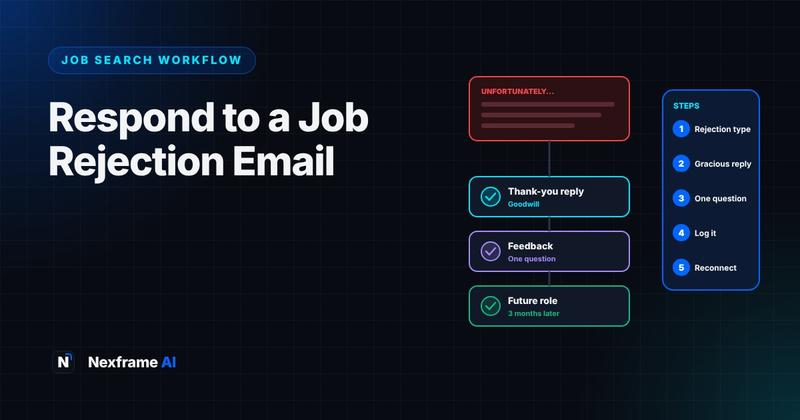
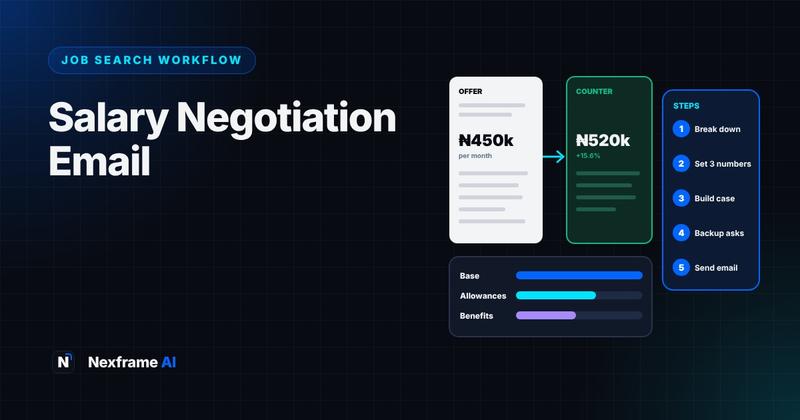
If the answer is a no, reply graciously. Our workflow for responding to a job rejection email shows how to keep the door open. If it is an offer, you may want our salary negotiation email workflow next.
Checkpoint: You have a reminder in your calendar for the follow-up date, and you have stopped refreshing your inbox.
Three Example Thank You Emails
These are illustrative; replace every detail with your own.
Example 1: One-to-one interview
Subject: Thank you: Customer Success Associate interview, Tuesday
Dear Mr Ojo,
Thank you for taking the time to speak with me today about the Customer Success Associate role. I especially enjoyed hearing how your team reduced response times by moving support onto WhatsApp.
Having handled more than 40 customer queries a day during my NYSC placement, I would welcome the chance to help the team keep that standard as you grow.
I look forward to hearing about the next steps.
Kind regards, Bisola Adeyemi
Example 2: With a value point
Subject: Thank you for today's conversation, Kelechi Nwosu
Dear Ms Bello,
Thank you for the interview this afternoon. Your question about how I would prioritise conflicting requests from sales and operations has stayed with me. My answer was rushed, so to add: I would agree a simple weekly priority list with both team leads and share it every Monday, so nobody is surprised.
I enjoyed learning about the Abuja expansion and would be glad to contribute to it.
Kind regards, Kelechi Nwosu
Example 3: Follow-up after silence
Subject: Re: Thank you: Operations Analyst interview
Dear Mr Hassan,
I hope you are well. I am following up on my interview for the Operations Analyst role on 3 November. I remain very interested in the position and would be grateful for any update on the timeline.
Kind regards, Musa Garba
Worked Example: A Panel Interview at a Lagos Fintech
Temitope (an invented example) is 26 and applied for a Product Analyst role at a mid-sized payments fintech in Yaba, Lagos. Her final round was a 45-minute panel with three people: the Head of Product, a senior engineer and an HR business partner.
Step 1. On the BRT bus home she recorded a four-minute voice note. The AI organised it into three clear sections. The Head of Product had talked about failed transfers during peak hours. The engineer had asked how she would work with developers on a data request. The HR partner had asked about her final-year project and why she wanted to move from banking to fintech.
Step 2. The interview ended at 4pm on Thursday. She scheduled her emails for 9am on Friday.
Steps 3 and 4. She drafted a base email, then asked for three personalised versions. The Head of Product's email referenced the failed-transfer problem and her experience analysing transaction exception reports at her bank. The engineer's email mentioned her habit of writing a one-page data request with clear definitions before asking developers for anything. The HR email focused on her motivation and thanked the HR partner for coordinating the day.
Step 5. She felt her answer on failed transfers was vague. For the Head of Product only, she added one sentence: she would start by splitting failures by bank and time of day to see whether a few partner banks drove most of the problem. The AI first suggested a longer paragraph with technical jargon; she cut it to one plain sentence.
Steps 6 and 7. Subject lines followed the pattern "Thank you: Product Analyst interview, Thursday". The proofreading prompt caught one problem: she had spelled the engineer's name wrongly.
Step 8. The HR partner had said decisions would come "within two weeks". She set a follow-up reminder for three working days after that. In the end, she received an invitation to a final chat with the CEO after nine days, and the Head of Product mentioned that her idea about splitting failures by bank was "exactly how we started looking at it".
Common Mistakes
Sending one email to the whole panel. Unless you only have one contact, write to each person separately.
Letting AI invent details. If your notes are thin, the AI will fill gaps with generic praise or, worse, made-up facts. Feed it real notes.
Writing too much. Over 200 words reads like a second cover letter. Aim for 100 to 150.
Waiting too long. A thank you sent four days later looks like an afterthought.
Re-arguing the whole interview. One value point is enough. Do not list every answer you wish you had given.
Sounding desperate. "I really need this job" weakens your position. Stay warm and confident.
FAQ
Is it necessary to send a thank you email after an interview?
It is not required, and it rarely decides an outcome on its own. But it is expected in many companies, costs little and keeps you memorable while decisions are being made.
How soon should I send a thank you email after an interview?
Within 24 hours. Same day is best if the interview was in the morning; next morning works if it ended late.
Can I use AI to write my thank you email?
Yes, as long as you give it real notes and edit the result. Interviewers can spot generic AI wording, so make sure each email includes details only you would know.
Should I send a thank you email after a virtual interview?
Yes. The same rules apply. You can also mention anything specific from the call, such as a document they screen-shared.
What if I don't have the interviewer's email address?
Ask the recruiter or HR contact for it, or send one email to them thanking the panel by name and asking them to pass it on.
How do I prepare better for the next interview?
Use your post-interview notes to spot weak answers, then practise. Our guide on how to pass an AI job interview covers AI screening interviews and a three-day prep plan.
Send It Today
A thank you email after an interview takes 30 minutes with AI and real notes. Capture what happened while it is fresh, write a separate email for each interviewer, add one useful point and send within 24 hours. Then set a follow-up reminder and get back to your search. If you are still lining up interviews, Nexframe Opportunities at opportunities.nexframeai.io lists checked jobs you can apply for next.
More in Job Search Workflows.