AI Taking Jobs? What Anthropic Found Inside Its Own Company
Anthropic says junior technical hires fell from 27% to 9% as AI agents took on more work. What the report found and what job seekers should do next.
The debate about AI taking jobs usually runs on predictions. This week, one of the world's leading AI companies published hard numbers from inside its own walls.
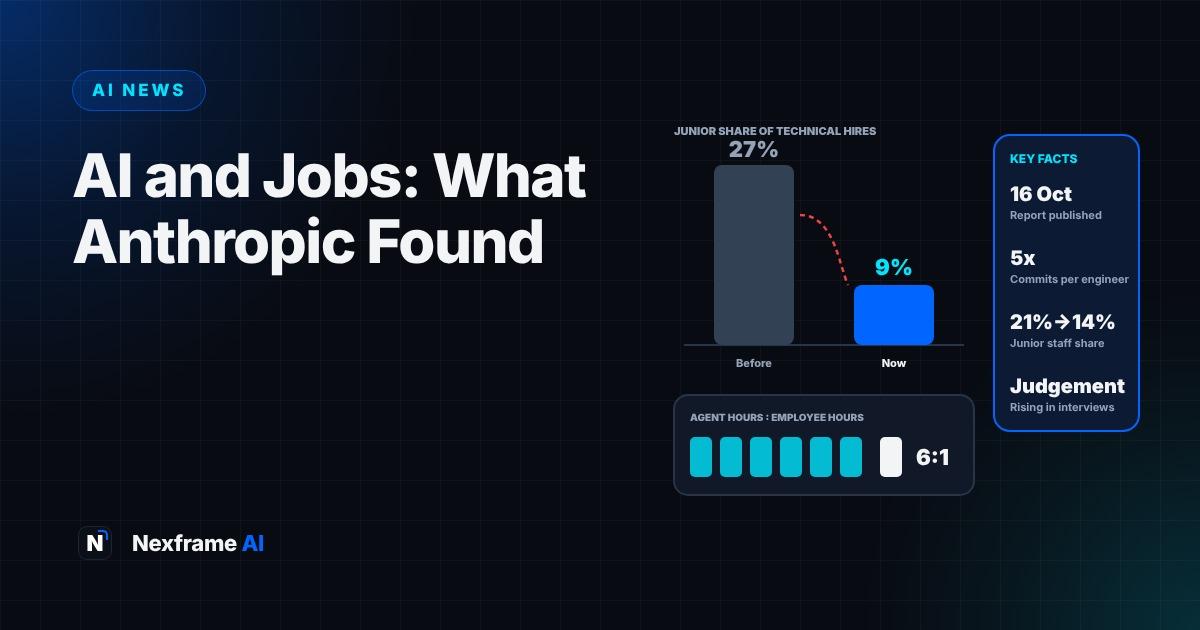
On 16 October 2026, Anthropic, the company behind Claude, released a report called "How employment is changing at Anthropic". Its researchers studied how the company's own workforce changed as staff started using AI agents for more of their work. The most striking finding: junior people made up 27% of technical hires before, and now make up just 9%.
Anthropic is not a typical employer. It builds AI, so its staff adopt new tools faster than almost anyone. But that's exactly why the report matters: it's an early look at what may happen elsewhere as AI tools spread. This article covers what the report found, what it doesn't prove and what students, graduates and job seekers in Nigeria can do about it.
What the report found
The report, written by Nathan Wilmers, Regina Catipon, Maxim Massenkoff and Peter McCrory, draws on Anthropic's internal hiring, work and survey data.
Fewer junior roles. Since early 2025, the share of junior employees in Anthropic's technical departments fell from 21% to 14%. Among new technical hires, the junior share dropped from 27% to 9%. Junior job postings fell especially sharply after December 2025. The report puts it plainly: "Anthropic has been hiring for a smaller share of junior technical positions."
AI agents doing more of the work. Total work hours by AI agents passed human work hours in March 2026. By August, interactive agent hours were about six times employee hours (using a standard 40-hour human work week).
Much more output per engineer. Code commits per engineer reached about five times their level six months earlier. In a comparison of 192 engineers who adopted coding agents and 74 who didn't, output rose after adoption. Code written by agents was no more likely to be reverted or deleted later than human-written code.
Technical headcount still grew. Even as junior hiring fell, Anthropic's technical headcount grew in absolute terms. Technical departments' share of total staff fell from 61% to 56%, while sales, finance and recruiting grew faster.
How the work itself changed
The report also shows that jobs didn't disappear so much as change shape.
From doing to managing. In an April 2026 staff survey, 20% of employees described their role shifting "from actually doing work to managing Claudes". Staff describe directing "fleets" of AI agents.
People became the bottleneck. About 80% of interactive Claude session time is spent waiting for a human to respond. For some non-technical teams, the output Claude produces in a week could take over half a work week just to read.
More "meta-work". Work such as building tools for agents and monitoring their pipelines rose from 10% to 22% of interactive sessions between autumn 2025 and spring 2026.
Non-technical staff started coding. Coding-focused agent sessions by non-technical staff rose from 2 a month in August 2025 to 90 in May 2026. A sales rep built a dashboard; a finance manager built an agent to review purchases.
More meetings, not fewer. Median meeting time rose 20% year on year, as people spent more time coordinating.
What employers now look for
Perhaps the most useful part of the report for job seekers is how Anthropic's hiring criteria shifted. The researchers studied interviewers' scorecards, not job adverts, from 2024 to 2026.
AI tool use matters more. Mentions of how candidates use AI tools roughly tripled for technical roles and quadrupled for non-technical roles.
Judgement and autonomy rose most. For technical candidates, "the single biggest increases were in comments on applicants' autonomy and judgment." Discussion of pure domain expertise shrank as a share of assessments.
Customer focus for non-technical roles. Comments on customer and mission orientation rose, while comments on basic execution skills fell.
In other words, being able to do a task is worth less when an AI agent can do much of it. Knowing what to do, checking whether it's right and taking ownership of the result are worth more.
What the report doesn't prove
The authors are careful about the limits of their findings, and it's worth being just as careful when reading headlines about the report.
Anthropic isn't a normal company. It builds AI and adopts tools faster than almost any employer. The authors say its practices can't be fully copied across the economy.
Correlation, not proof. Staff weren't randomly assigned to use agents. People planning big projects may have adopted tools for those projects.
Output isn't the same as quality. More commits doesn't automatically mean better products or business results.
The company grew fast. Business growth over the same period affects hiring, too.
Internal data. Much of the data comes from Anthropic's own systems, which outsiders can't check.
So this isn't proof that AI will cut junior jobs everywhere at the same speed. It is an early, detailed signal from the company closest to the technology, and it matches what Anthropic's chief executive and Google DeepMind's chief executive both said at Davos in January: that they were seeing early signs of AI reducing demand for junior roles.
What Anthropic says should happen next
The report ends with policy ideas. Anthropic recommends wider employee share ownership so workers benefit from AI gains, an early-warning system to spot jobs facing AI-driven change and moving affected staff into new roles internally. The authors also say government action on retraining and income support is needed, because internal measures don't fix reduced junior hiring.
What this means for job seekers in Nigeria
If you're a student, recent graduate or early-career professional, the report is a warning and a guide. Entry-level roles that consist mainly of routine tasks are the most exposed. The good news is that the skills employers now value are ones you can build deliberately.
1. Get genuinely good at AI tools. Not just chatting, but using AI to finish real work: drafting, analysing data, writing and testing code, researching. Anthropic's interviewers increasingly ask how candidates use AI. Be ready with specific examples. For developers, our guides to what agentic coding is and how developers use it in 2026 are good places to start.
2. Show judgement, not just output. Employers want people who can tell when AI is wrong, decide what's worth doing and own the result. In interviews and on your CV, describe decisions you made and problems you caught, not only tasks you completed.
3. Build evidence, not just certificates. With fewer junior roles, employers need proof you can deliver from day one. Projects, freelance work, open-source contributions and NYSC or SIWES achievements with real results all help. Put them front and centre on your CV with Nexframe Resume, and check it with the free ATS checker.
4. Look beyond pure technical roles. At Anthropic, sales, finance and recruiting grew faster than technical teams. Roles that combine domain knowledge, customer skills and AI fluency may be more resilient. Our guide to AI careers that don't require coding lists options.
5. Prepare for AI-era interviews. Expect questions about how you use AI, how you check its work and how you handle ambiguity. Our guide to passing an AI job interview covers what to expect.
6. Search smarter. With fewer junior openings, a focused search matters more. Use the daily AI job search routine to find real leads quickly, and browse graduate roles, internships and scholarships on Nexframe Opportunities.
What this means for employers
If you run a business or lead a team, the report raises a hard question: if AI handles more junior work, how will the next generation of senior people learn? Junior roles have always been where people build experience.
Some practical steps: keep hiring some junior staff and pair them with AI tools and mentors, redesign entry-level roles around checking, judgement and customer work, and train existing staff to work alongside agents. Our guide to the rise of AI employees explores how businesses are approaching this.
Worked example: updating a graduate CV for AI-era hiring
Samuel finished a computer science degree in Ogun State and completed NYSC at a logistics company. His CV listed tasks: "Wrote Python scripts", "Assisted with database management", "Created reports for management."
Based on what Anthropic's interviewers now look for (AI tool use, judgement and ownership), he rewrites three bullet points:
Before: "Wrote Python scripts." After: "Built a Python tool with an AI coding assistant that matched delivery records to invoices, cutting weekly reconciliation from 6 hours to 1; reviewed and tested every change before release."
Before: "Assisted with database management." After: "Spotted duplicate customer records causing failed deliveries, proposed a clean-up plan to my manager and led the fix across 4,000 records."
Before: "Created reports for management." After: "Used AI to draft weekly performance reports, then checked every figure against source data; caught two errors in automated totals before they reached directors."
Each new bullet shows a result, shows he uses AI and shows he checks AI's work and owns decisions. In interviews, he prepares one story about a time AI got something wrong and how he caught it.
That's the shift the report points to: being able to do a task matters less than showing good judgement about what to do and whether it's right.
FAQ
Is AI taking jobs?
Evidence so far shows AI is changing jobs and reducing demand for some junior roles, especially routine technical work. Anthropic's own report found junior technical hires fell from 27% to 9%, though the company says its experience can't be applied to every employer.
What did Anthropic's employment report find?
It found fewer junior technical hires, AI agents logging about six times as many work hours as employees by August 2026, about five times more code per engineer and a shift in hiring towards judgement, autonomy and AI tool skills.
Which jobs are most at risk from AI?
Entry-level roles made up mainly of routine, well-defined tasks are most exposed. Roles that need judgement, customer relationships and domain knowledge combined with AI skills appear more resilient.
Will AI take my job?
It depends on how much of your work is routine and how well you use AI. People who use AI to do more, check its work and make good decisions are in a stronger position than those who avoid it.
How can graduates in Nigeria prepare?
Build real AI skills, gather proof of results through projects, internships and NYSC, practise explaining your judgement in interviews and look at roles that mix technical, business and customer skills.
Did Anthropic lay people off because of AI?
The report doesn't describe layoffs. Technical headcount grew overall, but the company hired a much smaller share of junior technical staff.
Comments (0)
Sign in to post a comment.
- Be the first to comment.