Google Renames NotebookLM to Gemini Notebook
Google renamed its popular research tool NotebookLM to Gemini Notebook, adding native code execution and deeper ties to its Gemini AI lineup. Here is exactly what changed, who is affected, and what to expect next.
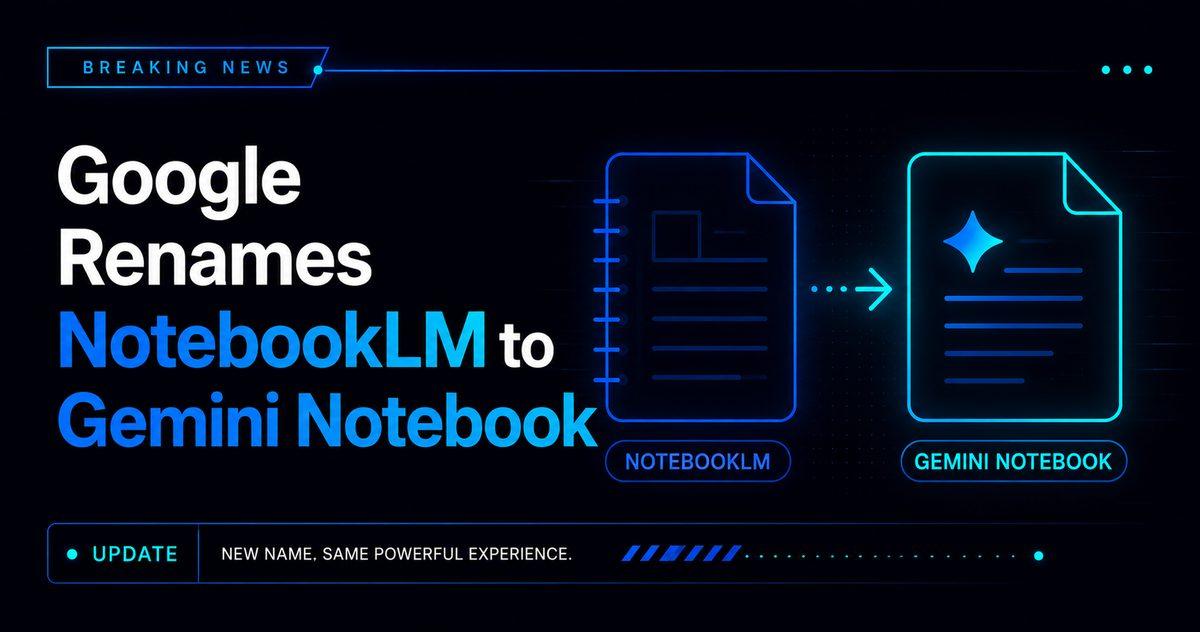
Google renamed its widely used research tool NotebookLM to Gemini Notebook on July 16, 2026, folding one of its fastest growing AI products fully into the Gemini brand. The rename came with a new blue and purple logo and, more importantly, a genuinely new capability, native code execution that lets users run real data analysis directly against their own uploaded documents. The change affects a large user base immediately. Google says the tool now has more than 30 million individual users and is used inside over 600,000 organizations, spanning students, researchers, and business teams who rely on it daily. This matters because it signals how deeply Google is consolidating its AI products under one brand, and because the new features point toward tighter integration between personal research tools and Google's core search product. Existing users keep their notebooks and links without any disruption, but anyone tracking how Google structures its AI lineup should pay attention to what this rename actually unlocks.
What Happened
Google renamed its AI research tool NotebookLM to Gemini Notebook on July 16, 2026. The announcement came directly from Google in a blog post written by Josh Woodward, Vice President of Google Labs, and the change rolled out immediately across the product's interfaces.
The tool itself has not changed in any fundamental way. It runs at the same web address, keeps the same core notebooks and Audio Overviews feature, and every shared link or existing notebook continues to work exactly as it did before the rename. What changed is the name, a new blue and purple logo matching Google's broader Gemini branding, and a set of new capabilities rolling out alongside the announcement.
This is not the first time Google has folded a standalone AI product into the Gemini name. The company took the same approach when it renamed its Bard chatbot to Gemini back in February 2024, and NotebookLM itself has already been through one earlier name change, launching at Google I/O in 2023 under the working title Project Tailwind before becoming NotebookLM.
Why It Matters
The rename itself is mostly cosmetic, but the timing and the added features point to something bigger. Google has been steadily pulling its AI products under one unified Gemini brand for months, and this move brings one of its most successful standalone tools fully into that structure.
Scale is a big part of why this matters. Gemini Notebook, as it is now called, has more than 30 million individual users and is used inside over 600,000 organizations, according to Google. A rename at that scale is not a minor internal decision, it directly touches how a very large number of people and businesses already work every day.
The bigger picture here connects to Google's broader strategy of building AI products that act more like agents than simple chat interfaces. That direction is visible across the company's other recent AI releases, including its work on faster, more capable models built for agentic tasks, covered in this related piece on Google's Gemini 3.5 Flash and its bigger bet on AI agents.
The Details
Alongside the new name, Google introduced a feature it calls a secure cloud computer, built into every notebook. This gives Gemini Notebook the ability to natively write and execute code against a user's own uploaded sources, enabling real data analysis, like pivot tables or statistical summaries, without needing to leave the app or move data anywhere else.
Google also added new output formats to the tool, including the ability to export notebooks as JSON files and Microsoft PowerPoint presentations, expanding what people can actually do with the research and summaries a notebook generates.
The rollout for these new capabilities is staggered by account type. Google AI Ultra subscribers and Workspace business customers with AI Ultra Access or AI Expanded Access got access starting the day of the announcement. Google AI Pro users on the web are expected to get access in the coming weeks.
Google confirmed that Gemini Notebook remains a standalone product for now, rather than being folded directly into the main Gemini chatbot. The company said notebooks will continue to sync across the standalone app and the broader Gemini app, a connection that was already fully integrated back in April 2026. Google also confirmed plans to bring notebooks into AI Mode inside Google Search soon, which would let users pull their own research and sources into search powered AI answers.
Who Is Affected
Students and researchers who already rely on the tool to organize notes, summarize documents, and generate audio overviews of their material will see the name and logo change first, with the underlying experience staying largely familiar in the short term.
Businesses and Workspace customers get the most immediate functional upgrade, since the new code execution feature is rolling out to Google AI Ultra and Workspace business accounts before reaching web based Pro subscribers. Teams doing data analysis directly from uploaded documents stand to benefit the most from this change.
Developers and power users who have built workflows or browser extensions around NotebookLM should not need to make any changes right away, since the website address and interface behavior remain the same even with the new name attached.
Anyone comparing AI research tools for learning or work should factor this rebrand into their evaluation. This comparison of NotebookLM against ChatGPT for learning and research is still relevant here, since the tool discussed is the same product now operating under the Gemini Notebook name.
What People Are Saying
Google framed the change as a natural next step for a product that has grown well beyond its original scope. In its announcement, the company pointed to the tool's growth from an experimental research helper into something used by businesses for onboarding materials and by students for converting notes into audio and video summaries.
Tech coverage largely treated the news as part of an established pattern rather than a surprise. Multiple outlets noted that Google has now renamed several major AI products to fold them under the Gemini brand, following the same approach used when Bard became Gemini in 2024.
Some early reaction from technical communities focused less on the name and more on the new code execution feature, with commentary suggesting the ability to run code directly against personal, uploaded documents fills a real gap for people who want AI assistance grounded specifically in their own data rather than open web search results.
What Comes Next
Google has said the updated name and logo will continue rolling out across interfaces over the coming weeks, and mobile users may need to update their app to see the change reflected.
The planned integration of notebooks into Google Search's AI Mode is the most significant upcoming change to watch. Once live, it would let people bring their own research directly into search powered AI answers, blurring the line between a personal research tool and Google's core search product even further.
This kind of deepening integration between AI products and core services like Search is also likely to draw continued regulatory attention. Google has already faced pressure over how its AI features interact with publisher content, covered in this related piece on UK regulators forcing Google to offer publisher opt outs from AI search, and further blending of research tools into search based AI features is likely to keep that scrutiny active.
How to Take Action
Existing NotebookLM users do not need to do anything right away. Notebooks, shared links, and core functionality remain the same, and the transition to the new name and logo will happen automatically over the coming weeks.
Business and Workspace administrators do not need to take any specific action either, according to Google, though teams eager to use the new code execution feature should check their account tier, since Google AI Ultra and qualifying Workspace plans get access first.
Anyone curious about the new code execution capability should try uploading a data heavy document, like a spreadsheet or report, and testing whether the built in analysis tools meet their needs, particularly if their current workflow involves exporting data to a separate tool for that kind of analysis.
Readers who want the full announcement straight from the source can review Google's original blog post detailing the rename and the new features included with it.
Final Thoughts
The rename from NotebookLM to Gemini Notebook fits a pattern Google has followed before, folding a standalone product into its central Gemini brand once it proves its staying power. What makes this particular change worth watching is not the new name itself, but what came with it, native code execution against personal documents and plans to bring research notebooks directly into Google Search's AI Mode.
For a tool already used by more than 30 million people and 600,000 organizations, even a mostly cosmetic change carries real weight simply because of how many workflows already depend on it. Google's decision to keep the product standalone, rather than merging it fully into the main Gemini chatbot, suggests the company still sees value in a dedicated, source grounded research experience distinct from general purpose AI chat.
If you already use this tool regularly, the practical takeaway is straightforward. Nothing breaks and nothing requires immediate action, but it is worth testing the new code execution feature once it reaches your account tier, since it could genuinely replace a separate data analysis step many users currently handle elsewhere.
Frequently Asked Questions
Is NotebookLM still available, or is it gone? NotebookLM has not been shut down, it has simply been renamed. The same website, same notebooks, and same core features are all still there under the new name Gemini Notebook.
Will my existing notebooks and shared links still work? Yes. Google confirmed that existing notebooks and shared links continue to work exactly as before, with the rename applying only to the name, logo, and some added features.
What is the new code execution feature in Gemini Notebook? It gives each notebook access to a secure cloud computer that can write and run code against your uploaded sources, enabling data analysis like pivot tables or statistical summaries without leaving the app.
Who gets access to the new features first? Google AI Ultra subscribers and Workspace business customers with AI Ultra Access or AI Expanded Access got access starting the day of the announcement. Google AI Pro users on the web are expected to gain access in the coming weeks.
Is Gemini Notebook the same as the main Gemini chatbot? No. Gemini Notebook remains a standalone product focused specifically on research grounded in your own uploaded sources, separate from Google's general purpose Gemini chatbot, though the two are increasingly connected.
Why did Google rename NotebookLM in the first place? Google said the rename aligns the tool with its broader Gemini brand and drops the somewhat technical Language Model acronym, following the same branding pattern it used when Bard became Gemini in 2024.
Comments (0)
Sign in to post a comment.
- Be the first to comment.