Meta Muse Spark Open: What the Open-Weight Model Means
Meta released Muse Spark Open, an 816B open-weight AI model with a 1M-token context. Here is what it can do, who can use it and what the licence allows.
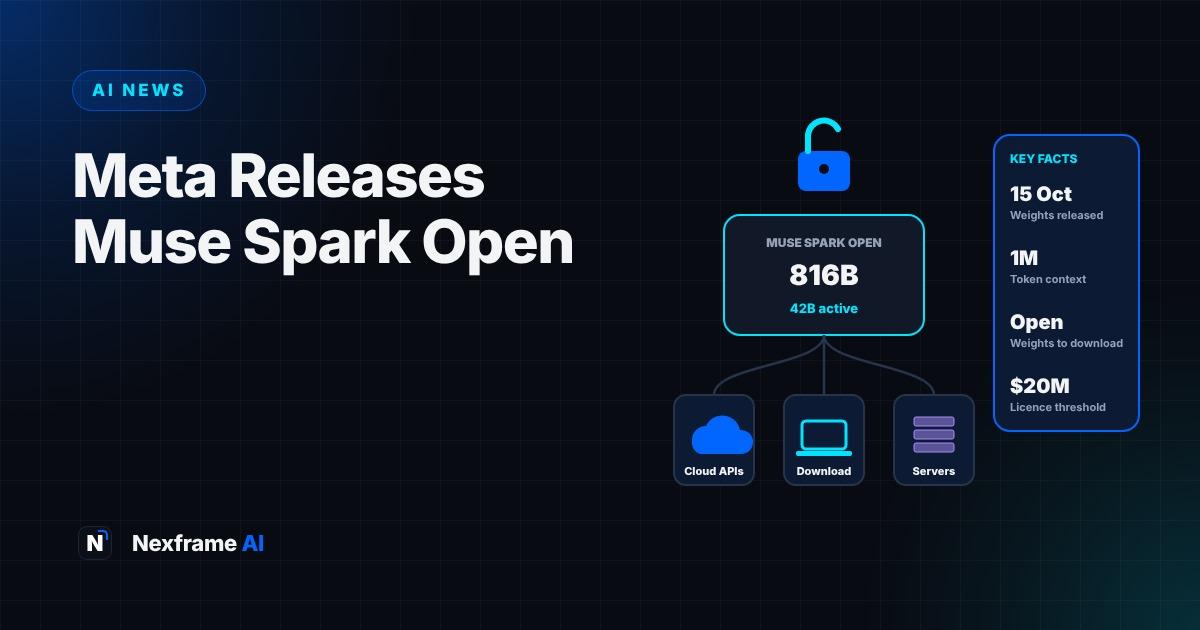
Meta has released Muse Spark Open, a large AI model whose weights anyone can download, run and modify. Meta published it on 15 October 2026 and calls it "the most capable US open-weight model to date".
The release matters because, for most of the past two years, the strongest open-weight models have come from Chinese labs such as DeepSeek, Moonshot (Kimi), Zhipu (GLM) and Alibaba (Qwen). Muse Spark Open gives developers a major US-built alternative they can host themselves or use through cheaper third-party providers.
This article explains what Muse Spark Open is, how it compares with other open models, what the licence actually allows and what it means for developers and startups in Nigeria.
What is Muse Spark Open?
Muse Spark Open is part of Meta's Muse family of models, the line that replaced Llama as Meta's main AI brand. It's an open-weight version of Muse Spark, built for coding and agentic work: long tasks, software engineering and multi-step reasoning where the model takes actions rather than only answering questions.
The headline specifications:
Size: 816 billion parameters in total, with 42 billion active for each token. It's a mixture-of-experts model, which means only part of it runs for each step, keeping it faster and cheaper than its full size suggests.
Context window: up to 1 million tokens.
Inputs: natively multimodal, so it can take in images and other media as well as text, and replies in text.
Reasoning levels: low, medium, high and xhigh, letting you trade quality for speed.
Meta also says the model received extra safety training because the weights are public, and that it met the release thresholds of Meta's internal safety framework.
What "open weight" means
Open weight is not the same as open source in the strict sense. With an open-weight model, you get the trained model itself, so you can run it on your own servers, fine-tune it on your data and build products on it. You don't necessarily get the training data or full training code, and the licence can still set conditions.
That's very different from closed models like GPT-6, Gemini 4 or Claude, which you can only use through the company's apps or API. Open weights give you three advantages:
Control: your data never has to leave your own servers if you host the model yourself.
Cost: you can shop around between hosting providers, or run it yourself at scale.
Customisation: you can fine-tune it for a specific job, language or industry.
The trade-off is that running a model this size yourself is expensive and technical, as the hardware section below shows.
How good is Muse Spark Open?
Meta's model card compares Muse Spark Open with other leading open-weight models. On Meta's own figures, at its highest reasoning level:
MCP-Atlas (tool use): 89.2, the highest score among the open models compared, ahead of Qwen3.8 (84.5) and GLM 5.3 (84.2).
Artificial Analysis Intelligence Index: 39, behind GLM 5.3 (45), Kimi K3 (44) and Qwen3.8 (40), but ahead of Mistral Large 4 (38).
Terminal-Bench 2.1: 76.4, behind GLM 5.3 (83.9) and Kimi K3 (85.0).
DeepSWE 1.1 (software engineering): 60, behind Kimi K3 (68) and GLM 5.3 (67).
The picture is clear: Muse Spark Open is very strong at using tools, which matters for agents that call APIs and work across apps, but the best Chinese open models still lead on general intelligence and coding tests. Meta also reports very strong resistance to jailbreak attempts in its own internal testing.
As always, treat vendor benchmarks with care. Many of these numbers are self-reported by each company using its own setup, and Meta says its full evaluation report is "available soon". Independent tests over the coming weeks will give a fairer picture. If you're comparing open models for coding, our news on Moonshot's Kimi K3 covers one of its main rivals.
Where you can use it
You don't need your own data centre to try Muse Spark Open. It's available in three main ways:
Hosted APIs: Baseten, Fireworks AI, Groq, Modal, Nebius, OpenRouter and Together AI. This is the easiest route for most developers. Prices vary by provider; Artificial Analysis puts the median at around $1.25 per million input tokens and $4.25 per million output tokens.
Cloud platforms: Hugging Face, Amazon SageMaker AI, Google Cloud Model Garden and Microsoft Foundry Models.
Self-hosting: with common inference engines including vLLM, SGLang, TensorRT-LLM, Hugging Face Transformers, llama.cpp and Apple's MLX.
To download the weights from Hugging Face, you have to fill in an approval form with your full legal name, date of birth and organisation.
What hardware you need
This is not a model you'll run on a laptop. According to Meta's model card, you need at least 700 GB of GPU memory using the compressed NVFP4 format, or about 2 TB at full BF16 precision.
Meta and Apple demonstrated it running on two Apple Mac Studios with M5 Ultra chips, each with 512 GB of unified memory, linked together. In the demo, the model fixed bugs, added features and built an open-source iOS app, and edited video in DaVinci Resolve. That's impressive, but it's still several thousand dollars of hardware.
For almost every developer in Nigeria, the realistic options are a hosted API or a cloud GPU rented by the hour. Self-hosting only makes sense for companies with strict data rules or very high volumes.
What the licence allows
Muse Spark Open uses Meta's Muse Model License. The main points:
You can use, modify, fine-tune, distil, distribute and sell the model and products built on it.
You must show a "Built with Muse Spark Open" notice in your product, documentation or website.
Large model-as-a-service providers (companies whose total revenue, including affiliates, exceeds $20 million in 12 months) must notify Meta and sign a separate agreement before offering the model through an API.
That threshold doesn't apply to internal use, research or using the model to power features inside your own product.
A usage policy lists prohibited uses.
For most Nigerian startups and developers, those terms are workable: you can build and sell a product on it for free, as long as you add the attribution and follow the usage policy. Read the full licence before launching a commercial product, and check how it fits with your company's own AI policy. Our AI policy template for small businesses is a good starting point.
What this means for developers and startups in Nigeria
More choice, lower prices. Every strong open-weight model adds competition between hosting providers. That tends to push prices down for everyone, including on closed models.
Data control for regulated industries. Fintechs, health startups and anyone handling sensitive customer data can host an open model in a region and setup they control, which can make data protection compliance simpler than sending everything to a third-party API.
Fine-tuning for local needs. Open weights make it possible to fine-tune for Nigerian English, Pidgin, Yoruba, Igbo or Hausa, or for a specific domain such as agriculture or legal documents. That's far harder with closed models. Our guide to using AI in Yoruba, Igbo, Hausa and Pidgin shows where today's models still fall short.
Strong tool use for agents. Muse Spark Open's lead on tool-use tests makes it worth trying for agents that call APIs, such as a WhatsApp assistant that checks order status or books appointments.
If you're building your first AI product, start small. Use a hosted API, test Muse Spark Open against one or two other models on real tasks and only consider self-hosting when you know it's the right fit. Our guides to building your first app with an AI API and securing AI features in your app cover the basics.
How to try it this week
Pick a host. OpenRouter is a simple way to test many models through one API key. Groq and Together AI also offer it.
Write 10 real test prompts. Use tasks from your actual product: a support reply, a data extraction job, a coding fix.
Run them on Muse Spark Open and your current model. Compare quality, speed and cost per task.
Test tool use. If you're building an agent, give it two or three real tools and see how reliably it calls them.
Check the licence fit before you ship anything to customers.
Worked example: hosted API or self-hosting?
Amaka is the technical lead at a Lagos health-tech startup that summarises patient intake forms for clinics. She's interested in Muse Spark Open because patient data is sensitive, and she wants to know whether self-hosting makes sense.
She compares three options:
Option 1: a hosted API such as OpenRouter or Together AI. No hardware, pay per token and live in a day. But patient data passes through a third-party provider, so she'd need to check each provider's data terms and where they process data.
Option 2: rented cloud GPUs. She'd need enough GPU memory for at least 700 GB in the compressed format, which means several high-end data-centre GPUs. That's a significant monthly bill even before engineering time, and it only pays off at high volume.
Option 3: buying hardware. The Mac Studio setup Meta demonstrated costs several thousand dollars before import duties, and it would need careful maintenance and backup.
Her startup processes a few thousand forms a month, so the volume doesn't justify options 2 or 3 yet. She chooses a hosted provider that offers a data processing agreement, removes names and phone numbers before sending forms to the model and keeps the full records in her own database. She'll revisit self-hosting if volumes grow tenfold or a large hospital client requires it.
The lesson: open weights give you the option to self-host, but for most small teams, a hosted API with careful data handling is the sensible first step.
What to watch next
Meta says a full evaluation report is coming soon, and independent benchmark results usually follow within weeks. Watch for smaller community versions that need less memory, fine-tuned versions for specific languages and jobs, and price changes as more hosting providers compete. If you plan to build on Muse Spark Open, also watch for any updates to the Muse Model License.
FAQ
What is Muse Spark Open?
Muse Spark Open is an open-weight AI model from Meta, released on 15 October 2026. It has 816 billion total parameters, 42 billion active, a 1-million-token context window and is built for coding and agent tasks.
Is Muse Spark Open free?
The weights are free to download under Meta's Muse Model License, but running the model costs money: either a hosted API that charges per token, or your own expensive hardware.
Can I use Muse Spark Open commercially?
Yes, with conditions. You must show a "Built with Muse Spark Open" notice and follow the usage policy. Large companies offering it as an API service, with over $20 million in revenue, need a separate agreement with Meta.
Can I run Muse Spark Open on my laptop?
No. It needs at least 700 GB of GPU memory in its compressed format. Most developers will use a hosted API instead.
How does Muse Spark Open compare with Kimi K3 and GLM 5.3?
On Meta's figures, Muse Spark Open leads on tool use but trails Kimi K3 and GLM 5.3 on general intelligence and coding benchmarks. Independent tests should give a clearer picture soon.
Is Muse Spark Open the same as Llama?
No. Muse is Meta's newer model family. Muse Spark Open is the open-weight version of Muse Spark.
Comments (0)
Sign in to post a comment.
- Be the first to comment.