Microsoft Ignite 2026: Seven New MAI Models Take On OpenAI on Price
At Ignite 2026, Microsoft AI launched seven new MAI models for coding, security, images, voice, healthcare and routing, and pitched them as cheaper alternatives to OpenAI and Anthropic. Here is what each one does and who can use it.
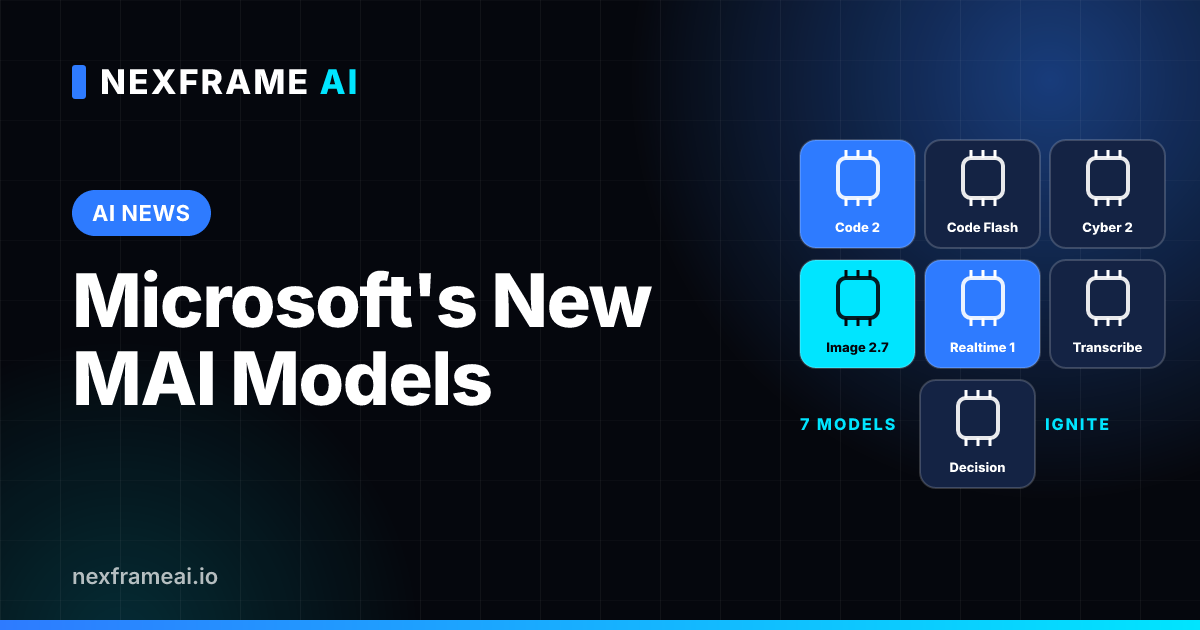
Microsoft launched seven new MAI models at its Ignite 2026 conference on 17 November, covering coding, cyber defence, image generation, live voice, clinical transcription and request routing. Microsoft AI, the company's in-house AI group led by Mustafa Suleyman, pitched them on a simple idea: close to the quality of the best models from OpenAI and Anthropic, at a fraction of the price. Two of the coding models are already showing up in GitHub Copilot, including, according to GitHub's changelog as reported, on the Free and Student plans.
This article explains what Microsoft announced, what each microsoft mai model does and costs, where you can use it, and what it means for developers, businesses, creators and readers in Nigeria who pay for AI in dollars. Where a claim comes only from Microsoft, we say so. Most of the quality comparisons below are Microsoft's own numbers and have not been independently tested.
What Happened
On stage at Microsoft Ignite 2026, Suleyman, chief executive of Microsoft AI, introduced the second wave of MAI models. The first wave of seven MAI models, including MAI-Thinking-1, arrived at Microsoft Build in June 2026, as we covered in our report on Microsoft's AI-first computing strategy at Build 2026. The Ignite launch is narrower and more practical. Instead of one giant general model, Microsoft announced a set of specialised models, each aimed at a particular job.
"We co-optimize quality and price together," Suleyman said, according to reports of the keynote. He closed with the line "Your IQ. Your Agents. Your Weights.", which points to the other big announcement: MAI Licensed Weights, a way for large organisations to customise an MAI model and run it in their own Azure environment.
Microsoft says all of the new models run on its own Maia 200 chips. That matters because owning the chips, the data centres and the models gives Microsoft more control over cost, which is the heart of its pitch.
The Seven Models at a Glance
| Model | What it does | Price (Microsoft) | Where available |
|---|---|---|---|
| MAI Code 2 | Everyday enterprise coding and front-end work | About 40% of GPT-6.1 Sol's price, per Microsoft | GitHub Copilot Pro, Pro+, Max, Business, Enterprise |
| MAI Code 2 Flash | High-volume routine code edits | About 65% of GPT-6 Luna's price, per Microsoft | GitHub Copilot, including Free and Student; limited preview in Microsoft Foundry |
| MAI Cyber 2 Flash | Agentic cyber defence | $0.10 input, $0.50 output per 1M tokens; 1M token context | Only inside Microsoft security products |
| MAI Image 2.7 and 2.7 Flash | Image generation and editing | About $34.82 per 1,000 images; Flash about $10.24 | Microsoft Foundry, fal, Genspark, OpenRouter, Vercel |
| MAI Realtime 1 | Live speech to speech conversation | From $0.01 per audio minute | Sign up through MAI Labs |
| Dragon Copilot Transcribe | Clinical transcription for healthcare | Not stated | Microsoft's Dragon Copilot healthcare tools |
| MAI Decision 1.1 | Routes requests to big models only when needed | $0.042 per 1M input tokens | Generally available, per Microsoft |
Why It Matters
The price war just got sharper
For the past few years, most people have thought of Microsoft's AI as OpenAI's AI delivered through Microsoft products. Ignite 2026 shows Microsoft building a serious line-up of its own and comparing it directly with models from OpenAI and Anthropic. Microsoft's headline claims are bold. It says MAI Code 2 delivers about 98% of GPT-6.1 Sol's coding quality at about 40% of the price, and about 96% of Claude Opus 5.5's quality at about 5% of its price. It says MAI Code 2 Flash matches GPT-6 Luna at 65% of the price, and that MAI Decision 1.1 is 79 times cheaper and 50 times faster than GPT-6.1 Sol for the routing job it does.
We cannot confirm these figures, and "98% of the quality" depends on how quality is measured. Still, the direction is clear. Microsoft is not trying to win on raw intelligence alone. It is arguing that most everyday work does not need the most expensive model, and that a cheaper model that is nearly as good will save businesses a great deal of money.
The relationship with OpenAI
Microsoft remains closely tied to OpenAI, and we are not going to guess at the details of their agreements. What we can say is what Microsoft did on stage: it benchmarked its models against OpenAI's and Anthropic's, and it put its own coding models into GitHub Copilot alongside other providers' models. The same week, OpenAI launched GPT-6.2 Astra and Sol, which we covered in our report on what GPT-6.2 Astra and Sol change for you. For customers, more competition at every price point is good news.
Specialised models are the trend
Several of these models do one narrow job: cyber defence, clinical transcription, routing. Instead of sending every request to a giant model, companies increasingly mix small, cheap models with larger ones and let a router decide, which is exactly what MAI Decision 1.1 does.
The Details
MAI Code 2 and Code 2 Flash
MAI Code 2 is aimed at everyday enterprise coding and front-end work. Microsoft says it is not tuned for science or for very long agentic work, so it is not meant to replace the top frontier models for the hardest jobs. MAI Code 2 Flash is a lighter model for high-volume routine edits, such as renaming, small refactors and repetitive changes.
According to GitHub's changelog as reported by TestingCatalog, MAI Code 2 is available in GitHub Copilot on the Pro, Pro+, Max, Business and Enterprise plans, and MAI Code 2 Flash is also available on the Free and Student plans. The report lists support in VS Code, Visual Studio, the Copilot CLI, JetBrains IDEs, Xcode and Eclipse. Code 2 Flash is also in limited preview in Microsoft Foundry, Microsoft's platform for building with models.
MAI Cyber 2 Flash
This model is built for agentic cyber defence, meaning AI that helps investigate and respond to security threats. It is priced at $0.10 per million input tokens and $0.50 per million output tokens, with a 1 million token context window. Microsoft says it scored 92.3% on the CyberGym-E2E benchmark, slightly ahead of GPT-6 Astra's 91.5%. You cannot buy it on its own. It runs only inside Microsoft's security products and will replace the model in Codename MDASH from mid-December.
MAI Image 2.7 and Image 2.7 Flash
MAI Image 2.7 is Microsoft's newest image model, with a cheaper Flash version. Microsoft points to a first place ranking for image editing on Artificial Analysis. Pricing works out at about $34.82 per 1,000 images for the standard model and about $10.24 per 1,000 for Flash. It is available on Microsoft Foundry and through third-party platforms fal, Genspark, OpenRouter and Vercel.
MAI Realtime 1
This is Microsoft's first live speech to speech model, meaning you talk to it and it talks back without converting everything to text first. Pricing starts at $0.01 per audio minute, and access is through a sign-up on MAI Labs.
Dragon Copilot Transcribe
Built on MAI Transcribe 2, this model handles clinical transcription, turning conversations between doctors and patients into notes. Microsoft says its transcription technology already handles 10 million patient encounters a month. It is aimed at healthcare organisations, not individuals.
MAI Decision 1.1
MAI Decision 1.1 is a routing model. It looks at each incoming request and decides whether a big, expensive model is really needed or whether a smaller one can handle it. It is generally available at $0.042 per million input tokens.
MAI Licensed Weights
Licensed Weights lets an organisation take an MAI model, customise it on its own data and run it inside its own Azure environment. Microsoft gave AT&T's custom 5G model as an example. It is offered through the Microsoft Frontier Company programme and Microsoft describes it as "coming soon". This is aimed at large enterprises with strict data rules, not small teams.
What It Means for You
If you are a developer
The most immediate change is in GitHub Copilot. If you are on a paid plan, you should see MAI Code 2 in the model picker. If you are on the Free or Student plan, MAI Code 2 Flash is reported to be available to you too, which gives you another option for routine edits. GitHub Copilot has used AI Credits since 1 June 2026, so check GitHub's own pages for how each model counts against your allowance.
A sensible approach is to try MAI Code 2 Flash for small, repetitive jobs and keep a stronger model for complex debugging or architecture decisions. A good low-risk test is our workflow on writing clear git commit messages with AI, since commit messages are short, frequent and easy to judge. If you are still deciding which coding tool to use at all, our comparison of Claude Code vs Cursor vs GitHub Copilot walks through the trade-offs.
If you run a business
Most small businesses will meet these models indirectly, through Microsoft 365 Copilot, GitHub Copilot or tools built on Microsoft Foundry. The bigger message for business owners is about cost. If Microsoft's claims hold up, the price of capable AI for routine work keeps falling. If you are weighing Microsoft's assistant against OpenAI's for everyday office work, our guide to Copilot vs ChatGPT compares the two in plain terms.
Teams building their own AI features should look at MAI Decision 1.1. Routing simple requests to cheaper models is one of the most reliable ways to keep an AI bill under control.
If you are a creator
MAI Image 2.7 is the model to watch. You may meet it on one of the third-party platforms listed above rather than directly from Microsoft. Treat Microsoft's editing ranking as a starting point and test it against the tools you already use. Our guide to the best AI image generators in 2026 explains what to compare, from prompt accuracy to text in images. Once you have your images, you can bring them into Nexframe Studio to build them into finished posts and edits.
If you are in Nigeria
For anyone paying for AI in dollars from Nigeria, price per task matters more than almost anything else, because every dollar costs more naira when the exchange rate weakens. Here are some rough illustrations at about ₦1,450 to US$1. Exchange rates move, so treat these as estimates only.
- Images. 1,000 images with MAI Image 2.7 at about $34.82 would cost about ₦50,500. The same number with Image 2.7 Flash at about $10.24 would cost about ₦14,800.
- Routing. 100 million input tokens through MAI Decision 1.1 at $0.042 per million would cost about $4.20, or roughly ₦6,100.
- Coding. Microsoft says MAI Code 2 costs about 40% of GPT-6.1 Sol. As an illustration only, if a small team spent $100 a month on a model at Sol's price, about ₦145,000, the same work at 40% would be $40, about ₦58,000, assuming Microsoft's figure holds for your workload.
Chidi, an invented example, runs a two-person web studio in Enugu building sites for local shops. He could use MAI Code 2 Flash in GitHub Copilot for routine edits, keep a stronger model for tricky bugs, and only pay for heavy usage when a project needs it.
The free route matters most of all. Students and developers on GitHub Copilot's Free or Student plans reportedly get MAI Code 2 Flash without paying anything extra, which removes the currency problem entirely for that use.
What to Watch Next
- Independent tests. Microsoft's quality and price comparisons are its own. Watch for independent benchmarks of MAI Code 2 and Image 2.7.
- MAI Cyber 2 Flash in MDASH. The model is due to replace the existing model in Codename MDASH from mid-December.
- Licensed Weights roll-out. Microsoft describes it as coming soon through the Frontier Company programme. Look for the first customers beyond AT&T.
- MAI Realtime 1 access. Watch how quickly access through MAI Labs widens and which apps adopt it.
- Responses from OpenAI and Anthropic. With Microsoft openly competing on price, expect pricing moves from the other big labs.
Final Thoughts
Microsoft Ignite 2026 was less about one dazzling model and more about a strategy. Microsoft is building a family of specialised MAI models, running them on its own chips, and selling them on the promise of near top-tier quality for much less money. If the numbers hold up in independent testing, that matters for anyone who pays for AI by the token, especially in markets like Nigeria.
The practical next step is simple. If you use GitHub Copilot, try the new MAI coding models on real but low-risk tasks and judge them on your own work, not on anyone's slides.
Frequently Asked Questions
What are Microsoft MAI models?
MAI models are AI models built in-house by Microsoft AI, the group led by Mustafa Suleyman. The first seven launched at Build in June 2026, and seven more arrived at Ignite on 17 November 2026, covering coding, cyber defence, images, voice, clinical transcription and routing.
Can I use MAI Code 2 for free?
According to GitHub's changelog as reported, MAI Code 2 is on paid GitHub Copilot plans (Pro, Pro+, Max, Business and Enterprise), while MAI Code 2 Flash is also available on the Free and Student plans. Check your Copilot model picker to confirm what your account shows.
Is MAI Code 2 better than GPT-6.1 Sol or Claude?
Microsoft says MAI Code 2 reaches about 98% of GPT-6.1 Sol's coding quality and about 96% of Claude Opus 5.5's, at a much lower price. Those are Microsoft's own figures. It also says MAI Code 2 is not tuned for science or very long agentic work, so the top models may still be better for the hardest tasks.
How much does MAI Image 2.7 cost?
Microsoft puts it at about $34.82 per 1,000 images, with Image 2.7 Flash at about $10.24 per 1,000. That is roughly ₦50,500 and ₦14,800 at about ₦1,450 to US$1, though exchange rates move. It is available on Microsoft Foundry, fal, Genspark, OpenRouter and Vercel.
What is MAI Licensed Weights?
It lets an organisation customise an MAI model on its own data and run it in its own Azure environment. Microsoft cited AT&T's custom 5G model as an example. It is offered through the Microsoft Frontier Company programme and is described as coming soon.
Does this mean Microsoft is moving away from OpenAI?
We would not go that far. Microsoft still works closely with OpenAI. What Ignite showed is that Microsoft now has its own competitive models and is willing to compare them openly with OpenAI's and Anthropic's on quality and price.
Comments (0)
Sign in to post a comment.
- Be the first to comment.