Gemini 4 Neon: Google's New Middle Model for Coding and Deep Work
Google has released Gemini 4 Neon, a model that sits between Carbon and Hydrogen for coding, documents and long agent tasks. Here is who can use it, what it costs in naira and what free users get.
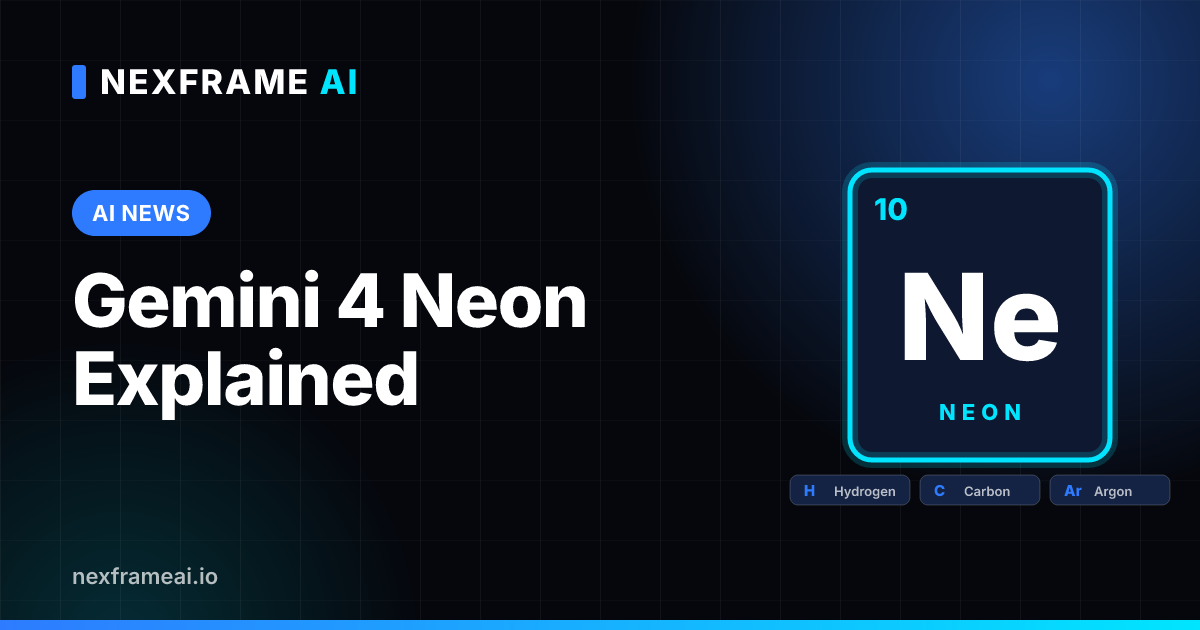
Google released Gemini 4 Neon on 18 November 2026, the fourth model in its Gemini 4 family in seven weeks. Google describes it as offering "frontier-level intelligence with fast end-to-end task completion across complex software engineering, knowledge work, and science workflows", and positions it between Gemini 4 Carbon, its strongest model, and Gemini 4 Hydrogen, its fast everyday model. Neon is available in the Gemini app for Google AI Pro and Ultra subscribers and through the paid Gemini API at $3 per million input tokens and $15 per million output tokens.
This article explains where Neon fits in the Gemini 4 line-up, what Google claims it can do, what it costs in naira, who in Nigeria can actually use it, and what free users get instead. Where a claim comes only from Google, we say so.
What Happened
The announcement came in a Google blog post by Koray Kavukcuoglu, senior vice president at Google DeepMind and Google's Chief AI Architect. Google's framing is a three-tier family: Carbon tackles the hardest long-horizon projects, Hydrogen handles fast everyday execution, and Neon "balances depth and efficiency".
Neon completes a busy autumn. According to ITdaily's timeline, Gemini 4 Argon arrived on 30 September, Carbon on 28 October (released first to cyber defenders, then widely on 10 November), Hydrogen on 12 November and Neon on 18 November. We covered each step in our reports on Gemini 4 Argon in the Gemini app, Gemini 4 Carbon for cyber defenders and Gemini 4 Hydrogen.
In the Gemini app, 9to5Google reports that the model picker now shows four choices: Auto, Everyday help (Hydrogen), Deeper analysis (Neon), and Code & complex work (Carbon). Neon replaces Argon in the app, although ITdaily reports that Argon remains available in the API.
Why It Matters
Neon arrived one day after OpenAI released GPT-6.2 Astra and Sol, which we cover in our report on GPT-6.2 Astra and Sol, and in the same week as Microsoft announced seven MAI models. The big labs are now competing hard on the middle of the market: models that are nearly as capable as the flagship but much cheaper to run.
That middle tier matters most for real work. Few people need the absolute strongest model for every task, but many need something better than a fast, light model for coding, long documents and multi-step jobs. Google is pitching Neon as that default for serious work, especially for AI agents that run for a long time and use many tools. If agents are new to you, our explainer on what an AI agent is covers the basics.
The Details
Pricing and context window
Google says Neon costs $3 per million input tokens, $15 per million output tokens and $0.15 per million cached input tokens, with a 1 million token context window. That makes the pricing picture a little unusual for the next few days.
| Gemini 4 model | Input per 1M tokens | Output per 1M tokens | Notes |
|---|---|---|---|
| Hydrogen | $1.50 | $7.50 | Fast everyday model |
| Neon | $3 | $15 | Balances depth and efficiency |
| Carbon (until 30 Nov) | $2 | $10 | Introductory price, per ITdaily |
| Carbon (from 1 Dec) | $4 | $20 | Standard price, per ITdaily |
| Argon (until 30 Nov, then $4/$20) | $2 | $10 | Still in the API, per ITdaily |
Until 30 November, Neon is actually the dearest Gemini 4 model per token, because Carbon and Argon are on introductory prices. From December, when those rise, Neon becomes 25% cheaper per token than Carbon. Google also says Neon has a 32% lower cost per task than Carbon at the "high" thinking level, partly because it gets work done with less back and forth.
Thinking levels
ITdaily reports that Neon offers four thinking levels: Low, Medium, High (the default) and Extra High. Higher levels let the model reason for longer before answering, which costs more tokens but can improve results on hard problems. For simple tasks, a lower level is cheaper and faster.
What Google claims about performance
All of these figures come from Google:
- Artificial Analysis Intelligence Index: 61 at the extra-high setting, which Google says ranks third.
- Vals Index: second place, at 70.9%.
- Artificial Analysis Coding Agent Index: first place, at 58.6.
- Agents' Last Exam: 75.8%.
- Zapier AutomationBench: first place, at 56.3%.
- The "lowest fabrication rate yet" in Google's internal testing in Antigravity, its agentic coding environment, and a 99.2% pass rate on agent honesty.
For context, Decrypt reported in its GPT-6.2 coverage that the same Artificial Analysis index scores Claude Fable 5.2 at 65 and GPT-6.2 Astra at 62, which fits Google's claim that Neon ranks third. The coding agent result is the most notable claim: if it holds up in independent testing, Neon would lead on the kind of long, tool-heavy coding work that agents do.
What Neon is built for
Google highlights several agent features. It says Neon handles long-running, tool-heavy tasks, makes fewer redundant file reads, compacts its context so long sessions do not run out of room, and can orchestrate several Hydrogen subagents working in parallel inside Antigravity. In the Gemini app, Google says Neon is better at working with spreadsheets, PDFs and photos, and can pull information from Gmail and Google Docs.
Google also says a cyber-defence version of Neon will go to trusted defenders through its Fairwind Program "in the coming days".
How Neon compares with OpenAI's new models
Because GPT-6.2 launched the day before, many readers will compare the two. On list prices per million tokens, Neon ($3 input, $15 output) sits between GPT-6.2 Sol ($2 and $10) and GPT-6.2 Astra ($8 and $40), according to each company's announcement. Both companies also claim their models need fewer tokens per task, so the real cost of a job can differ from what the list price suggests.
The positioning is similar too. OpenAI pitches Sol for everyday work and Astra for the hardest projects. Google pitches Hydrogen for everyday execution, Carbon for the hardest long-horizon work and Neon in between. In practice, Neon competes with the upper end of Sol's work and the lower end of Astra's. Neither company has published a head-to-head test against the other's new model, so treat any comparison you read this week with care.
Where it is available
According to Google, Neon is available in:
- the Gemini API paid tier (rolling out from 18 November);
- Google AI Studio for Pro and Ultra subscribers;
- the Gemini app model picker for Google AI Pro and Ultra subscribers;
- Google Antigravity for paid AI Pro and Ultra subscribers;
- Gemini Enterprise.
It is not available to free users. ITdaily reports that Hydrogen is the only Gemini 4 model on the free API tier.
What It Means for You
If you are a developer
Neon is worth testing if you build agents or coding tools. Here is a sample workload, with naira estimates at about ₦1,450 to US$1 (exchange rates move, so treat these as rough). Imagine an app handling 1,000 requests a month, each with 3,000 input tokens and 1,000 output tokens: 3 million input and 1 million output tokens a month.
| Model | Monthly cost | About in naira |
|---|---|---|
| Gemini 4 Hydrogen | $12 | ₦17,400 |
| Gemini 4 Neon | $24 | ₦34,800 |
| Gemini 4 Carbon (from 1 Dec) | $32 | ₦46,400 |
Run your own numbers with our AI token counter, and remember that thinking levels change real token use. A sensible pattern is to route simple requests to Hydrogen, which is also on the free API tier for prototyping, and send only complex or agentic work to Neon. To try Neon quickly, open Google AI Studio if you have a Pro or Ultra subscription, pick Neon, and run the same three or four real prompts you already use with your current model. Compare the answers, the time taken and the token counts shown. Keep the thinking level at the default High for a fair first test, then try Medium on simpler prompts to see whether quality holds at lower cost. If your work involves agents, test a long task that reads many files, because Google says Neon makes fewer redundant file reads on that kind of work.
If you use AI inside your daily coding routine, the habits in our workflow on writing git commit messages with AI apply whichever model you choose: give it small, focused inputs and check every output.
If you are a student or job seeker
On the free Gemini app, nothing changes. The free tier runs on Gemini 3.5 Flash Lite, which is fine for summarising notes, drafting a CV or practising interview answers. Neon's strengths show on long PDFs, data-heavy spreadsheets and research tasks, so it matters most for final-year projects and postgraduate work. Our guide to Gemini Pro for students explains how students can get Google AI Pro and use it well.
If you run a small business
If you already pay for Google AI Pro, select "Deeper analysis" in the Gemini app model picker for jobs such as reconciling a sales spreadsheet, reading a supplier contract or summarising a month of customer emails from Gmail. For quick replies and short drafts, "Everyday help" with Hydrogen is faster. If your business uses Google Workspace with Gemini Enterprise, ask your administrator whether Neon has been switched on.
If you are in Nigeria
To use Neon in the Gemini app you need a Google AI Pro or Ultra subscription. Google AI Pro has historically cost about US$20 a month, roughly ₦29,000, but check the price Google shows you in the app or Play Store, as local pricing and exchange rates change. Some Nigerian bank cards limit foreign currency spending, so check your card first.
Free users in Nigeria stay on Gemini 3.5 Flash Lite in the app. Developers can prototype on the free API tier with Hydrogen, then move to the paid tier for Neon. For most individuals, the free tier remains useful, and Neon only becomes worth paying for if you regularly work with long documents, spreadsheets or coding tasks that the free model struggles with.
What to Watch Next
- Independent benchmarks. Google's numbers put Neon first on a coding agent index. Watch for third-party tests to confirm or challenge that.
- The 30 November price change. When Carbon and Argon move to $4/$20, Neon's value case gets stronger. Check your API bills in December.
- Fairwind access. Google says a cyber-defence Neon will reach trusted defenders "in the coming days". Watch for details on who qualifies.
- Free tier changes. Neon is paid only. Whether Google brings a Gemini 4 model to free app users would matter most to readers in Nigeria.
- Argon's future. Neon has replaced Argon in the app. Watch whether Google retires Argon from the API too.
- Competition from OpenAI and Microsoft. With GPT-6.2 Sol at $2/$10 and Microsoft's MAI models priced aggressively, watch whether Google adjusts Neon's price.
Final Thoughts
Gemini 4 Neon fills the gap Google left between its fast and flagship models. On Google's own numbers it is strong at agentic coding and honest about what it does, and it is cheaper per task than Carbon. Those claims need independent checks, and the short-term pricing quirk means Carbon is cheaper per token until the end of November.
For readers in Nigeria, the practical picture is clear. Free users lose nothing by waiting. If you pay for Google AI Pro, try "Deeper analysis" on your hardest weekly task. If you build with the API, prototype on Hydrogen and test Neon where depth matters.
Frequently Asked Questions
What is Gemini 4 Neon?
Gemini 4 Neon is a Google AI model released on 18 November 2026. Google says it balances depth and efficiency, sitting between Gemini 4 Carbon, its strongest model, and Gemini 4 Hydrogen, its fast everyday model. It is aimed at coding, knowledge work, science and long-running agent tasks.
Is Gemini 4 Neon free?
No. Google says Neon is available to Google AI Pro and Ultra subscribers in the Gemini app, in AI Studio and Antigravity for paid subscribers, in Gemini Enterprise and on the paid Gemini API tier. Free Gemini app users stay on Gemini 3.5 Flash Lite, and ITdaily reports that Hydrogen is the only Gemini 4 model on the free API tier.
How much does Gemini 4 Neon cost on the API?
Google says Neon costs $3 per million input tokens, $15 per million output tokens and $0.15 per million cached input tokens. For a sample app using 3 million input and 1 million output tokens a month, that is about $24, or roughly ₦34,800 at ₦1,450 to the dollar.
How do I select Neon in the Gemini app?
If you have Google AI Pro or Ultra, open the model picker in the Gemini app. According to 9to5Google, Neon appears as "Deeper analysis", alongside Auto, "Everyday help" (Hydrogen) and "Code & complex work" (Carbon). Neon has replaced Argon in that menu.
Is Gemini 4 Neon better than GPT-6.2?
It depends on the task. Google says Neon ranks first on the Artificial Analysis Coding Agent Index and third on the Artificial Analysis Intelligence Index, where Decrypt reported GPT-6.2 Astra scoring 62 and Claude Fable 5.2 scoring 65. On price, Neon sits between GPT-6.2 Sol and GPT-6.2 Astra. Testing both on your own work is the best guide.
What is the context window of Gemini 4 Neon?
Google says Neon has a 1 million token context window, enough for very long documents or large codebases. It also says Neon compacts its context during long agent sessions so it can keep working without running out of room.
Comments (0)
Sign in to post a comment.
- Be the first to comment.