AI Voice Cloning Scams: How to Protect Your Family
AI voice cloning scams copy a loved one's voice to ask for money. Learn how they work, the warning signs, a family safe word plan and what to do if targeted.
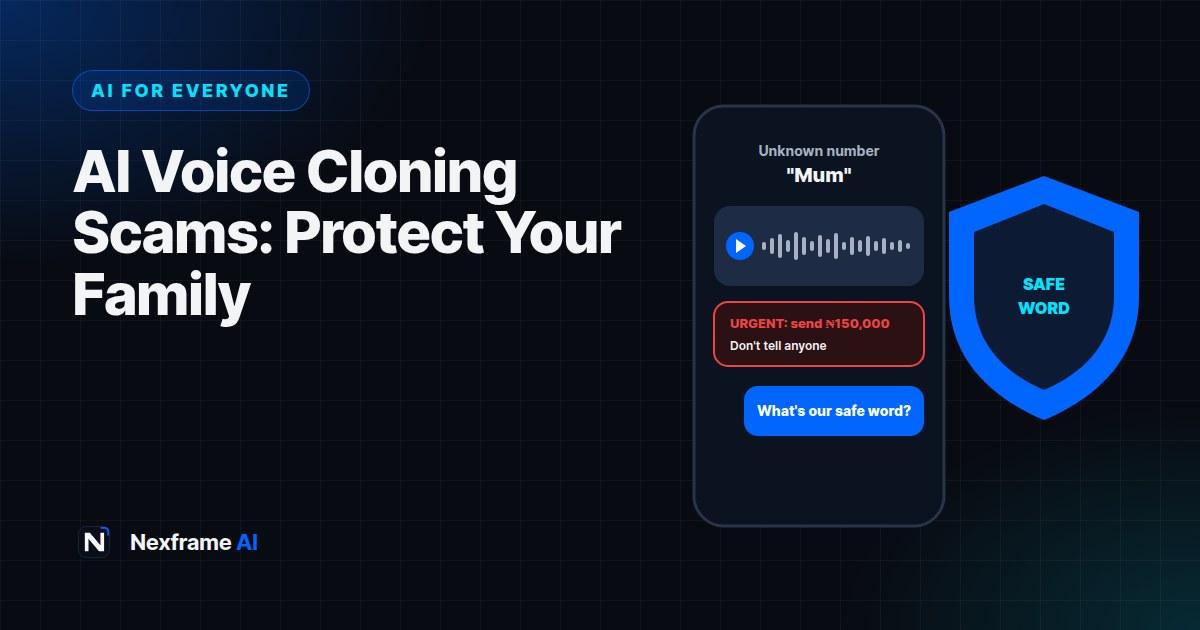
The phone rings late at night. It's your younger brother, and he sounds terrified. "Please, I've been arrested. I need money for bail right now. Don't tell Mum. Just send it to this account." The voice is his. The way he says your name is his. You're already opening your banking app.
But it isn't him. It's a scammer using AI to copy his voice from videos he posted online.
AI voice cloning scams are one of the most frightening uses of new technology, because they attack the thing we trust most: the voices of people we love. This guide explains how AI voice cloning scams work, the warning signs, a simple family safe word plan that stops them, and exactly what to do if you're targeted.
How Voice Cloning Scams Work
AI voice cloning tools can create a convincing copy of someone's voice from a short recording, sometimes just a few seconds of clear speech. The scammer types what they want the voice to say, and the AI speaks it in that person's voice.
A typical scam follows these steps:
Find a voice. Scammers collect audio from social media videos, voice notes, YouTube, TikTok or even a short phone call where they keep you talking.
Research the target. They look up family relationships, names, schools and workplaces on social media.
Clone the voice. They use AI tools to generate speech in that voice.
Create an emergency. An arrest, an accident, a kidnapping, a hospital bill or being stranded abroad.
Demand fast money. Usually by bank transfer, mobile money, gift cards or crypto, with pressure to act immediately and in secret.
The emotional shock is deliberate. Scammers want you to act before you think.
Common Versions of the Scam
The family emergency. A child, sibling or parent "calls" or sends a voice note saying they're in trouble and need money urgently.
The fake boss. A voice that sounds like a manager or company owner tells a staff member to make an urgent payment to a new account. Businesses have lost large sums this way.
The fake bank or official. A voice claiming to be from your bank, the police or a government agency asks for your account details, PIN or a one-time code.
The kidnapping hoax. A frightening call with a crying voice that sounds like a loved one, followed by a ransom demand. In most cases, the person is completely safe.
The WhatsApp voice note. A hacked or cloned account sends voice notes to contacts asking for a quick loan.
In Nigeria, many of these arrive through WhatsApp voice notes and calls from unfamiliar numbers, often claiming the person's phone is "spoilt" or "seized", which explains why they're using a different number.
Warning Signs
Even when the voice sounds right, the situation usually gives the scam away. Be suspicious if:
There's extreme urgency. "Right now", "in the next 10 minutes", "before it's too late".
You're told to keep it secret. "Don't tell Mum", "Don't call anyone".
It's a new number. "My phone was seized, use this number."
They want money in an unusual way: a stranger's bank account, gift cards, crypto or a mobile money agent.
They avoid questions or the call cuts off when you ask something personal.
The voice sounds slightly off: flat emotion, odd pauses or strange background noise.
They ask for codes or PINs. No legitimate person needs your one-time code.
One warning sign is enough to stop and verify. Real emergencies can wait the two minutes it takes to check.
The Family Safe Word Plan
The single most effective protection is a family safe word: a secret word or phrase that only your family knows, used to confirm identity in an emergency.
How to set it up
Choose a word or phrase that's easy to remember but impossible to guess. Avoid pet names, birthdays or anything posted online. Something like "blue garden chairs" works better than "Mummy's birthday".
Share it in person, not by text or social media.
Agree the rule: anyone asking for money or help in an emergency must say the safe word. No safe word, no money, no matter how real they sound.
Include everyone, especially older relatives and children who might be targeted or impersonated.
Change it if you think it has been shared or overheard.
How to use it
If you get an emergency call or voice note, calmly ask: "What's our safe word?" A real family member will know it. A scammer won't, and will often hang up or invent an excuse.
For workplaces, a similar approach works: agree that any urgent payment request, even from the boss, must be confirmed through a second channel, such as a call back on a known number. Our guide to writing an AI policy for your small business covers payment verification rules.
Verify Before You Act
If you don't have a safe word, or you're still unsure, verify another way:
Hang up and call back on the number you already have saved for that person. Don't use a number provided in the call or message.
Contact someone close to them, such as a spouse, roommate, colleague or school.
Ask a personal question only the real person would know, and that isn't on social media.
Check with the institution. If someone claims to be police, a hospital or your bank, find the official number yourself and call it.
Take your time. Scammers rely on panic. A short pause to breathe and verify is your best defence.
Reduce Your Family's Risk
You can't completely stop scammers finding voice recordings, but you can make it harder:
Review what's public. Long videos of family members speaking clearly, posted publicly, are ideal cloning material. Consider making personal accounts private.
Limit personal details online. Scammers use family names, schools and travel plans to make stories believable.
Be careful with unknown callers. If a stranger keeps you talking with odd questions, they may be recording your voice. You can simply hang up.
Secure WhatsApp and social accounts. Turn on two-step verification in WhatsApp and two-factor authentication elsewhere, so scammers can't take over accounts and send voice notes from them.
Never share one-time codes. Many account takeovers start with someone tricking you into sharing a code sent to your phone.
If You've Been Targeted or Scammed
If you've received a scam call, report the number and warn your family and friends, since scammers often target several people in the same circle.
If you've already sent money:
Contact your bank immediately. Ask them to stop or recall the transfer. Speed matters.
Report it. In Nigeria, you can report to the police and the EFCC, and to the platform used, such as WhatsApp. Elsewhere, report to your national fraud reporting service.
Secure your accounts. Change passwords and turn on two-factor authentication if you shared any details.
Save evidence. Keep the number, voice notes, messages and transaction details.
Beware of recovery scams. People offering to recover your money for a fee are often the same scammers.
Don't blame yourself. These scams are designed to fool smart, caring people. Talking about it helps protect others.
A Worked Example: The Voice Note From "Mum"
Chidinma, a university student in Enugu, receives a WhatsApp voice note from an unknown number. It's her mother's voice: "Chi, my phone fell into water, this is my new number. I'm at the hospital with your aunty and I need ₦150,000 for a scan urgently. Send it to this account, I'll explain later."
Warning signs: A new number, urgency, an unfamiliar account and no chance to talk properly.
Her response: Her family agreed a safe word last year. She replies, "Mummy, what's our word?" The sender stops replying.
Verification: She calls her mother's usual number. Her mother answers from home, safe and confused.
Next steps: Chidinma reports the number on WhatsApp, warns her family group and reminds everyone about the safe word.
The whole thing took five minutes, and she lost nothing.
Talk to Older Relatives and Children
Parents, grandparents and young people are often the most targeted. Have a short, calm conversation:
Explain that AI can copy voices, so a familiar voice isn't proof.
Share the family safe word and practise using it.
Agree that nobody sends money after an emergency call without verifying first.
Make it clear they won't be in trouble for checking, even if it turns out to be real.
Our guide to telling if an image or video is AI-generated is a helpful companion, since fake videos and photos are often part of the same scams.
Common Mistakes to Avoid
Trusting a familiar voice. AI can copy voices convincingly. Verify the situation, not the voice.
Acting under pressure. Urgency is the scammer's main weapon. Slow down.
Calling back the number provided. Always use a number you already know.
Sharing codes or PINs. No genuine family member, bank or official needs them.
Keeping it secret. Scammers ask for secrecy because talking to others exposes them.
What to Say When the Call Comes
In a moment of panic, it helps to have words ready. Save these responses somewhere you can find them quickly.
When someone claims to be a family member in trouble: "I want to help. What's our safe word?" If they can't answer: "I'm going to call you back on your usual number."
When someone claims to be from your bank: "I'll call the bank directly using the number on my card." Then hang up and do exactly that. Banks don't ask for PINs or one-time codes.
When someone claims to be police or an official: "Please give me your name and station. I'll call the station myself to confirm." Find the number independently.
When your boss asks for an urgent payment by voice note: "No problem, I'll confirm with you on your usual line before I make the transfer."
When an unknown caller keeps asking questions: "Sorry, I'm not comfortable continuing this call." Then hang up. You don't owe a stranger an explanation.
Settings That Help
A few phone and app settings reduce your exposure:
Turn on two-step verification in WhatsApp. It adds a PIN that stops scammers taking over your account even if they get a verification code.
Silence unknown callers. WhatsApp and many phones let you silence calls from numbers not in your contacts. You can still check voicemails and messages later.
Make social profiles private. Limit who can see your videos, voice notes and personal details.
Set up bank alerts. Instant transaction alerts help you spot unauthorised activity quickly.
Save official numbers. Keep your bank's official customer care number and close family members' numbers saved, so you never need to rely on a number given during a suspicious call.
These steps take ten minutes and make you a much harder target.
Final Thoughts
AI voice cloning scams are convincing because they use the voices we trust most. But they rely on panic and secrecy, and a simple plan defeats them: a family safe word, a habit of calling back on a known number, and a rule that no money moves without verification.
Set up your family's safe word this week. It takes five minutes and could save you from losing money and a great deal of distress.
For more ways to stay safe, see our guide to spotting AI-powered job scams. And if you use AI voices legitimately, for example in content, our guide to AI voiceovers for TikTok and YouTube covers how to clone your own voice safely and ethically.
Frequently Asked Questions
How much audio do scammers need to clone a voice?
Sometimes only a few seconds of clear speech. More audio usually produces a more convincing clone, which is why long public videos are attractive to scammers.
How can I tell if a voice is AI?
It can be very hard. Listen for flat emotion, odd pauses or unusual background noise, but don't rely on that. Verify through a safe word or by calling back on a known number.
What is a family safe word?
A secret word or phrase that only your family knows, used to confirm identity in emergencies. If someone asking for money can't say it, don't send anything.
Can scammers clone my voice from a phone call?
It's possible if they record enough of your voice. If an unknown caller keeps you talking with strange questions, it's fine to hang up.
What should I do if I sent money to a voice cloning scammer?
Contact your bank immediately to try to stop the transfer, report it to the police and relevant authorities, secure your accounts and save all evidence.
Are businesses targeted by voice cloning?
Yes. Scammers impersonate bosses or suppliers to request urgent payments. Businesses should require a second-channel check for any payment request.
Should I stop posting videos online?
Not necessarily, but consider making personal accounts private, limiting long clips of family members speaking and sharing fewer personal details.
Is voice cloning illegal?
Cloning a voice isn't automatically illegal, but using a cloned voice to deceive or defraud people is fraud in most places.
Comments (0)
Sign in to post a comment.
- Be the first to comment.