Free Business Plan Template with AI Prompts
Plan your business on one page with a fill in business model canvas, then write the full plan section by section with worked examples and an AI prompt for every part. Your answers save as you go and export to PDF.
What's inside
- 01How to use this template
- 02Part 1: Your one page business plan
- 03Part 2: The full business plan template
- 04Before you share your business plan
- 05Plain business plan outline
- 06Common business plan mistakes
- 07Keep going
A business plan does not need to be fifty pages long to be useful. It needs to answer a few hard questions clearly: who will pay you, why they will choose you, how you will reach them and when the money coming in will cover the money going out. This free business plan template walks you through those questions in order. Start with the one page canvas to get the whole idea on a single screen, then build the full plan section by section, with a worked example and an AI prompt for every part.
- A one page business model canvas you can fill in for any idea in about 30 minutes.
- An eleven section plan for small businesses and startups, from the executive summary to risks.
- A worked example for every section, based on a small meal prep delivery business in Lagos.
- A copy ready AI prompt for every section, so you can draft faster without letting the AI make things up.
How to use this template
- Fill in the one page canvas first. It forces you to name your customer, your offer and your costs before you write any long paragraphs. If a box is hard to fill, that is the part of the idea to test next.
- Work through the full plan in order. Each section explains what to write, shows an example answer and gives you a box to write your own. Your answers are saved in this browser, so you can stop and come back later.
- Use the AI prompts to draft, not to decide. Paste your own notes into the prompt, then check every claim and number the AI gives back. A plan full of guesses that sound confident is worse than a short plan that is honest.
- Save or share it. Use Save as PDF or Download my copy at the top of the page when you are ready to send the plan to a partner, a lender or an investor.
The example business used throughout is FreshBox, an imaginary meal prep service that delivers healthy weekday lunches to office workers in Lagos. Its figures are illustrations to show you the method, not market data. Replace them with numbers from your own research and quotes.
Part 1: Your one page business plan
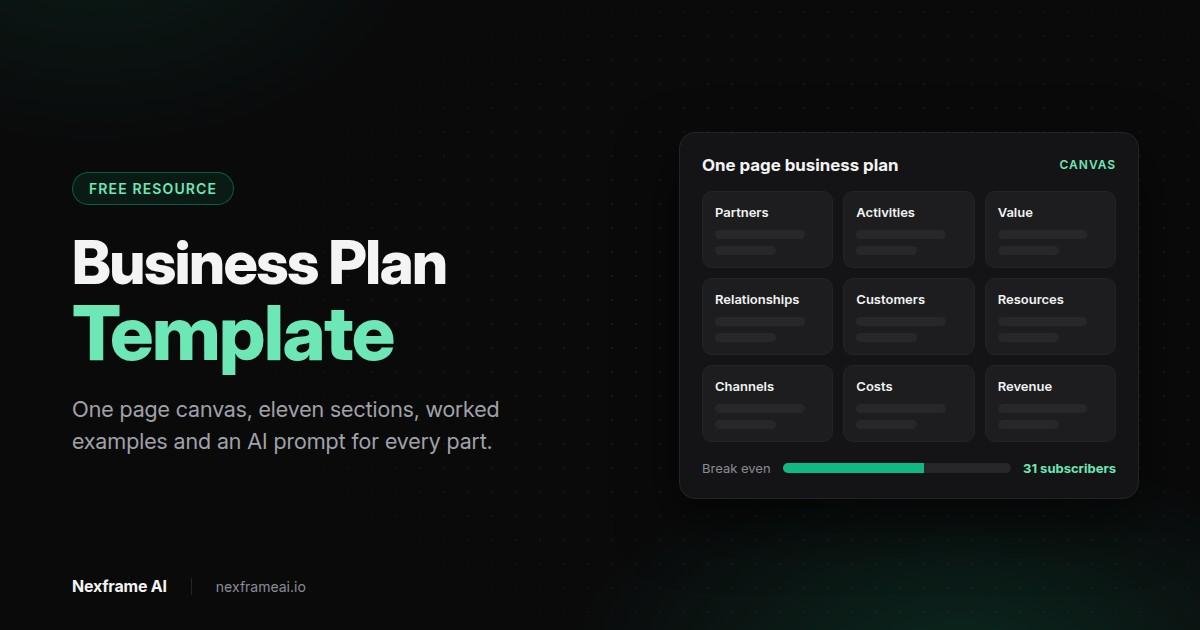
This is a business model canvas, a format created by Alexander Osterwalder that fits a whole business on one page in nine boxes. Lenders and investors rarely ask for it directly, but it is the fastest way to check that the parts of your idea fit together. Write short phrases, not essays. One or two lines in each box is enough.
Be specific about who they are and where they are. Everyone is not a customer segment.
Describe the problem you remove or the result you give, in the customer's words.
Cover both how people find you and how they receive what they buy.
Think about what makes someone buy a second and a tenth time.
Name the price and how often people pay.
Equipment, people, skills, licences and money.
The few jobs the business fails without.
Suppliers, platforms and people outside your team.
Split costs that grow with each sale from costs you pay every month regardless.
AI prompt: check my one page plan
Paste this into ChatGPT, Claude or Gemini after you fill in the canvas.
Act as an experienced small business adviser. Below is my one page business model canvas.

[Paste your nine canvas answers here]

1. Point out any boxes that contradict each other, for example a price that does not cover the costs I listed, or a channel my customers are unlikely to use.
2. List the three riskiest assumptions in this plan, in order, and suggest a cheap way to test each one within two weeks.
3. Ask me up to five questions I should be able to answer before I write a full business plan.
Do not invent market statistics. If you mention a number, tell me it is an assumption I need to check.Part 2: The full business plan template
These eleven sections follow the order most banks, grant programmes and investors expect. A small business plan written this way is usually 8 to 15 pages. Write the executive summary last, even though it appears first, because it summarises everything else.
1. Executive summary
One page that lets a busy reader understand the whole business. Cover what you sell, who buys it, why now, how far you have got, how much money you need and what it will be used for. If someone reads only this page, they should know whether to keep reading.
Example. FreshBox delivers healthy, ready to eat weekday lunches to office workers in Lekki and Victoria Island, Lagos. Customers subscribe to a five lunch weekly plan for ₦27,500 and order by Friday for the week ahead, which lets us buy ingredients with little waste. In a four week pilot we served 18 paying subscribers, and 12 renewed. We are seeking ₦8,460,000 to equip a rented kitchen and cover three months of running costs, and we expect to break even at 31 weekly subscribers.
Aim for 150 to 300 words. Write this section last.
AI prompt: draft my executive summary
Write a one page executive summary for my business plan using only the facts below. Keep it under 300 words, in plain English, with no hype words such as revolutionary or game changing.

Business: [what you sell]
Customers: [who buys and where]
Problem it solves: [the problem]
Progress so far: [sales, pilots, sign ups or partners]
Money needed: [amount and what it pays for]
Key numbers: [price, break even point, targets]

If any of these facts are missing, leave a clearly marked gap like [ADD FIGURE] instead of guessing.2. Problem and solution
Describe the problem your customers have in their own words, then explain how your product or service solves it. Show evidence that the problem is real: conversations, a pilot, pre orders or complaints you have seen. A clear problem makes every later section easier to believe.
Example. Office workers on the island often eat fried food from nearby buka spots or skip lunch because they cannot leave their desks. In 25 conversations with office workers, 19 said they would pay for a healthy lunch if it arrived reliably on time. FreshBox solves this with a weekly menu, ordering one week ahead and delivery windows that end at 12:30pm.
Include at least one piece of evidence you collected yourself.
AI prompt: sharpen the problem
Here are my notes about the customer problem my business solves: [paste notes, quotes from customers and any pilot results].

Rewrite them as a clear problem and solution section for a business plan, in two short paragraphs. Use the customers' own words where I have quoted them. Then list three questions I could ask ten more potential customers to confirm the problem is real and urgent.3. Market and customers
Explain who your ideal customer is and how many of them you can realistically reach. A bottom up estimate is far more convincing than a huge national figure: count the customers in your area or channel, then estimate the share you can win. Say where every number comes from.
Example. Our first delivery zone covers Lekki Phase 1 and Victoria Island. Walking the area, we listed 40 office buildings with an estimated 6,000 staff between them. If 2% become weekly subscribers, that is 120 customers, almost four times our break even point. We will expand to Ikoyi once we pass 80 subscribers.
Show your working and name your sources.
AI prompt: build a bottom up market estimate
Help me build a bottom up market size estimate for my business. Business: [describe it]. Location or channel: [where you sell]. Ideal customer: [describe them].

Walk me through the estimate step by step: how many potential customers I can reach, what share might buy and how often, and the yearly revenue that implies. Show each step as a formula. Wherever you need a figure, tell me exactly how I could find or check it myself, and do not present any figure as a fact.4. Competition
List the main alternatives your customers use today, including doing nothing or doing it themselves. Compare them on what customers care about most, then explain your advantage honestly. Saying you have no competition tells a reader you have not looked. The free SWOT analysis template is a good way to organise this section.
Example. Customers currently buy from nearby food vendors, order from restaurants on delivery apps, bring food from home or eat in an office canteen. Vendors are cheap but rarely healthy. Delivery apps offer choice, but lunchtime deliveries are often late and each meal costs more. Our advantage is a planned weekly menu, guaranteed delivery windows and a lower price per meal through weekly subscriptions.
Include at least one indirect alternative, such as doing it themselves.
AI prompt: compare my competitors
My business: [describe it]. My customers currently use these alternatives: [list competitors and alternatives you know about].

Create a comparison table with these alternatives as rows and these columns: price, convenience, quality, reliability and main weakness. Fill it in using only what I have told you, and mark any cell you are unsure about with a question mark so I can research it. Then suggest how I could describe my advantage in one sentence.5. Products, services and pricing
Describe exactly what customers get, what it costs and why that price makes sense. Include your cost per unit so readers can see the margin on every sale. Use the profit margin calculator to check that your price leaves enough room after costs.
Example. The Lunch Plan is five lunches a week for ₦27,500, which is ₦5,500 per meal. Each meal costs us about ₦3,450 to make and deliver: ₦2,600 for ingredients, ₦350 for packaging and ₦500 for delivery. That leaves ₦2,050 per meal, a margin of about 37%, to pay for rent, salaries and other fixed costs.
Show the cost breakdown for your main product.
AI prompt: check my pricing
I sell [product] for [price] to [customer]. My cost per unit is [cost], broken down as [list costs]. Competitors charge about [prices, if known].

Work out my margin per unit and as a percentage. Then suggest two alternative pricing options, such as a bundle, a subscription or a premium tier, and explain the trade off of each. Do not assume costs I have not given you.6. Marketing and sales plan
Explain how customers will hear about you, why they will buy and how you will keep them. Pick two or three channels you can do well rather than listing every possible one. Include a budget and the numbers you will track, such as cost per new customer and how many customers come back.
Example. We will grow through three channels: Instagram posts and short videos of the week's menu, free tasting lunches for HR teams in target offices, and a referral offer that gives both people one free lunch. Our monthly marketing budget is ₦150,000. We will track how many new subscribers each channel brings and aim to keep the cost of each new subscriber under ₦5,000.
Two or three channels done well beat ten done badly.
AI prompt: plan my first 90 days of marketing
Create a 90 day marketing plan for my business. Business: [describe it]. Customers: [who and where]. Monthly budget: [amount]. Channels I can use: [list them]. What I am good at: [for example, video, writing or talking to people].

Pick the two channels that fit best and explain why. For each one, give a weekly routine, what to measure and a realistic target I can check after 30 days. Keep it practical for one or two people running the business.7. Operations
Explain how the business runs day to day: where you work, what equipment you need, who your suppliers are and how an order goes from purchase to delivery. Mention any licences or permits you need for your industry and location, and check the current requirements with the relevant authority.
Example. FreshBox rents a shared commercial kitchen in Lekki. Orders close every Friday at 6pm, ingredients are bought on Saturday and Monday, and cooking starts at 6am each weekday. Meals are packed by 10:30am and delivered by two riders in planned routes, all finishing by 12:30pm. We will register the business with the Corporate Affairs Commission and check the food safety permits required before launch.
Walk through one order from start to finish.
AI prompt: map my daily operations
Here is how my business works: [describe your location, equipment, suppliers and how an order is fulfilled].

Turn this into a clear step by step process from order to delivery. For each step, note who does it, roughly how long it takes and what could go wrong. Then list the licences, permits or registrations a business like mine usually needs in [your country or city], and remind me to confirm each one with the official authority because rules change.8. Team and management
Introduce the people running the business and why they can make it work. Focus on relevant experience and results, not job titles. Be honest about gaps in the team and say how you will fill them, whether by hiring, using advisers or outsourcing.
Example. Founder Amaka Eze spent six years as an operations supervisor in a hotel kitchen, managing food costs and a team of eight. Head cook Tunde Bello trained as a chef and has run a catering business for weddings and events. We do not yet have finance experience on the team, so we work with a part time accountant who prepares our monthly accounts.
One short paragraph per person is enough.
AI prompt: write the team section
Write the team section of my business plan. Here are the people and their backgrounds: [list each person, their role and relevant experience or results].

Write one short paragraph per person that links their experience to what this business needs. Then add a short paragraph that names the gaps in the team honestly and how we plan to fill them: [describe your plan]. Do not add qualifications or achievements I have not listed.9. Financial plan
This is the section readers check most closely. Include three things: your startup costs, your monthly running costs and your break even point. If you have been trading, add your actual sales and costs so far. A simple 12 month projection is enough for most small businesses. Keep your assumptions in a list so anyone can see where each number comes from.
Your break even point is the level of sales where your income covers every cost. Work it out by dividing your fixed monthly costs by the money each sale leaves after its own costs. The break even calculator does this for you, and the Nigeria tax calculator helps you plan for tax if you trade in Nigeria.
Example: startup costs. Kitchen equipment ₦2,400,000, kitchen rent deposit ₦1,050,000, first stock of packaging ₦300,000, branding and a simple website ₦350,000, registration and permits budget ₦250,000, and three months of fixed costs as working capital ₦4,110,000. Total: ₦8,460,000.
Example: monthly fixed costs. Kitchen rent ₦350,000, two cooks ₦400,000, founder pay ₦250,000, gas and power ₦180,000, marketing ₦150,000, phone, data and software ₦40,000. Total: ₦1,370,000 a month.
Example: break even. Each meal leaves ₦2,050 after its own costs. ₦1,370,000 divided by ₦2,050 is about 669 meals a month, which is roughly 155 meals a week, or 31 subscribers on the five lunch plan.
Use real quotes where you can. Add a buffer of 10% to 20% for surprises.
Fixed costs stay the same whether you sell one unit or a thousand.
Show the calculation, not just the answer.
AI prompt: build a simple 12 month projection
Help me build a simple 12 month financial projection for my business as a table I can paste into a spreadsheet.

Price per unit: [price]
Variable cost per unit: [cost]
Fixed monthly costs: [list and total]
Startup costs: [list and total]
Expected sales in month 1: [number], growing by about [percentage or number] a month
Currency: [currency]

Show monthly revenue, variable costs, fixed costs, profit or loss, and cumulative cash. Tell me which month I break even and how much cash I need to reach that point. List every assumption you used at the end, and do not add costs or income I have not given you.10. Milestones
Set out the key steps for the next 12 months, each with a date and a measurable result. Milestones show readers that you have a realistic path, and they give you a way to check your progress. Tie each one to the money or people it needs.
Example. Month 1: kitchen fitted and soft launch with 15 subscribers. Month 3: reach 31 subscribers and break even. Month 6: reach 60 subscribers and hire a third rider. Month 9: sign two corporate lunch contracts. Month 12: expand delivery to Ikoyi.
Every milestone should be something you can measure.
AI prompt: turn my goals into milestones
Here are my goals for the next year: [list them]. My current position is: [sales, customers, team and money available].

Turn these into 6 to 8 milestones over 12 months. Give each a target month, a measurable result and what it depends on, such as money, hiring or a partner. Flag any milestone that looks unrealistic given my current position and explain why.11. Risks and how you will manage them
Name the biggest things that could go wrong and what you will do about each one. Readers trust a plan more when it shows you have thought about risks clearly. Cover market, operational, financial and people risks.
Example. Food prices may rise quickly, so we review menu costs every month and can change ingredients or adjust prices with one week's notice. A rider could fall ill, so we have an agreement with a delivery company for backup. If subscribers grow slowly, our working capital covers three months of fixed costs while we test new channels.
Three to six risks is usually enough.
AI prompt: stress test my plan
Act as a cautious lender reviewing my business plan. Here is a summary of the plan: [paste your executive summary, pricing and financial plan].

List the six biggest risks you see, covering market, operations, finances and people. For each one, rate how likely it is and how much damage it would do, and suggest a practical way to reduce it. Then tell me the three questions you would ask before lending me money.Before you share your business plan
Business plan review checklist
Tick each item when it is true for your plan.
0 of 13 done
Clarity
Evidence
Numbers
Finish
Plain business plan outline
Prefer to write in a document or Google Docs? Copy or download this outline and fill it in there.
Business plan outline
# [Business name] Business Plan
Prepared by [your name], [date]

## 1. Executive summary
What we sell, to whom, our progress so far, the money we need and what it is for.

## 2. Problem and solution
The customer problem, the evidence it is real and how we solve it.

## 3. Market and customers
Our ideal customer, how many we can reach and the share we aim to win, with sources.

## 4. Competition
The alternatives customers use today, how we compare and our advantage.

## 5. Products, services and pricing
What customers get, the price, the cost per unit and the margin.

## 6. Marketing and sales plan
Our main channels, monthly budget and the numbers we track.

## 7. Operations
Location, equipment, suppliers, daily process, licences and permits.

## 8. Team and management
Who runs the business, relevant experience, gaps and how we fill them.

## 9. Financial plan
Startup costs, monthly running costs, break even point and a 12 month projection.
Assumptions:
-

## 10. Milestones
Month, milestone and what it depends on.

## 11. Risks
Risk, likelihood, impact and our plan.Common business plan mistakes
Using a huge market figure instead of a realistic one
A national market size tells a reader very little about your business. Show the customers you can actually reach in your area or channel, and the share you can realistically win. Smaller, well reasoned numbers are far more convincing.
Forgetting working capital
Many new businesses budget for equipment and launch costs but not for the months before sales cover costs. Include enough cash to pay your fixed costs for at least a few months while you grow.
Letting AI write numbers you have not checked
AI tools are good at structure and wording, but they can state made up figures with confidence. Use the prompts on this page to draft, and treat every number they give you as a question to check, not an answer.
Writing the plan once and never opening it again
A business plan is most useful as a working document. Review it every quarter, compare your real numbers with your targets and update the sections that have changed.
Keep going
- Read how to write a business plan with AI for funding for more on what lenders and investors look for.
- Check your numbers with the break even calculator and the profit margin calculator.
- Map your strengths, weaknesses, opportunities and threats with the SWOT analysis template.
- Once you are trading, see how to use AI for bookkeeping in a small business.
Newsletter
Get new free resources every two weeks
Join 500+ people getting AI tips, prompts, and templates.