Freelance Dev Offer Builder | Pricing + Proposal Kit
Package your development work into a clear offer, price it with a fixed price calculator and three tiers, and generate an editable client proposal.
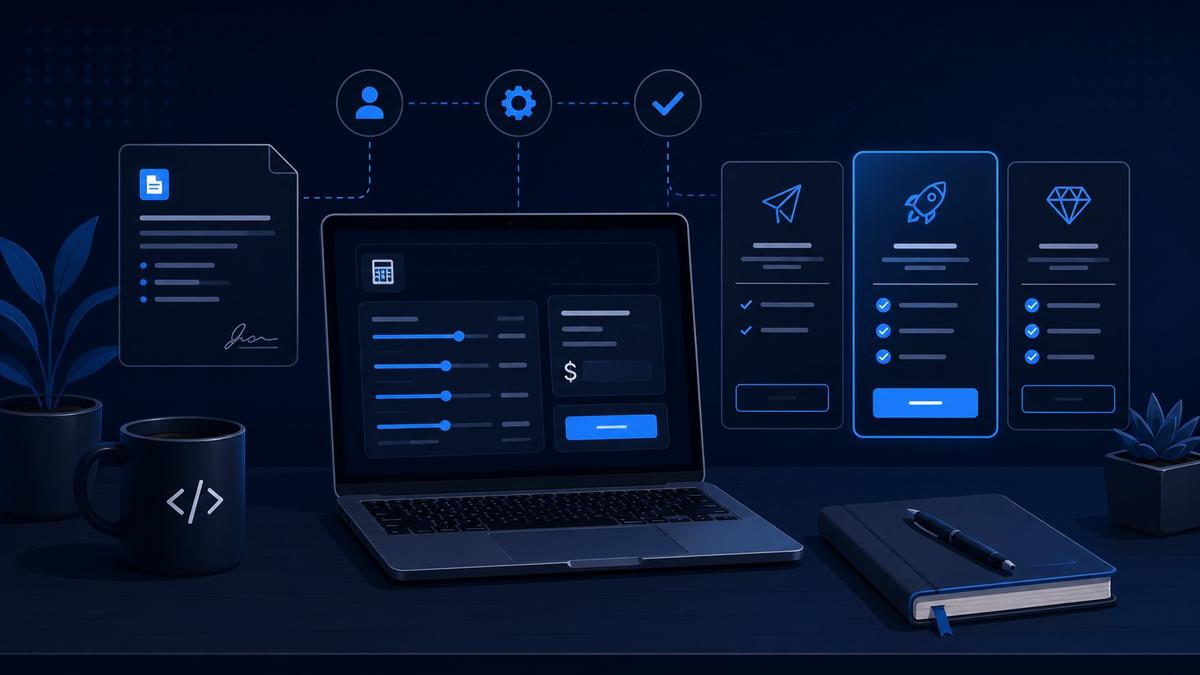
What's inside
- 01Step 1: Define your offer
- 02Step 2: Price your offer
- 03Step 3: Your proposal
- 04Step 4: Objection handlers
Stop guessing and start shipping offers. This kit helps developers turn their skills into a clear, productized service, price it with confidence and produce a client ready proposal in minutes rather than days.
- Write your offer in under 10 minutes.
- Price it without underselling yourself.
- Send proposals that answer the client's questions before they ask.
Work through the four steps in order. Everything you enter is saved in this browser and flows into the next step, so your tiers and proposal stay in sync with your offer.
Step 1: Define your offer
Be specific. An offer that names a niche and a deliverable is far easier for a client to say yes to than a vague "I do web development" pitch.
Your offer
Your scope items become the feature list for each package tier.
Your tiers and proposal update as you type.
From 1 to 52.
From 0 to 90.
Scope boundary clause. Any work not explicitly listed in your scope items is out of scope. Changes to scope need a written change order, an agreed timeline adjustment and an additional fee. This protects your time and keeps delivery on track.
Step 2: Price your offer
Work out a fixed price from first principles. Hours multiplied by your rate is the floor; the multipliers account for complexity, risk and client friction. The suggested price is rounded to the nearest 50.
Pricing calculator
Pick your currency, then adjust the numbers. Your three package tiers update as you go.
Changes the symbol and number format. It does not convert amounts.
From 0 to 100.
Use a negative number for a discount.
$120 per hour × 60 hours × 1.25 complexity × 115% risk buffer, rounded to the nearest 50.
Between 30% and 50% is common. Work starts once it is paid.
Package tiers
Core scope only
- Add scope items in step 1
- Delivered in 3 weeks
- 7 days of support
Full scope
- Add scope items in step 1
- Delivered in 4 weeks
- 14 days of support
Full scope plus priority support and a review call
- Add scope items in step 1
- Priority async support
- Post launch performance review call
- Delivered in 5 weeks
- 28 days of priority support
Pricing tip. Always quote a fixed price, not an hourly one. Fixed prices reward your speed, protect clients from open ended bills and make your offer feel like a product rather than a gamble. If you are unsure, round up to a clean number, such as the nearest 500.
The Basic tier is about 65% of your price and covers the first half of your scope (at least two items) in about 70% of the time. Premium is 150% of your price and adds priority support, a review call and two extra weeks of support.
Step 3: Your proposal
Your proposal is written from your offer and pricing. Edit it directly in the box, then copy it into an email or document. Fill in anything in square brackets, such as your calendar link and payment methods, before you send it.
Client proposal
This updates as you change your offer and pricing. Edit it directly whenever you like.
Step 4: Objection handlers
Six ready to use answers to the most common client pushbacks. Open each one and adapt the language to your own voice.
"Your price is too high."
That is fair to raise. The price reflects the fixed scope, fixed risk nature of this engagement, so you will never get a surprise invoice. If you hire someone cheaper by the hour, a 20% increase in scope turns a "cheaper" project into a more expensive one. I am happy to show you what a reduced scope Basic tier looks like at $6,750.
"The timeline is too long."
I understand the urgency. The timeline I have quoted includes room for your review cycles, your team's feedback and production quality work. Rushing removes that room, and that is when things break in production. If you need it sooner, I offer a priority lane at a 25% premium that moves you to the front of my schedule.
"What if the scope changes?"
All scope changes go through a change order: a short written agreement on the new work, the added cost and the revised timeline. This protects us both. You get transparency, and I can deliver without absorbing unlimited work. No surprises either way.
"Can you do it cheaper?"
Yes, by reducing the scope. Let us look at the Basic tier, which covers the most critical deliverables at roughly 65% of the full price. We ship the core, you test it with real users, and we add the rest in a follow on project if the results justify it. That is often better product strategy too.
"We need this as soon as possible. Can you rush it?"
I can prioritise your project with a rush rate, typically 25% to 30% on top of the base price. That means I set other work aside and focus on your project until delivery. To start, I need the deposit and all client inputs within 24 hours of agreeing. The scope must be locked, with no changes once we begin.
"Can you add this to the scope?"
Happy to consider it. If it is small (roughly 2 hours or less), I will often include it as goodwill. If it is larger, I will send a change order with the price and timeline adjustment before any work starts. I never just absorb extra scope, because that is how projects slip and relationships sour. Tell me what you have in mind and I will give you a quick estimate.
Keep scope tight. Protect delivery time. Every yes to an unscoped request is a no to delivering on time. The best client relationships are built on clear agreements, not goodwill.
Running the numbers on a bigger decision? Try our free profit margin calculator or break even calculator, and use the commit message generator to keep your project history tidy.
Newsletter
Get new free resources every two weeks
Join 500+ people getting AI tips, prompts, and templates.