Resume Summary Examples: Write Yours With AI in 20 Minutes
Real-looking resume summary examples for eight situations and a seven-step AI workflow to write, tailor and check your own in about 20 minutes.
- Time to complete
- 20 minutes
- Difficulty
- Beginner
- Tools needed
- ChatGPT or Claude or GeminiNexframe Job Description AnalyzerNexframe Resume ATS checker
A resume summary is the three or four lines at the top of your CV that tell a recruiter who you are, what you are good at and what you want to do next. The fastest way to write a strong one is to pull keywords from the job ad, feed AI your real achievements, and edit its draft until every line is true and specific. This workflow does that in about 20 minutes.
Below you will find a seven-step process with copy-paste prompts, plus resume summary examples for graduates and NYSC members, career changers, mid-level and senior professionals, tech, sales, customer service and remote roles. All the examples are invented, but they are written the way good summaries look, so you can see the pattern and adapt it.
A quick note on words: in Nigeria and the UK most people say CV, while many international employers and job sites say resume. For this purpose they mean the same document, and everything here applies to both.
What You'll Need
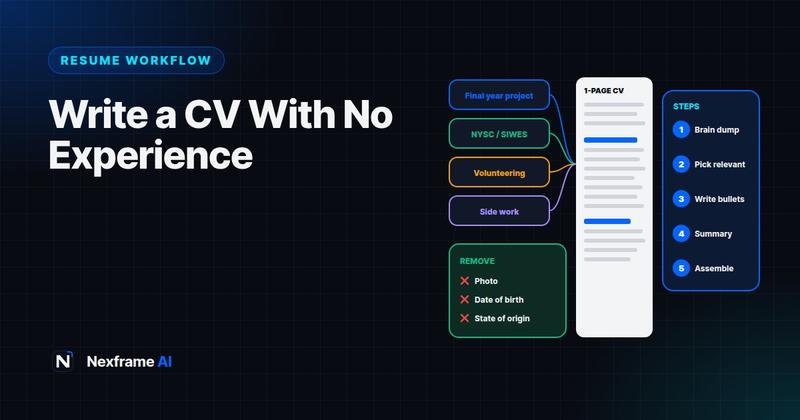
- Your current CV, even a rough one. If you have nothing yet, start with our workflow on how to write a resume with no experience.
- One target job ad, copied in full.
- Three to five achievements with numbers, such as sales growth, customers served, money saved or projects delivered.
- A chatbot: ChatGPT, Claude, Gemini or Copilot. The free versions are fine.
- About 20 minutes of quiet time.
Step 1: Decide What Your Summary Must Do
A summary has one job: make the recruiter keep reading. Recruiters skim quickly, so your summary should answer three questions in under 60 words: what you are, what you have achieved, and what you bring to this role.
Use this simple formula:
[Job title or identity] with [experience or training] in [field]. [One or two achievements with numbers]. [Key skills that match the job]. [What you want to do next, tied to the employer].
Ask AI to explain the formula against your own background before you write anything.
I am a [CURRENT ROLE OR STATUS] with [YEARS] years of experience in [FIELD]. I am applying for [TARGET ROLE] at [TYPE OF COMPANY]. In one short paragraph, tell me what a recruiter for this role most wants to see in a resume summary, and which parts of my background I should lead with.
Checkpoint: You know your opening identity (for example "Customer service specialist" or "Computer science graduate") and the one thing you want the reader to remember.
Step 2: Pull Keywords From the Job Ad
Applicant tracking systems (ATS) and recruiters both look for words that match the job ad. Paste the ad into the free Nexframe Job Description Analyzer to pull out the skills, tools and requirements that matter most, or use the prompt below.
Here is a job ad: [PASTE JOB AD]. List the 10 most important keywords and phrases a recruiter or ATS would look for, grouped into: hard skills, tools or software, soft skills, and qualifications. Mark the three that appear most important.
Pick four to six keywords you genuinely have. Never add skills you cannot back up in an interview.
Checkpoint: You have a shortlist of four to six honest keywords from the job ad.
Step 3: Collect Your Proof
A summary without evidence reads like everyone else's. Gather two or three achievements with numbers. If your bullet points are still written as duties, our workflow on resume bullet points that show achievements helps you turn them into results first.
Here are my main responsibilities and results from my last [NUMBER] roles: [PASTE]. Turn them into five short achievement statements with numbers where possible. If a number is missing, ask me for it instead of inventing one.
Checkpoint: You have at least two real achievements with numbers, such as "served 120 customers daily" or "cut stock losses by 15%".
Step 4: Draft Three Versions With AI
Now give AI everything at once and ask for options. Three versions with different emphasis help you see what works.
Write three resume summary options for me, each 40 to 60 words, in the first person without "I" (resume style). Target role: [ROLE]. My background: [IDENTITY, YEARS, FIELD]. Achievements: [PASTE 2 TO 3]. Keywords to include naturally: [PASTE 4 TO 6]. Version A should lead with experience, version B with a key achievement, version C with skills. Avoid clichés such as "hard-working", "team player", "results-driven" and "passionate". Do not invent anything.
Checkpoint: You have three drafts, each under 60 words, using only facts you supplied.
Step 5: Edit for Truth and Your Own Voice
Choose the strongest draft and edit by hand. Check every claim. Replace vague words with specifics. Read it aloud: if it sounds like nobody in particular, add one detail only you could write, such as an industry, a city or a type of customer.
Here is my chosen summary: [PASTE]. Point out any words that are vague, generic or overstated, and suggest a more specific replacement for each. Then give me a tightened version under 55 words. Keep every fact the same.
Checkpoint: Every sentence is true, specific, and something you could explain in an interview.
Step 6: Tailor It for Each Application
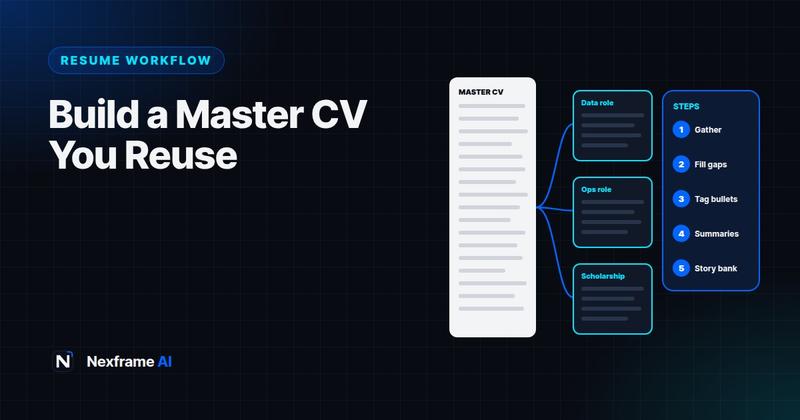
Your summary should change slightly for each job. Keep a base version in a master CV and adjust the opening title and keywords per application. Our workflows on building a master resume with AI and turning a job posting into a tailored resume show how to do this quickly.
Here is my base resume summary: [PASTE]. Here is a new job ad: [PASTE]. Adjust the summary for this job in under 60 words. Change the opening title to match the job title if it honestly fits, swap in relevant keywords, and keep all facts unchanged. Show what you changed.
Checkpoint: You have a tailored summary for this specific job, and your base version is saved for next time.
Step 7: Check It Against the ATS
Before you send, check how your CV reads to an applicant tracking system. Upload it to the free ATS checker in Nexframe Resume, compare against the job ad, and look at which keywords are missing and whether the layout parses cleanly. Fix gaps only where the skill is genuinely yours.
My ATS check says these keywords are missing: [LIST]. Here is my summary and my skills section: [PASTE]. Which missing keywords could I honestly add, based on the experience I have described, and where should each go? Do not add skills I have not shown.
Checkpoint: Your summary contains the main honest keywords, the CV parses correctly, and you are ready to apply.
Resume Summary Examples by Situation
Every example below is invented. Swap in your own facts, numbers and keywords.
Graduate or NYSC Member
Economics graduate (Second Class Upper, University of Ibadan) completing NYSC as a data assistant with a Lagos state agency. Cleaned and analysed survey data for 2,400 households using Excel and Power BI, and presented findings to senior staff. Seeking an entry-level analyst role where accurate reporting and clear communication matter.
Mass communication graduate with internship experience in a Lagos digital agency, writing captions and blog posts for four brands and helping grow one Instagram page by 3,000 followers in three months. Comfortable with Canva, WordPress and basic analytics. Looking for a junior content role.
Career Changer
Secondary school teacher moving into learning and development, with six years of designing lessons, assessing 150 students a term and training new colleagues. Completed a certificate in instructional design and built two e-learning modules in Articulate Rise. Ready to bring clear teaching and adult training skills to a corporate L&D team.
Former bank customer service officer transitioning into product operations. Handled over 60 customer cases daily, documented recurring problems and worked with IT on fixes that cut repeat complaints by 20%. Now completing a product management course and keen to join a fintech team.
If product work is your target, our guide to becoming an AI product manager covers this kind of move in more detail.
Mid-Level Professional
Marketing executive with five years in FMCG, managing campaigns worth ₦80 million a year across radio, social and retail activations. Grew trade partner sales by 18% in the South West in 2025 by tightening promotion timing. Skilled in campaign planning, budget tracking and agency management.
Senior Professional
Operations director with 14 years leading logistics and supply chain teams in West Africa. Built a 120-person distribution network across 11 states, reducing delivery times by 30% and annual costs by ₦450 million. Experienced in vendor negotiation, P&L ownership and leading change across regions.
Tech
Backend developer with four years building APIs in Node.js and Python for payments and logistics products. Led the migration of a payment service to a new provider with zero downtime for 50,000 monthly users. Strong in PostgreSQL, Docker and AWS, with growing experience building AI features and agent-style workflows.
Sales
B2B sales executive with three years selling software to SMEs in Lagos and Abuja. Closed ₦62 million in new business in 2025, 124% of target, and built a referral pipeline that now brings in a third of new leads. Skilled in prospecting, demos and CRM discipline in HubSpot.
Customer Service
Customer service representative with four years in telecoms, handling up to 80 calls and chats a day with a 94% satisfaction score. Trained six new agents and wrote the team's guide for handling billing complaints. Fluent in English, Yoruba and Pidgin, and calm under pressure.
Remote Roles
Virtual assistant with three years supporting founders in the UK and US remotely from Enugu. Manage inboxes, calendars and client onboarding for up to four clients at once, across time zones, using Google Workspace, Notion and Slack. Known for clear written updates and reliable delivery without close supervision.
Notice what they share: a clear identity, at least one number, specific tools or skills, and a short line about direction. None of them say "hard-working team player".
Worked Example: Ngozi, a Customer Service Officer in Lagos
Ngozi, an invented example, has spent four years in customer service at a Lagos e-commerce company and wants to move into a customer success role at a fintech. Her old summary read: "Hard-working and result-oriented customer service professional seeking a challenging role in a reputable organisation."
Steps 1 and 2. She pastes the fintech job ad into the Nexframe Job Description Analyzer. The top keywords are customer onboarding, retention, churn, CRM, Zendesk, cross-functional and product feedback. She has used Zendesk, worked with the product team and handled onboarding calls, so five keywords are honest fits. Churn analysis is not, so she leaves it out.
Step 3. Her achievement prompt brings out three numbers: she handled about 70 tickets a day, kept a 92% satisfaction score, and her written guide on refund questions cut repeat tickets by about 25%.
Steps 4 and 5. AI gives three versions. She picks the achievement-led one and edits it:
Customer service specialist with four years at a Lagos e-commerce company, handling 70 tickets a day in Zendesk with a 92% satisfaction score. Wrote a refund guide that cut repeat tickets by 25% and shared customer feedback with the product team each month. Ready to bring onboarding and retention skills to a customer success role.
Steps 6 and 7. She saves this as her base summary and runs her CV through the ATS checker. It flags "customer onboarding" as missing, so she adds a bullet about the onboarding calls she ran for new merchants. Total time: about 25 minutes, including the fix.
Common Mistakes
- Using clichés. "Hard-working", "results-driven" and "team player" tell a recruiter nothing. Replace them with a number or a specific skill.
- Writing an objective instead of a summary. "Seeking a challenging role" is about you. A summary shows what you offer the employer.
- Letting AI invent achievements. If you did not do it, do not claim it. Interviewers will ask.
- Keyword stuffing. A summary crammed with every keyword reads badly to humans. Use four to six naturally.
- Making it too long. Keep it to three or four lines, roughly 40 to 60 words.
- Never tailoring. One generic summary for every job underperforms. Adjust the title and keywords each time.
FAQ
What is the difference between a resume summary and an objective?
A summary describes what you have done and what you offer, backed by evidence. An objective states what you want. Most recruiters now prefer a summary, though a single line about direction at the end of the summary is useful, especially for graduates and career changers.
How long should a resume summary be?
Three or four lines, or about 40 to 60 words. Anything longer starts to look like a cover letter and is likely to be skipped.
Should a graduate with no experience include a summary?
Yes, but focus on your degree, NYSC posting, internships, projects and relevant skills. Numbers from projects or volunteering, such as "organised a 200-person campus event", work well when you lack formal job history.
Can recruiters tell if my summary was written by AI?
They can often spot generic AI writing, with its stock phrases and lack of detail. They cannot spot a summary that is specific, accurate and in your own voice, which is why the editing step matters more than the drafting step.
Should I mention AI skills in my summary?
Only if they are relevant to the job and you can show them. Saying you use AI tools to draft reports or analyse data is useful in many roles. If you are applying for tech roles, being able to explain concepts such as what an AI agent is can be a real advantage in interviews.
Start This Week
Pick one job you want to apply for, set a 20-minute timer and work through the seven steps. You will finish with a tailored, honest summary and a base version you can reuse. Then run your CV through the free ATS checker before you hit send, and repeat the tailoring step for every application after that.
More in Resume Workflows.