Anthropic Launches Claude Duet, a Proactive AI Assistant That Works in the Background
Anthropic's Claude Duet works in the background, watches your apps and asks before acting. What it does, who can get it and what it means in Nigeria.
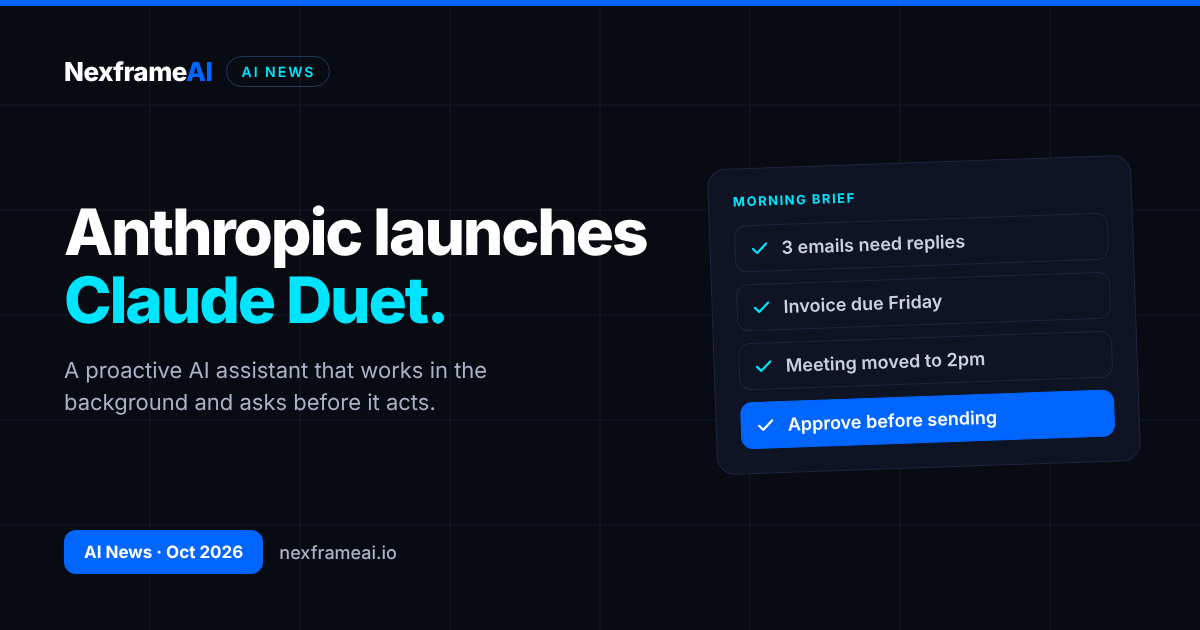
Anthropic has released Claude Duet, a research preview of an assistant that keeps working on your behalf even when you are not typing to it. Here is what it does, how its approval system is designed, who can use it today, and what Nigerian professionals and small-business owners can do while they wait for it to reach them.
On 21 October 2026, Anthropic announced Claude Duet, which it describes as "a new app where Claude works as a proactive agent". Built on Claude Opus 5.5, the newest model in Anthropic's Claude 5.5 family, the app is aimed at professionals and small-business owners. It is opening first through a waitlist for Pro and Max subscribers in the United States, so it is not yet available in Nigeria.
What Happened
Most AI assistants, including the regular Claude, ChatGPT and Gemini apps, wait for you to ask a question. You open the app, type a request, get an answer and close it. Anthropic's new app is built around a different idea: the assistant stays switched on in the background, keeps an eye on the apps you connect, and only messages you when something actually needs your attention.
According to Anthropic's announcement, your day starts with a morning brief. During the day, Duet watches your connected apps and steps in when it spots something important, such as a client email that needs a reply or a meeting that needs scheduling. You talk to it in one ongoing thread, by typing or by voice, rather than starting a fresh chat each time.
Anthropic is calling this a research preview. That label matters. It means the company is still testing how people use the product and has openly listed things it does not yet do well, which we cover below.
The Details: How Claude Duet Works
Here is a summary of what Anthropic said about the app on launch day.
Area | What Anthropic announced |
|---|---|
Model | Built on Claude Opus 5.5 |
Status | Research preview |
Audience | Professionals and small-business owners |
How you talk to it | One ongoing thread, by text or voice |
Where it runs | Its own virtual machine with its own browser; your devices can be switched off |
Connectors | More than 6,000, including Gmail, Slack, QuickBooks, Stripe, Gusto, LinkedIn, Docusign, HubSpot, Canva and Shopify |
Payments | Purchases through a Stripe Link virtual card and Shop Pay |
Sign-in | 1Password sign-in "coming soon" |
Platforms | iOS, Android and claude.ai |
Access | Waitlist, starting with US Pro and Max subscribers |
Price | No extra charge; shares your plan's usage limits |
What It Can Do
Anthropic's examples go well beyond answering questions. The company says Duet can schedule meetings, build dashboards, produce financial and sales forecasts, and prototype or build web apps. For a small-business owner, that might mean the assistant pulling figures from an accounting tool and a payments tool, then turning them into a forecast you can review over breakfast.
It Works on Its Own Computer
One of the more unusual design choices is that the assistant runs on its own virtual machine, with its own browser. A virtual machine is simply a computer that exists in the cloud rather than on your desk. Because the work happens there, Anthropic says your phone and laptop can be switched off while it carries on.
Connectors and Payments
Connectors are the links that let an AI tool read from and act inside other apps. Anthropic says Duet supports more than 6,000 of them, and the examples it named lean heavily towards business software: email, team chat, accounting, payroll, payments, e-signatures, sales and online shops.
For purchases, the app uses a Stripe Link virtual card and Shop Pay. Anthropic also said sign-in through the password manager 1Password is "coming soon", which would let the assistant log into services on your behalf in a more controlled way.
The Safety and Approval Design
This is the part most worth understanding. An assistant that acts without being asked could, in theory, send the wrong email or spend money you did not intend to spend. Anthropic's answer is an approval step.
The company says the assistant asks for your approval before it sends a message, makes a payment, signs a document or deletes something. In Anthropic's words, before risky actions "it shows you exactly what it's about to do and waits for your approval."
There are also hard limits. Anthropic says Duet will not trade securities or move money between accounts, even if you approve it. In other words, some actions are simply off the table, not just gated behind a confirmation button.
The Limits Anthropic Admits
Anthropic was unusually direct about weaknesses. It said the assistant may misread an email thread or misjudge how urgent something is. It is weaker at personal errands, such as booking tickets. And for now, you cannot watch its browser while it works, so you see the results and the approval requests rather than every click along the way.
Why It Matters
From Chatbot to Colleague
For the past few years, most people have used AI as a very capable answering machine. Agents changed that by letting AI carry out multi-step tasks, but you usually still had to start each task yourself. Duet pushes the idea one step further: the assistant decides when to speak up.
That is a meaningful shift. It moves AI closer to the role of an assistant or junior colleague who reads your inbox, tracks what is happening and flags what matters. We explored this broader trend in our piece on the rise of AI employees, and this launch is one of the clearest examples so far from a major AI lab.
Trust Becomes the Main Question
When an assistant only answers questions, a mistake costs you a bad paragraph. When an assistant acts inside your email, accounts and payment tools, a mistake can cost money or a client relationship. That is why the approval design matters more than any single feature.
Anthropic's approach combines three layers: approval before sensitive actions, actions it refuses to take at all, and honesty about where it can go wrong. Whether that is enough will only become clear once more people use it with real businesses. Its own warning that it may misjudge urgency is a reminder that AI can still be confidently wrong, a problem we explain in our guide to AI hallucination.
The Competition
Media coverage has compared the launch with efforts by Meta and OpenAI to build their own assistants that do more than chat. The race is no longer only about which model scores highest on tests. It is increasingly about which assistant people trust enough to connect to their working lives.
What It Means for You
It Is Not Available in Nigeria Yet
Let us be clear first: you cannot use Claude Duet in Nigeria today. Access starts with a waitlist for Pro and Max subscribers in the United States, and Anthropic has not announced dates for other countries. If you see anyone selling "access" to it in Nigeria, treat that with suspicion.
It is also worth noting that the connectors Anthropic named are mostly tools popular with US businesses. Many Nigerian small businesses run largely on WhatsApp, bank transfers and spreadsheets. We could not confirm how well the connector list covers tools common in Nigeria, so it is too early to say how useful the app would be for a typical Lagos or Kano business even once it arrives.
What Nigerian Professionals Can Do Now
You do not need to wait for this app to start working the way it promises. Much of the value comes from habits you can build with tools you already have.
Build your own morning brief. Every morning, paste your key emails, messages or notes into the AI assistant you already use and ask it to sort them. It is manual, but it trains you to think about what an assistant should flag.
Here are my unread messages and notes from today: [paste messages]. Sort them into three groups: needs my reply today, can wait this week, and can be ignored. For each item in the first group, write one sentence on why it is urgent and suggest a short reply in a professional but friendly tone. Do not invent details that are not in the messages.Try one agent task at a time. Agent features already exist in many mainstream tools. Our guide to AI agents for everyday tasks shows how to hand off simple jobs, such as research or form-filling, and check the results before you rely on them.
Keep a human approval step. Copy Anthropic's design in your own work. Let AI draft emails, invoices and proposals, but never let anything go to a client, a supplier or a bank without you reading it first.
What Small-Business Owners Can Do Now
If you run a shop in Ibadan, a logistics business in Abuja or an online store from your phone, the lesson from this launch is that AI assistants work best when your business processes are clear.
Write down how you do things. An assistant cannot follow a process that only exists in your head. Our workflow for writing a standard operating procedure with AI helps you turn routine tasks, such as handling refunds or onboarding a new staff member, into clear written steps. Those documents become instructions you can give any AI tool today, and any agent tomorrow.
Start with the low-risk jobs. Our guide to AI agents for small businesses covers where agents genuinely help, such as summarising enquiries or preparing weekly reports, and where they can cause trouble.
Set rules for your team. If staff are already pasting customer details into chatbots, you need ground rules. Our AI policy template for small businesses helps you decide what data can be shared, which tools are allowed and who checks the output.
A Quick Example
Imagine Chiamaka runs a small online fashion business in Lagos. Each morning she copies her overnight orders, customer messages and supplier updates into her AI assistant and uses the prompt above. In about ten minutes she knows which customers need a reply, which orders are delayed and which supplier she must chase. She drafts her replies with AI, reads each one, edits the tone and sends them herself.
That is a manual version of what this new app aims to automate. If proactive assistants reach Nigeria later, Chiamaka will already know what she wants flagged, which tasks are safe to hand over and which ones she must always approve herself.
The Wider African Picture
Products like this run on large amounts of computing power, mostly hosted outside Africa. The question of who owns that infrastructure, and where African data lives, came up the same week in Abuja, where Nigeria proposed that African countries pool their AI computing resources. We covered that story in our report on Nigeria's shared AI compute proposal at BUILD 2026.
What to Watch Next
International rollout. The biggest question for our readers is when access widens beyond US Pro and Max subscribers. Anthropic has not given a timeline, so we will update this article if that changes.
1Password sign-in. Anthropic says this is "coming soon". It would let the assistant sign into more services, which raises both its usefulness and the importance of the approval system.
Seeing what it does. At the moment you cannot watch its browser as it works. If Anthropic adds that, users would be able to follow its actions step by step, which could build trust.
How well it judges urgency. Anthropic admits the assistant may misjudge what is urgent. Early user reports will show whether it pings you too often, too rarely or about the wrong things.
The rival assistants. With Meta and OpenAI pursuing similar ideas, expect more announcements of assistants that act on your behalf. The approval and safety designs will be the main thing to compare.
Final Thoughts
Anthropic's new app is an early look at where AI assistants are heading: from tools you open to helpers that stay switched on and tell you when something needs you. The approval-first design and the list of actions it will never take are sensible starting points, and Anthropic's openness about its weaknesses is welcome.
For now, it is a US-only research preview. Nigerian professionals and business owners do not need to wait to benefit from the idea behind it, though. Write down your processes, practise handing simple tasks to the AI tools you already use, and keep yourself as the final approver. When proactive assistants do arrive, you will be ready to use them well. A good first step this week is turning one routine task into a written SOP using our SOP workflow.
Frequently Asked Questions
What is Claude Duet?
It is a new app from Anthropic in which Claude works as a proactive agent. It runs in the background, watches the apps you connect, sends you a morning brief and messages you when something needs attention. It is built on Claude Opus 5.5 and is currently a research preview.
Can I use it in Nigeria?
Not yet. Access is through a waitlist that starts with Pro and Max subscribers in the United States. Anthropic has not announced when other countries will get it.
Does it cost extra?
Anthropic says there is no extra price. It is included for eligible subscribers but shares the same usage limits as your plan, so heavy use could reduce what is left for normal chats.
Can it spend my money without asking?
Anthropic says it asks for approval before sending messages, making payments, signing documents or deleting things. It shows you exactly what it is about to do first. It will not trade securities or move money between accounts, even if you approve.
What apps does it connect to?
Anthropic says it supports more than 6,000 connectors, naming examples such as Gmail, Slack, QuickBooks, Stripe, Gusto, LinkedIn, Docusign, HubSpot, Canva and Shopify. Purchases go through a Stripe Link virtual card and Shop Pay.
Does my phone or laptop need to stay on?
No. Anthropic says the assistant runs on its own virtual machine with its own browser, so it can keep working while your devices are switched off.
What are its known weaknesses?
Anthropic says it may misread a thread or misjudge urgency, it is weaker at personal errands such as booking tickets, and you cannot yet watch its browser while it works. As with any AI tool, check its work before you rely on it.
Comments (0)
Sign in to post a comment.
- Be the first to comment.