Nigeria Proposes Pooling Africa's AI Computing Power at BUILD 2026
At BUILD 2026 in Abuja, Nigeria proposed pooling Africa's AI computing power. What it means for AI in Africa, the proposed AI Bill and Nigerian developers.
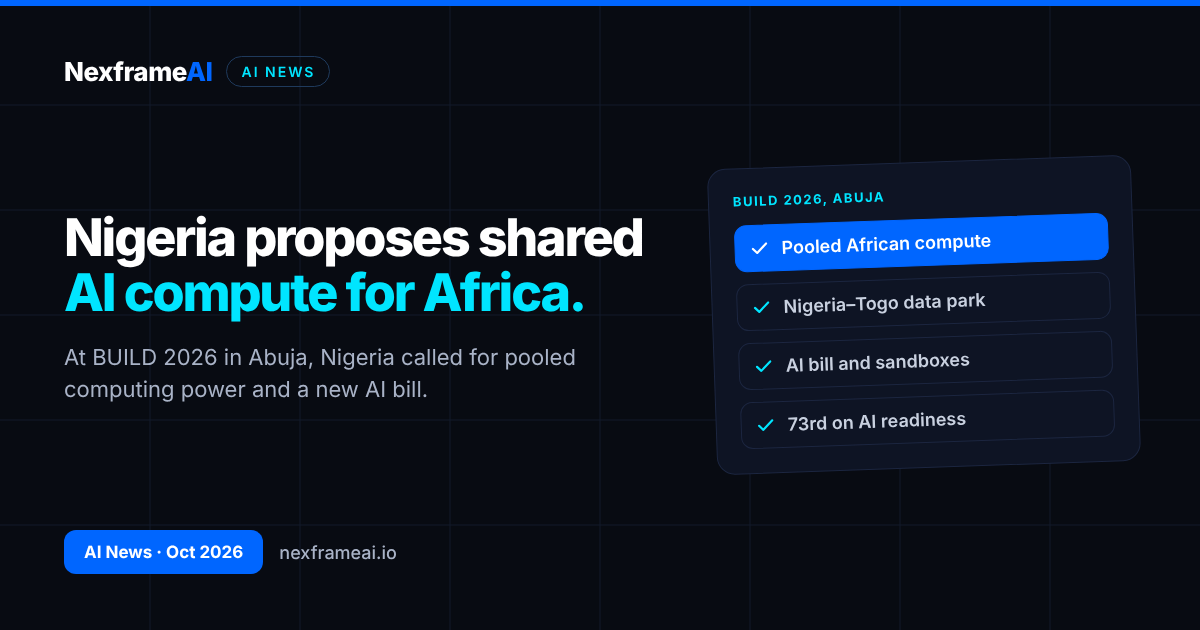
Nigeria has proposed that African countries pool their computing resources so researchers can run AI work no single nation could manage alone. Here is what was said at BUILD 2026 in Abuja, what Nigeria's proposed AI Bill contains, and what it could mean for AI in Africa and for Nigerian developers, students and startups.
The BUILD 2026 conference took place in Abuja on 21 and 22 October 2026 under the theme "Building Africa's Shared Compute and AI Infrastructure". It was hosted by the Nigeria AI Collective and led by the Federal Ministry of Communications, Innovation and Digital Economy, according to reports by Voice of Nigeria between 21 and 23 October.
What Happened
The Minister of Communications, Innovation and Digital Economy, Bosun Tijani, declared the conference open. Dr Olubunmi Ajala, National Director of the National Centre for Artificial Intelligence and Robotics (NCAIR), delivered remarks on the minister's behalf.
The central idea was simple to state but hard to deliver: African countries should share their computing resources. Instead of each country trying to build enough AI infrastructure on its own, a pooled approach would let researchers across the continent run AI work that no single country could support by itself.
The minister was frank about why. He said "access to computing power, electricity, connectivity and advanced chips will be decisive", and acknowledged that "Nigerian capacity might not be big enough" on its own.
Several concrete plans were cited in the reports, including a Nigeria–Togo data park and more fibre connectivity. Officials also pointed to Nigeria's progress on the Oxford Insights Government AI Readiness Index, where the country rose from 103rd to 73rd over two years.
The Details
Who Was Involved
The Nigeria AI Collective, which hosted the event, launched in October 2024. Its managing partners are Lagos Business School/Pan-Atlantic University, Data Science Nigeria, the Centre for Journalism Innovation and Development (CJID) and NCAIR. The Policy Innovation Centre serves as its secretariat. Its backers include Luminate, the Ford Foundation, the MacArthur Foundation and the AI Collaborative.
Representatives of Luminate and the MacArthur Foundation spoke on 21 October.
The $850 Million Question
The most striking figure came from Luminate's chief executive, Melanie Hui. She said research commissioned by Luminate found that Nigeria's reliance on foreign cloud infrastructure costs about $850 million a year. At roughly ₦1,550 to the dollar, that is about ₦1.3 trillion, though this is only a rough conversion for illustration.
Cloud infrastructure means the remote servers, storage and computing power that companies rent rather than own. When a Nigerian bank, app or government agency stores data or runs software "in the cloud", that cloud is very often located abroad and paid for in foreign currency. Hui put the wider point this way: "A country does not own its digital future when a data centre merely sits within its borders."
Nigeria's Proposed AI Bill
In an interview published on 23 October, Dr Ajala outlined what Nigeria's proposed AI Bill would cover. Based on his comments, the bill's main points include:
Area | What Ajala described |
|---|---|
Data sovereignty | Keeping control over Nigerian data and where it is stored |
Investment | Provision for Nigerians to invest, and opportunity for hyperscalers to invest in Nigeria |
Regulatory sandboxes | Controlled spaces to test AI products before wider release |
Twin data parks | Data parks that could also host other African countries' data |
Power | A private power plant indicated it could supply 200 MW as demand grows; solar, gas and mini-grids are being considered |
Ajala said the bill "gives provision for Nigerians to invest, but it also gives opportunity for hyperscalers to invest in Nigeria". Hyperscalers are the giant cloud providers that run data centres around the world. On testing, he said it "makes a provision where there are spaces for sandboxes before we take it out."
An important caution: the reports did not state the bill's number or its current stage in the legislative process. It is described as a proposed bill, so none of these measures should be treated as law yet.
What Was Not Announced
It is also worth being clear about what did not happen. No new funding programme was announced at the conference. The shared compute idea is a proposal, and the Nigeria–Togo data park and extra fibre were cited as plans rather than finished projects.
Other Notes From the Week
In separate coverage, Vanguard reported on 23 October that the UK's British Standards Institution and NCAIR ran a workshop on AI governance standards, ISO/IEC 42001 and 23894, under the UK Digital Access Programme. These are international standards for managing AI systems and AI risks responsibly.
Why It Matters for AI in Africa
Compute Is the New Bottleneck
To train or run modern AI models, you need compute: large numbers of powerful chips, mostly graphics processing units (GPUs), running in data centres with reliable electricity and fast internet links. These are expensive to buy, expensive to power and in short supply worldwide.
Most African countries cannot afford to build this at the scale that leading labs use. Pooling makes sense in that light. If several countries share data centres and link them with fibre, researchers in Lagos, Lomé or Nairobi could book time on shared machines rather than each country building its own half-sized facility.
Data Sovereignty in Plain Terms
Data sovereignty means that a country has control over its data, including where it is stored and whose laws apply to it. If Nigerian health records, financial data or government files sit on servers abroad, they may fall under foreign rules and depend on foreign companies' decisions.
Hui's point was that location alone is not enough. A data centre in Nigeria owned and controlled entirely from overseas does not automatically give Nigeria control of its digital future. That is why the proposed bill pairs data parks with local investment and rules.
Locally Relevant AI
Dr Osasuyi Dirisu of the Policy Innovation Centre described the ambition: "Our own AI journey could be owned by us, could be locally relevant or globally competitive."
Locally relevant AI matters in very practical ways. Many global tools still struggle with African languages, accents and contexts. Our guide to using AI in Yoruba, Igbo, Hausa and Pidgin shows both what works today and where the gaps remain. More local compute could make it easier for African researchers to build and improve models for these languages.
Why Not Just Rely on Global Cloud Providers?
It is a fair question. Global cloud providers already offer powerful computing to anyone with a card and an internet connection. For many Nigerian startups, that is exactly how they work today, and it will remain a sensible option for a long time.
The concern raised at BUILD 2026 is about dependence. When almost all of a country's computing is rented from abroad, the bills are paid in foreign currency, prices can change with exchange rates, and decisions about access are made elsewhere. For researchers working with sensitive local data, such as health or government records, there may also be legal limits on sending that data overseas.
The proposed bill does not reject global providers. Ajala's comments make clear that hyperscalers are invited to invest in Nigeria. The aim, as described, is a mix: local ownership and investment alongside global partners, with rules that keep control closer to home. For the future of AI in Africa, that balance may matter more than any single data centre.
Electricity Is Part of the Story
Anyone in Nigeria knows that power supply is a challenge. AI data centres need large amounts of constant electricity. The mention of a possible 200 MW supply from a private power plant, alongside solar, gas and mini-grids, shows that officials recognise compute plans will fail without reliable energy.
What It Means for You
For Developers
For now, most Nigerian developers build with AI through APIs and cloud services hosted abroad, often paid for in dollars. If shared African compute and local data parks become reality, you could one day run models closer to home, with lower delays and possibly costs in naira rather than foreign currency. That is a long-term possibility, not a near-term promise.
What you can do today is build skills that will be in demand whatever happens. Learn how to use AI models through APIs, how to fine-tune or adapt models, and how to work with open models you can host yourself. Our comparison of open-source and closed AI models explains why open models matter for countries and companies that want more control over where their AI runs. If you are new to building, our guide to building your first app with an AI API is a practical starting point.
For Students
If you are studying computer science, engineering, statistics or a related subject, this is a signal about where opportunities may grow. Data centre operations, AI infrastructure, machine learning engineering and AI policy will all need skilled people if these plans move forward.
Our AI engineer roadmap sets out the skills to learn, in order, and how to build a portfolio employers notice. If coding is not your path, there are still serious roles in AI policy, governance, research, data annotation and project management. Our guide to AI careers without coding covers those options.
The organisations involved in the Nigeria AI Collective, such as Data Science Nigeria and Lagos Business School, are also worth following for training programmes and events. For checked scholarships and fellowships in AI and technology, browse Nexframe Opportunities.
For Startups
If you run an AI startup, two parts of the proposed bill stand out. First, regulatory sandboxes could give you a safer way to test new products with the regulator's knowledge before a full launch. Second, data sovereignty rules could affect where you are allowed to store certain kinds of data.
Neither is law yet, so there is nothing to comply with today. But it is sensible to know where your data currently lives, which cloud providers you depend on and how much you spend in foreign currency each month. If local data parks become available, you will be better placed to judge whether moving makes sense.
A Quick Example
Ibrahim is a final-year student in Kano building a Hausa-language chatbot for his project. Today, he uses a free cloud notebook hosted abroad and often runs out of computing time. Under a pooled African compute arrangement, university researchers like him might be able to apply for time on shared machines in the region. Until then, he focuses on a smaller open model, careful data collection and clear documentation, skills that will transfer to any future infrastructure.
Keep Expectations Realistic
These are early proposals. The bill's legislative stage was not stated, no new funding programme was announced and the data park plans were described as plans. Big infrastructure projects take years. The value of this conference is that it sets out a direction and names the problem clearly.
What to Watch Next
The AI Bill's progress. Look for the bill's formal introduction, its number and its progress through the National Assembly. The details may change during that process.
Other countries joining. Shared compute only works if neighbouring countries sign up. Watch for formal agreements beyond the Nigeria–Togo data park plan.
Funding. No new funding programme was announced at BUILD 2026. Any future commitment from government, hyperscalers or foundations will be a key signal of whether plans move forward.
Power and fibre projects. Progress on the 200 MW supply idea, renewable options and new fibre routes will show whether the physical foundations are being built.
Governance standards. The BSI and NCAIR workshop on ISO/IEC standards suggests growing interest in formal AI governance. Watch whether these standards shape the bill or public-sector AI rules.
The wider industry. The same week saw global launches such as Anthropic's background assistant, which we covered in our report on Claude Duet. Products like that run on huge amounts of compute, mostly outside Africa, which is exactly the gap BUILD 2026 aimed to discuss.
Final Thoughts
Nigeria's proposal to pool computing resources across the continent is one of the clearest statements yet about the future of AI in Africa. It recognises a hard truth: no single African country, Nigeria included, can easily build all the compute, power and connectivity modern AI needs. Sharing could make the difference.
The $850 million a year that Luminate-commissioned research attributes to Nigeria's reliance on foreign cloud services shows what is at stake. Still, these are proposals, not finished projects, and the bill's progress remains to be seen. The best move for Nigerian developers, students and founders is to keep building skills and products now. Start with our AI engineer roadmap if you want to be ready for the jobs this infrastructure could create.
Frequently Asked Questions
What is BUILD 2026?
BUILD 2026 was a conference held in Abuja on 21 and 22 October 2026, themed "Building Africa's Shared Compute and AI Infrastructure". It was hosted by the Nigeria AI Collective and led by the Federal Ministry of Communications, Innovation and Digital Economy.
What did Nigeria propose?
Nigeria proposed that African countries pool their computing resources so researchers can run AI work that no single country could support alone. Plans cited include a Nigeria–Togo data park and more fibre connectivity.
What is in Nigeria's proposed AI Bill?
According to Dr Olubunmi Ajala of NCAIR, it covers data sovereignty, investment by Nigerians and hyperscalers, regulatory sandboxes and "twin data parks" that could host other African countries' data. Its legislative stage was not stated.
Where does the $850 million figure come from?
Luminate's chief executive, Melanie Hui, said research commissioned by Luminate found that Nigeria's reliance on foreign cloud infrastructure costs about $850 million a year.
Was any new funding announced?
No. No new funding programme was announced at the conference. The shared compute idea and data park plans remain proposals.
What does data sovereignty mean?
It means a country controls its own data, including where it is stored and which laws apply to it. It is not only about location; ownership and control matter too.
How can Nigerian students prepare?
Build skills in AI engineering, data, infrastructure or AI policy, follow organisations such as Data Science Nigeria and NCAIR, and look out for scholarships and fellowships in the field.
Comments (0)
Sign in to post a comment.
- Be the first to comment.