Gemini 4 Is Here: What Argon Means for Gemini App Users
Gemini 4 Argon is now in the Gemini app for AI Pro and Ultra users. Here is what changed, what it costs developers and what it means for users in Nigeria.
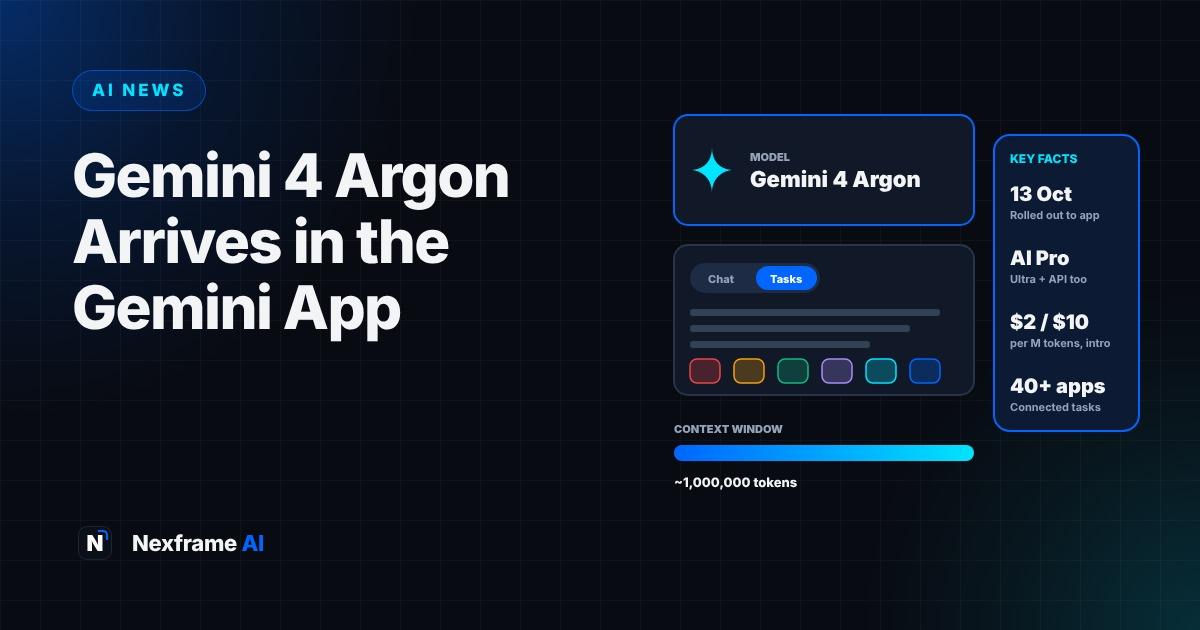
Google has started rolling out Gemini 4 Argon, the first model in its Gemini 4 family, to the Gemini app. Since 13 October 2026, Google AI Pro and Ultra subscribers can choose Argon in the app and in AI Mode in Google Search. Developers can use it through the paid Gemini API and Google AI Studio.
Google first announced Argon on 30 September. This month's rollout is the first time most people can actually use it. It arrives a few weeks after OpenAI's GPT-6 family and Anthropic's Claude Opus 5.5 and Sonnet 5.5, so the three biggest AI companies now each have a new flagship on the market at the same time.
This article covers what Gemini 4 Argon is, what's new in the Gemini app, what it costs developers and what it means if you use Gemini for study, work or building apps in Nigeria.
What is Gemini 4 Argon?
Gemini 4 Argon is Google's newest large language model. It's built for long, multi-step work such as coding projects, research tasks and jobs that run across several apps, rather than quick one-line answers.
The key specifications Google has shared:
Context window: about 1 million tokens (1,048,576), shared between your input, the model's thinking and its answer. That's roughly enough to hold several long books or a large codebase in one conversation.
Output: up to 65,536 tokens by default in a normal API call, with a "long decode" option for longer outputs.
Focus areas: reasoning, coding, agentic tasks (where the model takes actions, not just answers) and long video understanding.
Google also says Argon "answers questions more directly with less hedging", with fewer repeated phrases and clichés. If you've ever been frustrated by an AI that gives you five caveats before the answer, that change matters.
How good is it?
Google's own launch figures put Argon near the top on several tests:
DeepSWE v1.1 (long software engineering tasks): 77.9%
Zapier AutomationBench (business workflows across apps): 51.3%
LVBench (understanding long videos): 91.7%
These are Google's numbers, measured in Google's setup. They're useful for a rough sense of where the model sits, but they aren't independent tests. Different companies run benchmarks in different ways, so a 77.9% from Google and a 77% from another lab don't mean the models are equal.
The practical test is your own work. If you use AI mainly for essays, emails or quick questions, you may not notice a big difference from older models. The gains show up most on long, complicated tasks: debugging a large project, analysing a long report or getting an assistant to complete a multi-step job without hand-holding.
What's new in the Gemini app
The Gemini app update that came with Argon is as important as the model itself. Google highlighted four changes.
1. From chat to tasks. There's a new toggle in the main chat window that switches Gemini from conversation to task mode. Instead of answering, it works through a job step by step and can keep going while you're away from your computer.
2. More connected apps. Google says Gemini now connects to more than 40 apps, naming Instacart, OpenTable, Adobe and Shopify as examples, for jobs like ordering groceries, booking tables and building an online shop. Many of these services aren't widely used in Nigeria yet, but the direction is clear: Gemini is becoming an assistant that does things, not just one that talks.
3. Better progress updates. On longer tasks, Gemini now tells you what it's doing and how far along it is, rather than going silent until it finishes.
4. Coding in the app. Google's agentic coding environment, Antigravity, now appears inside the Gemini app on macOS, and you can switch between chat and coding. Antigravity access is limited to AI Ultra subscribers.
If you use Gemini's Canvas feature for drafts and documents, it works alongside these changes. Our guide to Google Gemini Canvas explains how to use it.
Who can use Gemini 4 Argon?
Access depends on how you use Google's AI:
Google AI Pro subscribers: Argon in the Gemini app and in AI Mode in Search.
Google AI Ultra subscribers: everything in Pro, plus Antigravity, Google's agentic coding tool.
Developers: the paid Gemini API, Google AI Studio and Google's enterprise platform.
Free Gemini users: Google's announcement doesn't mention free access to Argon. Free users stay on Google's other models for now.
Google hasn't published a country-by-country list for this rollout. Google's AI subscriptions have been sold in Nigeria since at least September 2025, when AI Plus launched in 40 countries including Nigeria. Open the plans page in the Gemini app to see which plans are offered on your account, their current price and whether Argon is included, because availability can lag behind the US for a few days.
There's also a separate programme, called Fairwind, that gives selected cyber security defenders access with different safeguards. Most people won't use it, but it shows Google is treating Argon's security abilities carefully.
What Gemini 4 costs developers
For developers using the API, Google is offering introductory pricing until 30 November 2026:
Input: $2 per million tokens
Output: $10 per million tokens
Cached input: $0.10 per million tokens, thanks to a 95% discount on repeated content
From 1 December, the price doubles to $4 per million input tokens and $20 per million output tokens.
To put that in naira terms at about ₦1,330 to the dollar: a million input tokens costs around ₦2,660 now and about ₦5,320 from December. A million output tokens costs around ₦13,300 now and ₦26,600 later. A million tokens is roughly 750,000 words, so a small app making a few hundred requests a day may spend far less than this. A coding agent working through a large codebase can spend it quickly.
Two money-saving tips if you're building:
Use caching. If your app sends the same long instructions or documents with every request, cached input at $0.10 per million tokens is far cheaper than re-sending them.
Don't default to the flagship. For simple tasks such as classifying messages, extracting fields or short replies, a smaller, cheaper model often does the job. Save Argon for the hard parts.
If you're new to building with AI APIs, start with our guide to building your first app with an AI API.
How Gemini 4 compares with GPT-6 and Claude
The three biggest AI labs released new flagships within about six weeks of each other:
OpenAI's GPT-6 family arrived in September, with different versions for paid and free ChatGPT users.
Anthropic's Claude Opus 5.5 and Sonnet 5.5 arrived in late September.
Google's Gemini 4 Argon was announced on 30 September and rolled out widely from 13 October.
Each claims strengths in coding and agentic work, and their published prices for flagship models sit in a similar range. For most people, the best choice still depends on what you do every day and which tools you already use. If your work lives in Gmail, Google Docs and Drive, Gemini fits in naturally. If you rely on ChatGPT's features, or on Claude for writing and coding, a new Gemini model alone may not be a reason to switch.
Our honest decision guide to GPT, Claude and Gemini walks through how to choose by task, and the approach still applies to this new generation.
What this means for users in Nigeria
Students: Argon's long context helps with large reading loads, such as a full textbook chapter or a long set of lecture notes. It's a paid feature, though. If you're on a budget, free tools still cover most study needs. Our guide to studying with Gemini Notebook shows how to get a lot out of Google's free tools.
Job seekers and professionals: more direct answers and task mode make Gemini more useful for research, drafting reports and preparing for interviews. Remember that tasks across connected apps mean giving the assistant access to your accounts. Only connect what you need.
Developers and startups: the introductory API price is a good window to test Argon against the models you already use. Run the same 20 to 30 real tasks from your product through each model and compare quality, speed and cost before committing. Lock in your choice before the December price rise if Argon wins.
Creators and small businesses: stronger video understanding could help with tasks like reviewing long recordings or turning a livestream into notes. As with any new tool, check its outputs before you publish or send them to customers.
Should you upgrade?
It's worth paying for Google AI Pro to get Argon if:
you already use Gemini daily and hit limits on hard tasks
your work involves long documents, large projects or video
you live in Google's apps and want an assistant that can act across them
It's probably not worth it yet if:
you mostly use AI for short questions, simple writing or translation
you're happy with another paid assistant and don't want two subscriptions
your budget is tight; free tiers still handle most everyday tasks well
Before paying for any AI subscription, read our guide to the hidden costs of free AI tools. It helps you work out what you actually need.
Worked example: testing Gemini 4 before you commit
Tunde runs a small software agency in Ibadan. His team uses a coding assistant every day, and he wants to know whether Gemini 4 Argon is worth switching to before the introductory price ends.
He sets up a simple test:
Pick real tasks. He chooses 30 tasks from the last month: 10 bug fixes, 10 small features and 10 code reviews from client projects.
Estimate the cost. Each task sends about 50,000 tokens of code and instructions and gets back about 5,000 tokens. That's 1.5 million input tokens and 150,000 output tokens in total. At the introductory price, the test costs about $3 for input and $1.50 for output, roughly ₦6,000. The same test after 1 December would cost about ₦12,000.
Run both models. He runs the same 30 tasks through Argon and through the model his team uses now, keeping the instructions identical.
Score the results. For each task, he records whether the code worked first time, how much editing it needed and how long it took.
Decide. Argon solved more of the bug fixes on the first try, but the difference on small features was minor. He switches for debugging work only and keeps the cheaper model for routine tasks.
The lesson applies to anyone: a few thousand naira spent on a structured test is far cheaper than a month of guessing. Use your own tasks, measure the results and only pay flagship prices where they make a real difference.
What to watch next
Google usually releases more than one model in a family. Watch for smaller, cheaper Gemini 4 models suited to everyday tasks and free users, and for Argon becoming available on Google's free tiers. Also watch the end of the introductory API price on 30 November: if you build on Argon, budget for the higher rate from December. Finally, keep an eye on independent benchmark results, which usually appear a few weeks after launch and give a fairer comparison than vendor figures.
FAQ
What is Gemini 4?
Gemini 4 is Google's newest family of AI models. The first model, Gemini 4 Argon, focuses on reasoning, coding and long multi-step tasks, with a context window of about 1 million tokens.
When was Gemini 4 released?
Google announced Gemini 4 Argon on 30 September 2026 and began a wide rollout to Gemini app subscribers and developers on 13 October 2026.
Is Gemini 4 free?
Not at launch. Gemini 4 Argon is available to Google AI Pro and Ultra subscribers and to developers on the paid Gemini API. Google hasn't announced free access.
How much does the Gemini 4 Argon API cost?
Until 30 November 2026, it costs $2 per million input tokens and $10 per million output tokens. From 1 December, it rises to $4 and $20.
Is Gemini 4 available in Nigeria?
Google hasn't published a country list for this rollout. Google's AI plans are sold in Nigeria, so check the plans page in the Gemini app to see whether AI Pro and Argon are offered on your account, and at what price.
Is Gemini 4 better than GPT-6 or Claude?
It depends on the task. Google's benchmarks put Argon near the top for coding and agent tasks, but those are vendor figures. Test each model on your own work before deciding.
Comments (0)
Sign in to post a comment.
- Be the first to comment.