AI Receptionist for Small Businesses: How It Works and What It Costs
What an AI receptionist does, what it costs in dollars and naira, and how to set one up for phone and WhatsApp without losing the human touch.
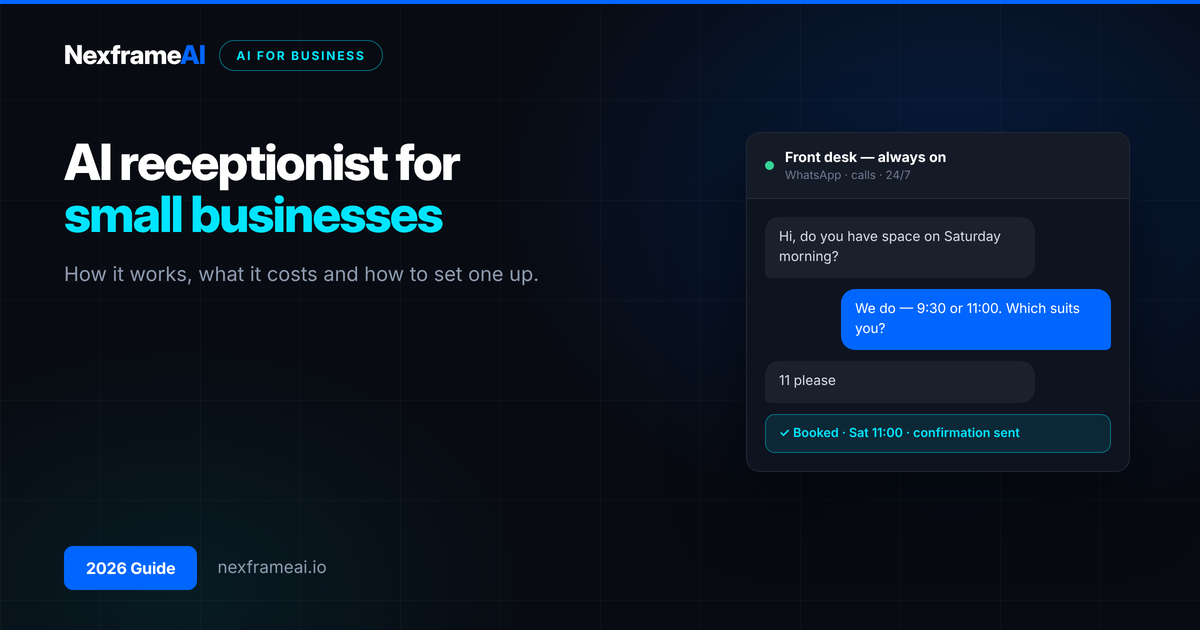
An AI receptionist is software that answers your business calls and messages for you, any time of day. It greets the customer, answers common questions, books appointments, takes messages and passes the tricky cases to a real person. For most small businesses it costs somewhere between $30 and $300 a month, depending on how many calls you get.
It's brilliant at the repetitive part of the front desk and still weak at anything sensitive, emotional or unusual. Set it up with clear limits and it stops you losing customers to unanswered calls. Set it up carelessly and it annoys people faster than a busy line ever did.
This guide explains how it works, what it can and can't do, what it really costs (in dollars and rough naira), and how to set one up for a Nigerian business where most customers would rather send a WhatsApp voice note than call.
What Is an AI Receptionist?
An AI receptionist is a virtual front desk. It sits on your phone line, your WhatsApp Business number, your website chat, or all three, and handles first contact with customers.
There are two main types:
Voice receptionists answer phone calls. They listen to the caller, turn speech into text, work out a reply and speak it back in a natural voice.
Chat receptionists answer written messages on WhatsApp, Instagram, Facebook or your website. They read the message, reply in text, and can often handle voice notes too.
Many tools do both. Most run on a large language model, the technology behind ChatGPT, Claude and Gemini. If that phrase is new to you, our explainer on what an LLM is and how it works covers it in plain English.
An AI receptionist is narrower than a general AI agent. It mostly answers, books and routes. If you want AI that also chases invoices, updates stock or follows up leads, read our guide to AI agents for small businesses.
How an AI Receptionist Works
When a customer calls or messages, five things happen in a few seconds:
It listens or reads. For calls, speech recognition turns the caller's words into text.
It understands the request. The language model works out what the person wants: prices, opening hours, a booking, a complaint.
It checks your information. It looks up the answers you've given it, such as your price list, FAQs, services and calendar.
It acts. It replies, books a slot, takes a message, sends a confirmation text or transfers the call to a human.
It records the conversation. You get a summary, transcript or log, usually by email, SMS or in a dashboard.
The quality of step three decides almost everything. An AI receptionist only knows what you tell it. Outdated price list, outdated quotes. Missing refund rules, and it may guess. That's why setup matters more than which tool you pick.
What an AI Receptionist Can and Can't Do
What it does well
Answer the same ten questions all day. "Where are you located?" "Do you open on Sunday?" Often most of your calls.
Book appointments. Most tools connect to Google Calendar, Calendly or a booking system and can check free slots.
Take messages properly. Name, number, reason for calling, best time to call back.
Work after hours. It picks up at 10pm on a Sunday, when your staff are asleep.
Qualify leads. It can ask a few questions (budget, location, date) before passing a serious lead to you.
Where it struggles
Angry or upset customers. It can apologise, but it can't really calm someone down. Hand these over fast.
Anything medical, legal or financial. It must never diagnose, advise or promise outcomes.
Heavy accents and noisy lines. Speech recognition has improved a lot, but busy markets, generator noise and weak network can still trip it up.
Local languages. Global tools are strongest in English. Support for Yoruba, Igbo, Hausa and Pidgin varies a lot, so test before you trust.
A good rule: let the AI handle the first 70 to 80 percent of routine contact, and make it very easy to reach a human for the rest.
What Does an AI Receptionist Cost?
Prices change often, so treat these as a snapshot. The figures below come from the providers' published plans as summarised in comparison reviews updated in mid-2026. Check each provider's pricing page before you sign up.
Tool | Starting price | What you get | Pricing model |
|---|---|---|---|
Rosie | $49/month | 250 minutes (booking on higher plans) | Per minute |
Goodcall | $79/month | Up to 100 unique callers | Per caller |
Smith.ai (AI plan) | $95/month | 50 calls | Per call |
Dialzara | $29/month | 60 minutes | Per minute |
Frontdesk AI (formerly My AI Front Desk) | Free plan, then $99/month | 20 free minutes; 200 minutes and chatbot on paid | Per minute |
Retell AI or Vapi | Roughly $0.07 to $0.30 per minute | Build-your-own voice agent | Pay as you go |
What that means in naira
At an official rate of roughly ₦1,330 to ₦1,360 to the dollar (late October 2026), a $49 plan works out at roughly ₦65,000 to ₦67,000 a month, and a $99 plan at roughly ₦130,000 to ₦135,000 a month. These are estimates. Your bank's card rate, FX charges and VAT can add 5 to 10 percent on top, and some Nigerian cards still block or cap foreign subscriptions.
Hidden costs to watch
Phone numbers. Most global tools give you a US or UK number. To use your Nigerian line, you'll usually need call forwarding, which your network may charge for, or a local VoIP number.
International call charges. If calls are forwarded abroad, someone pays for it. Ask before you commit.
Overage fees. Go over your minutes or callers and the extra can be $0.35 to $2.40 a unit, depending on the plan.
Local options
A few African providers now price in naira. Lagos-based PayWithPlay launched CallGPT in September 2026, a voice system that answers a business's existing phone line and, according to the company, supports Nigerian English, Pidgin, Yoruba, Hausa and Igbo. Pricing is in local currency, but full tier details hadn't been published at the time of writing. Zambian startup Caantin, which runs AI voice agents in Yoruba, Igbo and Hausa, was reported by TechCabal to charge about ₦117 a minute in Nigeria. Ask any local provider for a trial and a written quote.
The cheapest option: WhatsApp first
For many Nigerian businesses, the phone isn't where customers start. They message on WhatsApp. A chat-based AI receptionist on WhatsApp is often cheaper and more useful than a voice line. We cover the full setup in our guide to AI customer service on WhatsApp, and Meta's own WhatsApp tool is explained in our news piece on the Meta AI business agent for WhatsApp. This guide won't repeat those steps; think of a voice receptionist as the second layer, for customers who still prefer to call.
Nigerian Realities to Plan For
WhatsApp-first customers
Customers often call once, get no answer, then message on WhatsApp. Make sure your receptionist covers both, or that the voice line texts your WhatsApp link.
Pidgin, Yoruba, Igbo and Hausa callers
Test the tool with real phrases your customers use. "Abeg, how much be braids?" should not confuse it. If it can't cope with Pidgin, set it to switch politely to English or offer a callback. Our guide to using AI in Yoruba, Igbo, Hausa and Pidgin shows how well current models handle each language.
Power and network
Cloud receptionists keep working when your shop has no light, because they run on the provider's servers. But the human handover still needs your phone to have signal and battery, so keep a backup line and a power bank handy.
Data protection under the NDPA
The Nigeria Data Protection Act 2023 applies when you collect customers' names, phone numbers, health details or recordings. In practice:
Tell callers at the start that they're speaking to an AI and that calls may be recorded.
Collect only what you need.
Check where the provider stores data and how long it keeps recordings.
Never let the AI collect card numbers or bank PINs over the phone.
Write down who on your team can read the transcripts.
If your business doesn't yet have rules on how staff use AI, start with our AI policy for small businesses, which includes a free template.
How to Set Up an AI Receptionist
Step 1: List your top questions
Go through a week of calls and chats. Write down the 15 to 20 most common questions.
Step 2: Write a short knowledge base
Put your prices, hours, location, services, booking rules, refund policy and directions in one plain document. Keep it current. You can ask any AI chatbot to help you turn messy notes into a clean version:
I run a [type of business] in [city]. Below are my rough notes about prices, hours and services. Turn them into a clear FAQ for an AI receptionist. Use short answers. Flag anything that is unclear or missing so I can fix it.

[paste your notes]
Step 3: Write the receptionist's instructions
Most tools let you write a "prompt" or "persona". Be specific about tone, limits and handover.
You are the receptionist for [business name] in [area, city]. Greet callers warmly and say you are an AI assistant. Answer only from the FAQ provided. If you are not sure, say you will pass the message to a team member. Never give medical, legal or financial advice. Never ask for card details, PINs or OTPs. If the caller is upset, asks for a manager, or the request is not in the FAQ, take their name and number and transfer the call to [phone number] or promise a callback within [time]. Keep replies short. If the caller uses Pidgin, reply in simple English or Pidgin.Step 4: Connect your calendar and number
Link your booking calendar and set up call forwarding. Choose when the AI answers: all calls, after hours, or when nobody picks up within four rings.
Step 5: Test it like a customer
Call it ten times. Ask easy and hard questions. Speak Pidgin. Call from a noisy place. Pretend to be angry. Fix every wrong answer in the FAQ or instructions.
Step 6: Launch small and review weekly
Start with after-hours calls only. Read the transcripts every week for the first month and fix what you find.
Worked Example: A Salon in Lekki, Lagos
Funmi runs a hair and nail salon in Lekki with four stylists. The phone rings while everyone's hands are in someone's hair, and she estimates she misses eight to ten calls a day.
What she set up:
WhatsApp Business with an AI assistant for messages (the bulk of her enquiries).
A voice AI receptionist on a plan with about 250 minutes a month, answering only calls not picked up within four rings.
A knowledge base with her price list, opening hours, location directions ("opposite the filling station"), deposit rules and the stylists' days off.
A clear handover rule: complaints, bridal bookings and anything over ₦100,000 go to Funmi's personal line.
The cost (estimates):
Voice plan at $49 a month: roughly ₦65,000 to ₦70,000 a month after card charges.
WhatsApp assistant: depends on the tool; budget roughly ₦15,000 to ₦40,000 a month for a basic chat tool.
Total: roughly ₦80,000 to ₦110,000 a month.
The maths: Her average booking is about ₦25,000. If the receptionist saves just four extra bookings a month, it pays for itself. You can run your own numbers with our free ROI calculator.
What went wrong at first: Callers asking "Una dey open today?" got a confused reply in week one. Funmi added Pidgin examples to the FAQ and told the AI to answer in simple English when unsure. She also found it was quoting last year's price for knotless braids, because she'd pasted an old list. Two fixes, one afternoon.
The call logs also showed most new callers asked about bridal packages, so that became her next campaign. To do the same, our marketing plan template and AI workflow walks you through it.
Common Mistakes to Avoid
Hiding that it's AI. Customers feel tricked when they find out. Say it upfront.
No easy route to a human. "Press 0 or say 'speak to someone'" should always work.
Stale information. Old prices and wrong hours cause more complaints than robotic voices.
Letting it answer everything. Narrow beats broad. Limit it to your FAQ and bookings.
Paying for minutes you don't use. Start small and upgrade only when you hit the limit.
Collecting sensitive data you don't need. Under the NDPA, less is safer.
Final Thoughts
An AI receptionist won't replace a warm front desk person who knows regulars by name. It can make sure nobody's call goes unanswered at 9pm or during the lunch rush. That's often the difference between a booking and a lost customer.
Start with WhatsApp if that's where your customers are. Add a voice line for people who prefer to call. Keep it narrow, tell people it's AI, make the human handover easy, and read the transcripts. Do that, and an AI receptionist for a small business can pay for itself within weeks.
Frequently Asked Questions
What is an AI receptionist?
It's software that answers your business calls or messages, responds to common questions, books appointments and takes messages, then passes complex cases to a human. It runs around the clock and can handle several calls at once.
How much does an AI receptionist cost for a small business?
Most plans range from about $29 to $300 a month, depending on minutes, calls or callers. In naira that's roughly ₦40,000 to ₦400,000 a month at current exchange rates, before card charges. Some tools offer free trials or small free plans.
Can an AI receptionist understand Nigerian accents and Pidgin?
Many can handle Nigerian English reasonably well, but Pidgin, Yoruba, Igbo and Hausa support varies widely. Some local providers now advertise these languages. Always test with real customer phrases before launch.
Can I use my existing Nigerian phone number?
Usually yes, through call forwarding, though many global tools default to a foreign number. Check forwarding charges with your network first.
Is an AI receptionist safe for a clinic or pharmacy?
It can handle bookings, directions and opening hours, but it must not give medical advice. Set strict limits, hand any symptom or medication question to a qualified person, and handle patient data carefully under the NDPA.
Should I start with WhatsApp or a phone line?
For most Nigerian small businesses, WhatsApp first. It's where customers already are, and it's usually cheaper. Add a voice receptionist once you know you're missing calls.
Comments (0)
Sign in to post a comment.
- Be the first to comment.