What Is an LLM? Large Language Models Explained Simply
What is an LLM? Learn the LLM meaning, what LLM stands for, how large language models like ChatGPT work, what they get wrong and how to use them well.
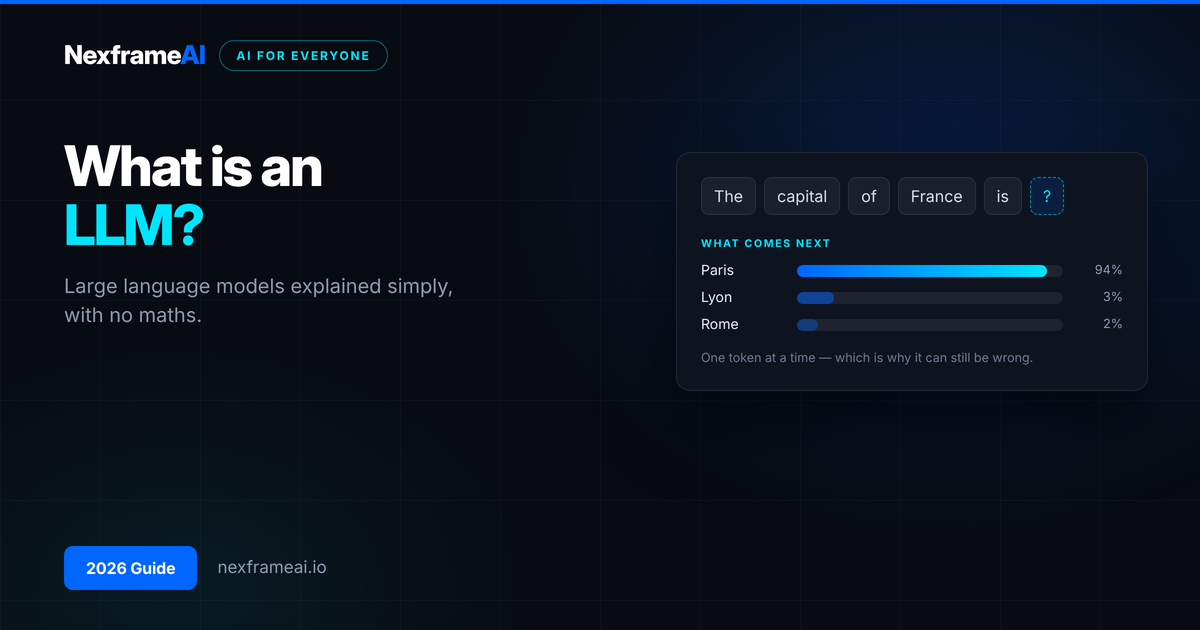
What is an LLM? An LLM, or large language model, is a type of artificial intelligence trained on huge amounts of text so it can understand and generate human language. It's the technology inside ChatGPT, Claude, Gemini and many other AI tools you've probably used.
In one sentence: an LLM reads your message and predicts, one small piece at a time, the most likely helpful words to come next. That simple idea, done at enormous scale, lets it answer questions, write essays, translate, summarise and even write code.
This guide explains the LLM meaning in plain English, how these models are built, what they're good and bad at, and how to use them well, whether you're a student in Ibadan, a shop owner in Kano or just curious.
What Does LLM Stand For?
LLM stands for Large Language Model. Each word tells you something:
Large: the model is trained on a vast amount of text (books, websites, articles, code and more) and has billions of internal settings, called parameters.
Language: it works with human language. Many modern LLMs also handle images, audio and video, but language is their core.
Model: it's a mathematical system that has learned patterns from data. It isn't a database of facts and it isn't a person.
So when people search for "LLM meaning", the simplest answer is: a large AI system that has learned the patterns of language well enough to read and write like a human.
One note: in law, LLM (often written LL.M.) also means Master of Laws, a postgraduate law degree. If you're reading about AI, it means large language model.
How Does an LLM Work? The Simple Version
You don't need maths to understand the basic idea. Think of it in four steps.
Step 1: Text becomes tokens
An LLM doesn't read words the way you do. It breaks text into small chunks called tokens. A token might be a whole word ("market"), part of a word ("mark" + "et") or a punctuation mark. As a rough guide, a short English word is often one token, and longer or less common words take several. You can see this for yourself with our free AI token counter.
Step 2: The model learned patterns during training
Before you ever use it, the model is trained on a massive collection of text. During training it plays one game billions of times: guess the next token. Each time it guesses wrong, it adjusts its parameters slightly. After enough practice, it becomes very good at predicting what comes next in almost any kind of text.
That's how it "learns" grammar, facts, writing styles, reasoning patterns and even some coding, without anyone programming those rules directly.
Step 3: Fine-tuning makes it helpful
A model trained only to predict text would ramble. So companies fine-tune it further, using examples of good answers and feedback from human reviewers, so it follows instructions, answers politely and avoids harmful content. This is a big part of why ChatGPT feels like an assistant rather than an autocomplete tool.
Step 4: Your prompt sets the direction
When you type a message (a prompt), the model reads it, along with any earlier messages in the chat, and generates a reply one token at a time. Each new token is chosen based on everything before it. That's why clear, detailed prompts get better answers.
A quick analogy
Imagine someone who has read almost every book in a huge library but has no internet and no notebook. Ask them anything and they'll answer fluently from memory. Usually they're right. Sometimes they mix things up or confidently make something up. That's an LLM.
Key Terms You'll Hear
Term | What it means in plain English |
|---|---|
Parameters | The model's internal settings, adjusted during training. More parameters often (not always) means more capability. |
Tokens | The small chunks of text a model reads and writes. Pricing and limits are often measured in tokens. |
Context window | How much text the model can consider at once, including your prompt, files and its reply. |
Training data | The text the model learned from. It has a cut-off date, so the model may not know recent events. |
Prompt | Your instruction or question to the model. |
Hallucination | When the model states something false as if it were true. |
Fine-tuning | Extra training to make a model better at a specific style or task. |
Multimodal | A model that can work with images, audio or video as well as text. |
Examples of LLMs in 2026
You've almost certainly used an LLM already. Some of the best-known families at the time of writing:
GPT (OpenAI): powers ChatGPT. GPT-6 arrived in October 2026, with Sol on paid plans and Luna on the free plan.
Claude (Anthropic): the Claude 5.5 family, released across September and October 2026.
Gemini (Google): Gemini 4 Argon is available in the Gemini app for AI Pro and Ultra subscribers, while the free tier runs on Gemini 3.5 Flash Lite.
Open-weight models: models from companies such as Meta, Mistral, DeepSeek and others that developers can download and run on their own hardware.
Some LLMs are "closed" (you use them through an app or paid API) and some are "open-weight" (you can download and run them). Our guide to open-source vs closed AI models explains the trade-offs.
The model and the app aren't the same thing. ChatGPT is an app; GPT-6 is the model inside it. Perplexity is an app that can use several different models, which is part of why the Perplexity vs ChatGPT comparison is about more than just "which AI is smarter".
What LLMs Are Good At
LLMs are strong at tasks that involve language and patterns:
Explaining hard topics simply, at your level.
Writing and editing: emails, essays, reports, social posts, CVs.
Summarising long documents, lecture notes or meeting transcripts.
Translating and working across languages, including (with mixed quality) Nigerian languages. See using AI in Yoruba, Igbo, Hausa and Pidgin.
Brainstorming ideas, names, angles and plans.
Writing and explaining code.
Turning messy information into structure: tables, lists, step-by-step plans.
What LLMs Get Wrong
Understanding the limits is the most important part of using an LLM well.
They can make things up
Because an LLM predicts likely text rather than looking facts up, it can produce answers that sound right but aren't: fake quotes, invented statistics, citations to papers that don't exist. This is called hallucination, and our guide on what AI hallucination is explains why it happens and how to catch it.
Their knowledge has a cut-off
A model only knows what was in its training data. Unless the app lets it search the web, it may not know about recent news, prices or exam dates.
They don't "understand" like humans
LLMs are brilliant pattern matchers, but they don't have experiences, beliefs or common sense in the human way. They can fail at simple tasks that need careful counting, exact logic or real-world checking.
They can reflect bias
If the training data contains stereotypes or gaps (for example, less text about African contexts), the model can repeat them. Always apply your own judgement, especially on local issues.
They forget beyond the context window
In a very long chat, early details may fall outside what the model can consider. Starting a fresh chat with a clear summary often helps.
How LLMs Get Smarter: Search, Tools and Your Data
Modern AI apps often combine an LLM with other tools to cover its weak spots:
Web search: the app searches the internet and gives the model fresh results to work from.
Retrieval-augmented generation (RAG): the app finds relevant passages in your own documents and feeds them to the model, so answers are grounded in your material. Our explainer, What Is RAG in AI?, covers this.
Tools and agents: the model can call a calculator, run code, fill in a spreadsheet or take actions in other apps.
This is why the same model can feel very different in different apps.
Why LLMs Matter for You
You don't need to build an LLM to benefit from understanding one. Knowing how they work helps you in three practical ways.
You'll get better answers. Once you know the model predicts text from your prompt and its training, you'll naturally give it more context and clearer instructions.
You'll avoid embarrassing mistakes. Knowing that LLMs can invent facts stops you from submitting a fake citation in an assignment or quoting a wrong price to a customer.
You'll spot opportunities. Small businesses in Nigeria already use LLMs to answer customer questions on WhatsApp, write product descriptions and draft proposals. Students use them as patient tutors. Job seekers use them to tailor CVs. Understanding the basics helps you see where they could save you time, and where a human still needs to be in charge.
How to Use an LLM Well
A few habits make a big difference:
Give context. Who you are, what you need and who it's for.
Be specific about the output. Length, format, tone.
Ask it to say when it's unsure.
Check important facts against a trusted source.
Iterate. Treat the first answer as a draft and ask for changes.
Here's a reusable prompt that applies those habits:
I'm a [your role, e.g. 200-level economics student at UNILAG].
Explain [topic] to me as if I'm new to it.
Use one example from everyday life in Nigeria.
Keep it under [number] words, then give me 3 quick questions to test myself.
If you're not sure about any fact, say so clearly instead of guessing.
For more techniques, read our guide to better prompts for better AI results. If you enjoy this and want to turn it into a career, see our guide to prompt engineering jobs.
Worked Example: Tunde Learns What an LLM Can (and Can't) Do
Tunde is a final-year accounting student in Ibadan. His lecturer mentioned "LLMs" in class, and he wants to know whether he can trust one to help with his project on small business taxes.
Test 1: Explaining a concept. He asks a free LLM app to explain depreciation with an example of a Lagos bakery's oven. The explanation is clear and the example makes sense. Good result.
Test 2: Summarising. He pastes in eight pages of his own lecture notes and asks for a one-page summary with key formulas. It does this well, though he notices it drops one formula, so he adds it back.
Test 3: Current facts. He asks for the latest Nigerian tax rates for small companies. The answer sounds confident, but when he checks official sources, some details are out of date. Lesson learned: the model's training data has a cut-off, and tax rules change. He switches to an app with web search and checks every figure against the official source.
Test 4: Citations. He asks for five academic references. Two of them don't exist. He now uses AI only to suggest search terms, then finds real papers himself.
Cost: ₦0 using free plans, plus data. He decides he doesn't need a paid plan yet, which would cost roughly ₦15,000 to ₦30,000 a month at current exchange rates (an estimate; prices and rates change).
Takeaway: Tunde now uses the LLM as a tutor and editor, never as his final source.
Common Mistakes to Avoid
Treating an LLM like a search engine. Without web search, it answers from memory, which may be outdated or wrong.
Copying answers without checking. Especially numbers, names, dates, laws and citations.
Sharing private information. Don't paste passwords, BVN, bank details or confidential work data.
Giving vague prompts. "Tell me about marketing" gets a vague answer. Add context.
Assuming all LLMs are the same. Different models and apps have different strengths, limits and prices.
Believing it "knows" you. Unless memory is switched on, it doesn't remember past chats.
Final Thoughts
So, what is an LLM? It's a powerful text-prediction system trained on vast amounts of language, fine-tuned to be helpful, and wrapped in apps like ChatGPT, Claude and Gemini. It can explain, write, summarise and code remarkably well. It can also be confidently wrong.
Use it like a clever, fast assistant who sometimes misremembers: give clear instructions, ask follow-up questions and check anything that matters. Do that, and an LLM becomes one of the most useful tools you have.
Frequently Asked Questions
What does LLM stand for?
LLM stands for Large Language Model, a type of AI trained on huge amounts of text to understand and generate language. In law, LL.M. also means Master of Laws, but in tech it almost always means large language model.
What is the meaning of LLM in simple terms?
An LLM is an AI that has read so much text that it can predict and write human-like language. You give it a prompt, and it generates a reply one small piece at a time.
Is ChatGPT an LLM?
ChatGPT is an app built on LLMs. The model inside it in late 2026 is GPT-6 (Sol on paid plans, Luna on the free plan). The app adds features like memory, web search, file uploads and image generation.
What's the difference between an LLM and a chatbot?
A chatbot is the interface you type into. An LLM is the engine that can power it. Older chatbots followed fixed scripts; modern ones often use an LLM underneath, which is why they can handle questions they weren't specifically programmed for.
Are LLMs the same as AI?
No. AI is the broad field. LLMs are one type of AI focused on language. Other types of AI handle things like image recognition, recommendations or self-driving systems.
Can an LLM think?
Not in the human sense. LLMs can reason through problems step by step and often produce impressive results, but they work by predicting patterns in text, not by having understanding, feelings or beliefs.
Why do LLMs make mistakes?
They predict likely text rather than looking up verified facts, their training data has a cut-off date, and the data may contain errors or gaps. That's why checking important facts matters.
Can I use an LLM for free in Nigeria?
Yes. ChatGPT, Gemini, Claude and Perplexity all offer free plans that work in Nigeria, with usage limits. Some free plans, including ChatGPT's, now show ads.
Comments (0)
Sign in to post a comment.
- Be the first to comment.