Perplexity vs Google in 2026: AI Search, AI Mode and Traffic Compared
Google handles about 90% of the world's searches, but Perplexity's cited answers still win for many research questions. We compare Perplexity vs Google in 2026: traffic and market share, Google AI Mode and AI Overviews, accuracy studies, research and everyday use, privacy and availability in Nigeria.
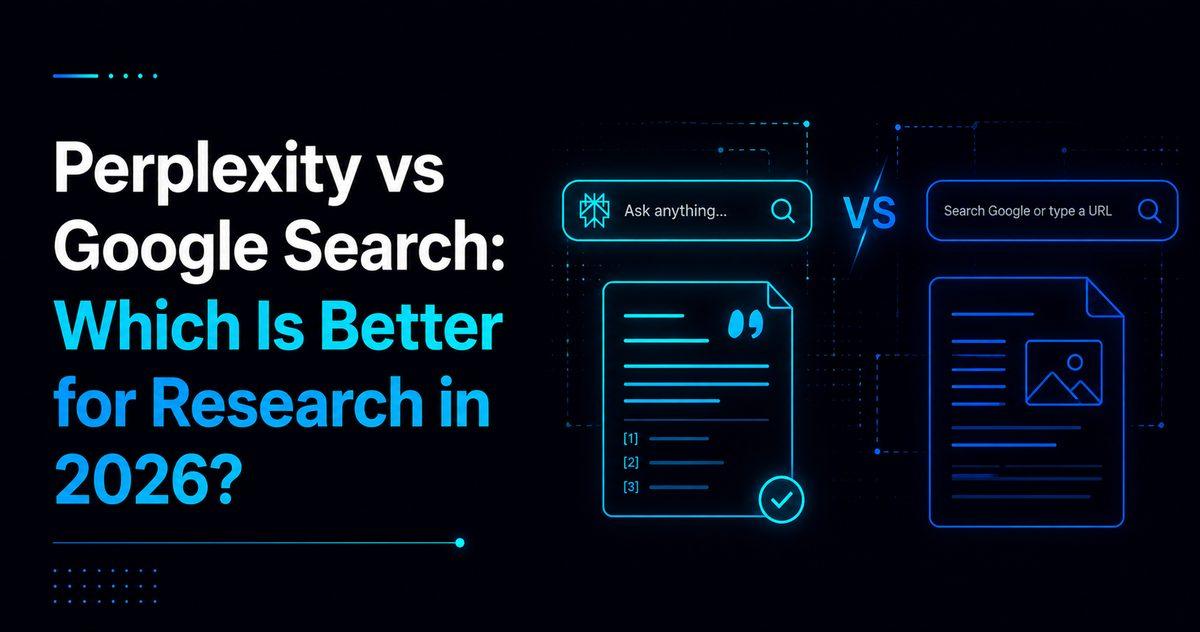
Perplexity is better when you want a direct, cited answer to a research question and a tidy place to dig deeper, while Google is better for almost everything else: local results, maps, shopping, news, and the sheer breadth of the web, now with its own AI answers through AI Overviews and AI Mode. In traffic, there is no contest. Google handles about 90% of the world's searches, while Perplexity is a small but fast growing challenger.
The comparison has changed a lot since 2024. Google has built AI answers into Search for billions of people, including in Nigeria, where AI Mode now works in English, Hausa and Yorùbá, and Perplexity has added Deep Research, a free AI browser called Comet and an agent called Computer. This guide compares Perplexity vs Google in October 2026: how big each is, how their AI search works, which is more accurate, and which to use for study, research and everyday questions.
Perplexity vs Google at a glance
Perplexity | Google (Search, AI Overviews and AI Mode) | |
|---|---|---|
What it is | An AI answer engine that searches the web and replies with citations | The world's largest search engine, with AI answers built in |
Share of searches | A small fraction | About 90% worldwide |
AI answers | Every answer, with numbered sources | AI Overviews at the top of results, AI Mode for conversations |
Follow up questions | Yes, in threads | Yes, AI Overviews continue into AI Mode |
Research tools | Pro Search, Deep Research, Labs, Spaces | Deep Search on paid plans, plus Google Scholar separately |
Local, maps and shopping | Limited | Excellent: Maps, reviews, opening hours, shopping and bookings |
Free plan | Yes: 3 Pro Searches a day and 1 Deep Research a month | Yes, free for everyone |
Paid plans | Pro (about $20 a month), Education Pro $10, Max $200 | Advanced features with Google AI Pro or Ultra |
Available in Nigeria | Yes, priced in US dollars | Yes, including AI Mode in English, Hausa and Yorùbá |
Google vs Perplexity traffic and market share
The gap is enormous:
Google handles about 90% of global searches, according to StatCounter's September 2026 figures, far ahead of Bing at about 5%. Google said in 2025 that it processes more than 5 trillion searches a year, which works out to roughly 14 billion a day.
Perplexity last shared an official figure in May 2025: 780 million queries a month, or about 26 million a day. On those numbers, Google handles several hundred times as many searches.
Website visits: web traffic estimates from Similarweb put Perplexity at roughly 140 to 170 million visits a month in mid 2026, down from a peak in late 2025.
Among AI tools: in Similarweb's September 2026 data for AI chatbot websites, Perplexity had about 0.9% of visits, behind ChatGPT, Gemini, Claude and others.
Google's own AI search is also huge: Google says AI Mode passed 1 billion monthly users in 2026.
Traffic is not the same as quality, though. Perplexity's users are often researchers, students and professionals who value its citations, and that is why it remains worth comparing.
What is Perplexity in 2026?
Perplexity is an AI answer engine. You ask a question in plain language, it searches the web, and it writes an answer with numbered citations you can click. Its main tools now include:
Pro Search: deeper searches that break your question into steps.
Deep Research: long, cited reports on a topic, which now run inside its Computer agent.
Labs: builds reports, dashboards, slides and simple apps from your research.
Spaces: project folders where you can keep threads and upload files.
Comet: an AI web browser, free worldwide since October 2025, that can summarise pages and carry out tasks for you.
Plans: the free plan includes 3 Pro Searches a day and 1 Deep Research query a month. Pro costs about $20 a month, students can get Education Pro for $10 a month after verification, and Max costs $200 a month for heavy users.
Perplexity also faces legal challenges. Several publishers, including the New York Times and Dow Jones, have sued it over how it uses their articles, and Cloudflare accused it in 2025 of getting around websites' crawling rules, which Perplexity denied.
What are Google AI Mode and AI Overviews?
AI Overviews are the AI summaries at the top of many Google results, powered by Gemini.
AI Mode is a conversational search tab. It splits your question into smaller searches, runs them at once, and writes an answer with links, and you can ask follow up questions by text, voice or photo.
Since May 2026 the two work together: you can start from an AI Overview and continue the conversation in AI Mode. Google has also added features such as booking help and background "information agents" that keep watch on a topic for you, although many new features launch in the US first. Deep Search, which produces long cited reports, launched for paid Google AI subscribers.
In Nigeria, AI Mode launched in August 2025, and since March 2026 AI Overviews and AI Mode also support Hausa and Yorùbá.
Which is more accurate?
Neither is perfect, so check the sources for anything important.
Citing news correctly: in a March 2025 study by Columbia University's Tow Center, eight AI search tools were asked to identify the source of news excerpts. They got it wrong more than 60% of the time overall. Perplexity had the lowest error rate, at 37%, while some rivals were wrong far more often.
Google's AI answers: an April 2026 analysis reported by The New York Times found AI Overviews answered about 91% of test questions correctly on Google's Gemini 3 model, up from about 85% on the previous model. At Google's scale, even a 9% error rate means a very large number of wrong answers, and Google disputed the study's method.
The practical lesson is the same for both: AI search is a fast starting point, not the final word. Open the cited pages and confirm key facts, dates and numbers yourself.
Perplexity vs Google for research and study
Perplexity is usually better for research questions. Every answer shows its sources, you can filter towards academic sources, follow up questions stay in one thread, and Spaces keep a project's research together. Education Pro at $10 a month makes the paid features cheaper for students.
Google is better for finding specific pages and primary sources. Use Google Scholar for academic papers, ordinary Google Search for official websites, and AI Mode when you want a quick explained overview.
A good research routine:
Use Perplexity or AI Mode to get an overview and a list of sources.
Open the original sources and read the relevant parts yourself.
Use Google Scholar to find the key papers and check they really exist.
Put your chosen sources into a tool like Gemini Notebook to compare them with citations, as explained in our guide to Gemini Notebook vs ChatGPT for research.
For a full project method, see our guide to using AI for a literature review and final year project.
Perplexity vs Google for everyday searches
Google wins for everyday life. Searching for a restaurant, a pharmacy that is open now, directions, a phone number, product prices, the weather or breaking news is faster on Google, with Maps, reviews and shopping results built in.
Perplexity wins when you want an explanation. Questions like "what are the pros and cons of solar inverters for a small shop in Lagos?" or "explain how the new tax rules affect freelancers" get a clear, cited summary instead of ten links.
AI search means fewer clicks to websites
If you run a website or a business, AI answers change how people find you. A 2025 Pew Research Center study found that people clicked a regular search result on only 8% of visits when an AI summary appeared, compared with 15% when there was none, and rarely clicked the links inside the summary. SEO company Ahrefs reported in February 2026 that the top result gets far fewer clicks when an AI Overview is shown.
The response is to publish content that AI tools want to cite: clear answers, original information, real experience and named sources.
Privacy
Perplexity: by default it can use your searches to improve its AI. You can turn off AI data retention in your settings, which stops future use, and incognito threads are deleted after about a day.
Google: AI Mode conversations are saved in your Google account history, where you can review them, delete them or set them to delete automatically.
Using Perplexity and Google in Nigeria
Google AI Mode and AI Overviews are available in Nigeria, in English, Hausa and Yorùbá, at no cost.
Perplexity works in Nigeria, but its paid plans are priced in US dollars, and there is no local telecom deal offering free Pro, unlike Airtel's offer in India. Students can apply for Education Pro.
Data: both work well on mobile, but AI answers and the Comet browser use more data than a simple search, so watch your bundle on long research sessions.
Other AI search engines worth knowing
Perplexity and Google are not the only options. ChatGPT searches the web with citations, Gemini answers with Google Search built in, and Microsoft Copilot uses Bing. For a full comparison of the main assistants, read our guide to ChatGPT vs Claude vs Gemini, and if you want to understand how these tools find and cite sources, our explainer on what RAG is covers the technique behind them.
Frequently asked questions
Is Perplexity better than Google?
Perplexity is better for research questions where you want a direct, cited answer and a place to dig deeper. Google is better for local searches, maps, shopping, news and finding specific websites, and its AI Mode now gives cited AI answers too. Many people use both.
How much traffic does Perplexity get compared with Google?
Google handles about 90% of the world's searches, more than 5 trillion a year. Perplexity reported 780 million queries a month in May 2025, so Google handles several hundred times as many searches. Web traffic estimates put Perplexity at roughly 140 to 170 million visits a month in mid 2026.
What is Google AI Mode?
AI Mode is a conversational search experience in Google Search. It breaks your question into smaller searches, writes an answer with links, and lets you ask follow up questions by text, voice or photo. Google says it has more than 1 billion monthly users.
Is Perplexity free?
Yes. Perplexity's free plan includes everyday searches plus 3 Pro Searches a day and 1 Deep Research query a month. Pro costs about $20 a month, and students can get Education Pro for $10 a month.
Is Google AI Mode available in Nigeria?
Yes. AI Mode launched in Nigeria in August 2025, and since March 2026 Google's AI Overviews and AI Mode also work in Hausa and Yorùbá as well as English.
Is Perplexity accurate?
Perplexity is often accurate and shows its sources, but it still makes mistakes. In a 2025 study of AI search tools, it had the lowest error rate for citing news sources, at 37%, which is still high. Always open the sources for important facts.
What is Perplexity Comet?
Comet is Perplexity's AI web browser. It has been free worldwide since October 2025 and can summarise pages, answer questions about what you are reading and carry out tasks for you.
Which is better for students, Perplexity or Google?
For research and essays, Perplexity is useful for quick cited overviews, and Education Pro is cheaper for students. Google is essential for finding primary sources through Google Scholar and official websites. The best approach is to use both, then read and cite the original sources yourself.
Comments (0)
Sign in to post a comment.
- Be the first to comment.