AI Drug Discovery: Anthropic Reports Early Wins With Claude
Anthropic says Claude is speeding up early AI drug discovery work with six partners. What was reported, what's still unproven and what it means for Africa.
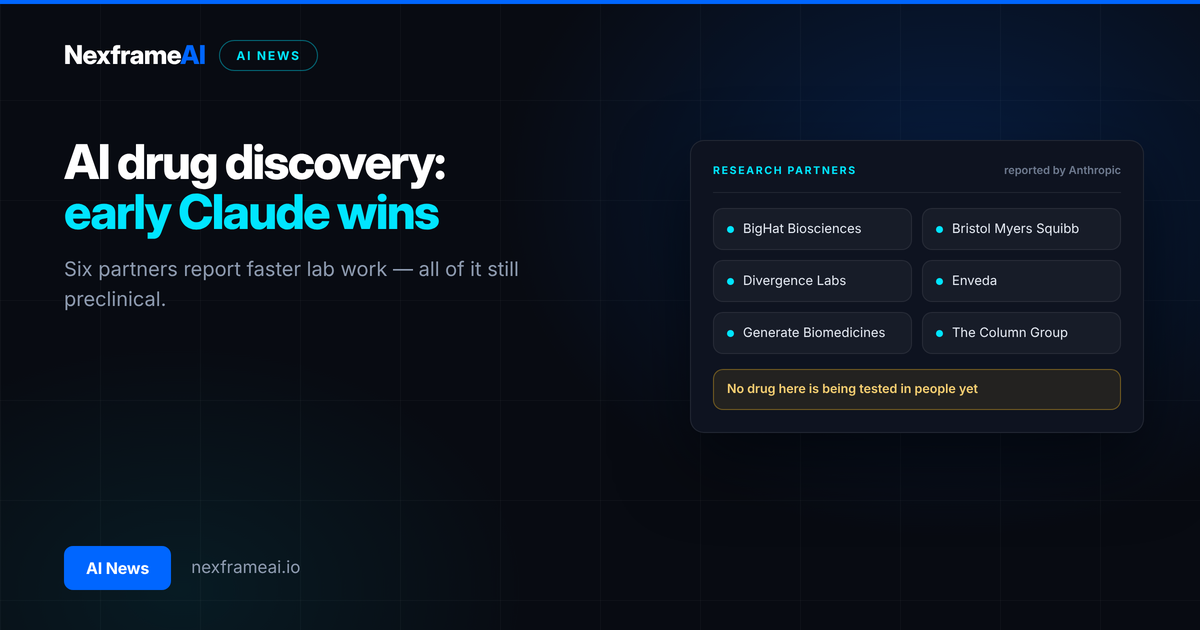
On 27 October 2026, Anthropic published a report on how its Claude models have been helping six drug developers design antibodies, redesign a cancer therapy and cut weeks of paperwork down to hours. It's one of the most detailed looks yet at AI drug discovery in practice, but Anthropic is clear that the work is early, mostly preclinical and, for the most part, not yet at the stage where the drugs are being tested in people.
That caveat matters. This is a story about faster lab work and smarter planning, not about new medicines you can get from a pharmacy. Here's what was actually reported, what it doesn't prove, and what it could mean for researchers and drug makers in Nigeria and across Africa.
What Happened
In a research post titled "Early progress on accelerating drug development with Claude", Anthropic said its life sciences team has spent several months in what it calls "deep research partnerships" with six organisations. It added: "We've also begun drug discovery efforts of our own."
The six partners are BigHat Biosciences, Bristol Myers Squibb, Divergence Labs, Enveda, Generate Biomedicines and The Column Group, which is setting up a new company called Pleiades.
Anthropic also said it has acquired Mithril Medicine, a one-person company developing treatments for two rare forms of muscular dystrophy, and has started its own programmes, including work on rare childhood forms of muscular dystrophy.
The company says it plans "to scale this work up substantially from here". A day later, on 28 October, Anthropic separately announced that its AI for Science programme, which gives free Claude credits to researchers, is expanding through 20 foundations, institutions and research groups.
Why It Matters
Bringing a new medicine to market usually takes many years and huge sums of money, and most candidate drugs fail somewhere along the way. Anything that makes the early stages faster or cheaper, or helps teams drop bad ideas sooner, could matter a lot.
AI has been part of drug discovery for years, mostly through specialist models that predict protein structures or screen molecules. What's different here is that Anthropic is reporting on a general-purpose AI model, the same Claude that people use for writing and coding, acting as a research assistant across the whole process: planning experiments, generating designs, analysing lab data, checking documents and drafting regulatory filings. If you want to understand how one model can do all of that, our explainer on what an LLM is covers the basics.
There's a business angle too. Anthropic first filed confidentially for an IPO back in June, has now made its finances public in its filing to list on Nasdaq, and we break down what the Anthropic S-1 reveals in a separate story. Science and health are areas where AI companies hope to show value beyond chatbots, so expect Anthropic to talk about this work a lot.
The Details
Here's what each partner reported, according to Anthropic. These are partner-reported results from lab tests and internal work, not peer-reviewed trials.
Generate Biomedicines: a shorter CAR T design
CAR T-cell therapy is a cancer treatment that reprogrammes a patient's own immune cells to attack tumour cells. Anthropic says six Generate scientists used Claude Code to propose new designs for one genetic component of the therapy.
One design was about 70% shorter than the standard version and, in lab tests, worked better. Immune cells produced roughly ten times more of the receptors that let them find cancer, killed tumour cells more efficiently and stayed active longer. Promising, but these are lab results, not results in patients.
Divergence Labs: antibodies for food allergy
Divergence Labs works on food allergies. According to Anthropic, Claude turned the team's goals into a design plan and then largely on its own generated about 35,000 antibody designs in roughly a month.
Early tests found three designs that bind IgE (the antibody behind allergic reactions) and 20 designs that could dislodge it. Three of those 20 dislodged IgE more than the standard medication did. The next step, Anthropic says, is a drug that combines the two approaches.
BigHat Biosciences: improving lead candidates
BigHat connected Claude to its lab data system and asked it to suggest changes to two antibody-fragment leads. About 1,010 variants were made and tested over roughly ten weeks.
When the team suspected some standard stability measurements were misleading, Claude and an Anthropic researcher reanalysed the data and proposed new measures and a change to the lab protocol. The best versions bound more than ten times more tightly, the cancer-targeting lead stayed in solution at a temperature 18°C higher, and the longer-lasting lead clumped more than 100 times more slowly.
Enveda: cutting paperwork
This one is less glamorous but perhaps the easiest to apply widely. Anthropic says Enveda's manufacturing chemists spent up to 75% of their time on paperwork.
Across 1,061 pages of manufacturing documentation, Claude caught all 11 issues human reviewers had found and flagged seven more they had missed. Human review time fell 89%, from more than 25 hours to under three. Claude also produced first drafts of two regulatory documents in four hours, work that took about three months by hand, and for one of them standard human review found just one minor error.
Bristol Myers Squibb and Pleiades
Bristol Myers Squibb is using Claude to assess trial plans for an early-stage drug and estimate their chance of success, with plans to expand the work in 2027. A BMS executive, Michael Pourdehnad, is quoted saying: "From a single prompt, Claude generated a robust initial analysis."
The Column Group is setting up Pleiades, which aims to use Claude to run more, and more complex, drug programmes than a small team normally could. Its first Claude skill, which judges whether a drug target is worth pursuing, has been tested on 45 target-disease pairs. Anthropic didn't share results and presents the approach as still unproven ("if this works").
Mithril Medicine and Anthropic's own work
Mithril's founder, Cody Tranbarger, used Claude to coordinate contracts, logistics and experiments with 11 outside labs. Anthropic says a possible treatment for one rare form of muscular dystrophy went from idea to promising results in mice in under 18 months. Tranbarger now works at Anthropic. If the candidates keep holding up, a drug could be ready for human trials as soon as late 2028.
Quick summary
Partner | Area | Reported result |
|---|---|---|
Generate Biomedicines | CAR T-cell therapy | Design ~70% shorter; ~10x more receptors in lab tests |
Divergence Labs | Food allergy | ~35,000 designs in ~a month; 3 beat standard medication at dislodging IgE |
BigHat Biosciences | Antibody optimisation | ~1,010 variants in ~10 weeks; >10x tighter binding |
Enveda | Manufacturing documents | 89% less human review time; 7 extra issues found |
Bristol Myers Squibb | Trial planning | Assessing early-stage trial plans; expansion planned for 2027 |
Pleiades (The Column Group) | Target assessment | Tested on 45 target-disease pairs; no results shared |
The caveats, in Anthropic's own words
Anthropic writes that "so far it is mostly preclinical" and "it isn't yet at the stage where the drugs are being tested in humans". It says some projects may lead to effective medicines if results keep holding up. Most of the figures above come from the partners themselves, and none have been independently replicated in what Anthropic published. Lab and mouse results often fail to carry over to humans.
How researchers can get access
Anthropic lists several routes:
Claude Science, which Anthropic describes as "our AI workbench for researchers".
The AI for Science programme, which gives Claude credits to scientists. Its 28 October expansion named partners such as the US National Science Foundation, the Simons Foundation, the Wellcome Sanger Institute and EMBL, which will distribute credits or use them internally.
The Life Sciences Verification Program, which lets trusted organisations use Anthropic's most powerful models with more permissive safeguards.
An open call for guest investigators, inviting proposals from research groups that want to use Claude for drug discovery.
What It Means for You
For ordinary readers: this is not medical advice
Nothing here changes how you or your family should treat any illness today. No drug from this work has been tested in humans. If you use Claude, ChatGPT or any AI tool to ask health questions, follow our guide on using AI for health questions safely and always confirm with a qualified doctor or pharmacist. AI can also state wrong things confidently, which we explain in what AI hallucination is.
For Nigerian and African researchers
Africa carries a heavy share of the world's disease burden but a small share of drug discovery research. Sickle cell disease is a clear example. According to a fact-check by Africa Check, data from the Institute for Health Metrics and Evaluation shows Nigeria has the highest number of people living with sickle cell disease in the world, and the World Health Organization has estimated that at least 150,000 Nigerian babies are born with it each year. Diseases like this, along with malaria and tuberculosis, are exactly where faster, cheaper early research would help most.
Could African institutions use these tools? Possibly, but it isn't clear yet. Anthropic's drug development post doesn't mention Africa, and the AI for Science expansion names no African partners. Neither page sets out who is eligible by country. If you're at a Nigerian university or a body such as the Nigerian Institute of Medical Research, the open call for guest investigators and the AI for Science programme are the routes worth checking. Read the current eligibility terms before you spend time on a proposal.
Lab capacity is the bigger limit. Claude generated thousands of antibody designs for Divergence, but someone still had to make and test them in a well-equipped lab. AI can speed up thinking and planning. It can't replace reagents, equipment, trained staff and reliable power.
For local pharma and regulatory teams
The Enveda result may be the most immediately useful for African companies. Nigerian manufacturers deal with large volumes of quality and regulatory paperwork, including filings for NAFDAC. Using AI to check documents for errors and draft first versions, with experts reviewing everything, is something a mid-sized local manufacturer could explore now with commercial tools, rather than waiting for frontier biology.
Worked example: a researcher in Ibadan
Take Dr Funmilayo, a pharmacology lecturer in Ibadan studying plant extracts traditionally used for sickle cell symptoms. She doesn't have a drug discovery lab or a big budget. Here's how she could use an AI assistant sensibly:
Literature mapping. She asks Claude to sort 60 papers she has already downloaded by method, dose and outcome, then checks every summary against the original paper. She never cites a source the AI suggests without opening it herself.
Experiment planning. She asks for a draft study plan, including controls and sample sizes, then reviews it with her head of department and a statistician.
Grant writing. She uses AI to tighten a funding application, but writes the science herself and checks every claim.
Access. She checks whether Anthropic's guest investigator call or AI for Science credits are open to Nigerian institutions, and asks her university's research office for help applying.
The cost is the subscription or API credits, which vary, so she checks current prices in dollars and converts at the day's rate. What she gets is time back for the lab work only she can do.
What to Watch Next
Peer-reviewed results. The strongest test is publication in journals, with data others can check. Watch for papers from these partners.
Human trials. Anthropic's earliest mention of possible human trials is late 2028 for Mithril's work. Until then, all of this remains preclinical.
Expansion in 2027. Bristol Myers Squibb plans to widen its use of Claude in trial planning next year.
Eligibility for African institutions. Look out for clearer rules on who can join AI for Science and the guest investigator call, and whether any African institutions take part.
Safety rules. The Life Sciences Verification Program, Anthropic says, loosens some safeguards for trusted organisations. How Anthropic decides who is trusted will matter, given the risks of misuse in biology. For background on how Anthropic handles its most capable models, see our coverage of Anthropic's Fable 5 release.
Final Thoughts
Anthropic's report is a genuine sign that general-purpose AI is becoming useful inside real labs, from antibody design to document review. The numbers are striking, but they are early, partner-reported and mostly from lab work, and AI drug discovery has a long history of exciting early results that didn't survive human trials.
For Nigeria and Africa, the opportunity is real but uneven. The diseases that burden the continent most could benefit hugely from faster research, yet the access routes and lab capacity aren't evenly spread. Watch the results, check the access programmes, and keep a healthy dose of scepticism.
Frequently Asked Questions
What is AI drug discovery?
AI drug discovery means using artificial intelligence to speed up the early stages of finding and developing medicines, such as choosing targets, designing molecules or antibodies, analysing lab data and preparing documents. It doesn't replace lab experiments or clinical trials.
Has Claude discovered a new drug?
No. Anthropic says the work is mostly preclinical and, for the most part, not yet at the stage where the drugs are being tested in humans. The earliest possible human trial it mentions is late 2028, and only if results keep holding up.
Who are Anthropic's drug discovery partners?
BigHat Biosciences, Bristol Myers Squibb, Divergence Labs, Enveda, Generate Biomedicines and The Column Group (through its new company, Pleiades). Anthropic also acquired Mithril Medicine.
Can Nigerian researchers use Claude Science or AI for Science credits?
Anthropic hasn't published country eligibility on these pages, and no African partners were named in the 28 October expansion. Check the current terms for AI for Science and the guest investigator call, and ask your institution's research office for help.
Should I use AI to decide on medical treatment?
No. These tools are for researchers working under expert supervision. For your own health, use AI only to prepare questions, and always follow advice from a qualified doctor or pharmacist.
Is the AI drug discovery hype justified?
Partly. The reported speed-ups in design and paperwork are impressive, but they come from partners and mostly from lab work. The real proof will be peer-reviewed results and, eventually, safe and effective medicines in human trials.
Comments (0)
Sign in to post a comment.
- Be the first to comment.