Anthropic Stock: What the S-1 Filing to List on Nasdaq as ANT Reveals
Anthropic stock will trade on Nasdaq as ANT. We break down the S-1: revenue, losses, share classes, the listing date and what Nigerians should know.
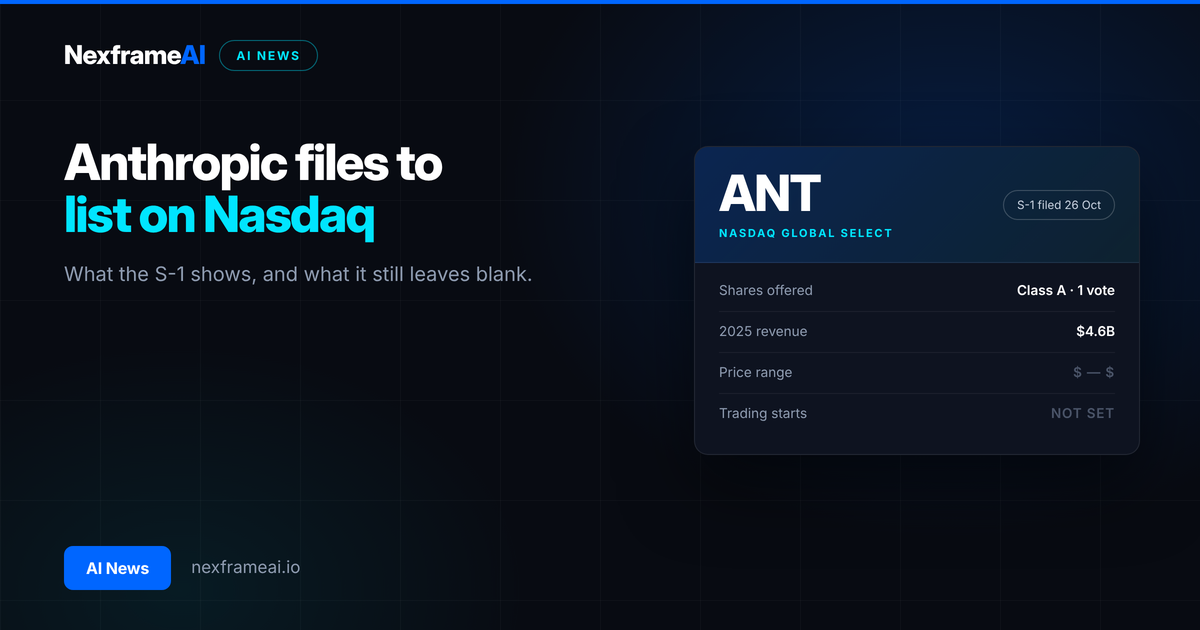
On 26 October 2026, Anthropic, the company behind Claude, publicly filed its S-1 registration statement with the US Securities and Exchange Commission, applying to list its Class A shares on the Nasdaq Global Select Market under the symbol "ANT". For the first time, anyone can read the company's real revenue, losses and ownership structure, and Anthropic stock is on track to become something you can actually buy.
This article explains what the filing shows in plain English, what's still unknown, and how people in Nigeria could follow a US listing like this. One thing first, said plainly: this is news and explanation, not investment advice. We're not telling you to buy, sell or avoid any share.
What Happened
Back in June, Anthropic filed confidentially for an initial public offering (IPO), which lets a company start the process without publishing its numbers. We covered that step in Anthropic files for IPO. The 26 October filing is the public version. The cover reads: "As filed with the Securities and Exchange Commission on October 26, 2026."
The key points from the filing itself:
Exchange and ticker: Nasdaq Global Select Market, symbol ANT. Anthropic says it has applied to list, and there's no public market for its shares yet.
What's on offer: Class A common stock, one vote per share.
Banks: Goldman Sachs and Morgan Stanley lead a group of more than 20 underwriters, including J.P. Morgan, Citigroup and Barclays.
Price and size: not set yet. The filing literally leaves the price range blank ("between $ and $"), along with the number of shares and total proceeds.
Use of money raised: general corporate purposes, including working capital, compute and infrastructure, and hiring, plus possible acquisitions (the filing says there are no agreements for any material ones).
When will trading start? The filing doesn't say. The Wall Street Journal reported that Anthropic aims to go public in the week of 16 November, citing people familiar with the matter, and other outlets have pointed to a November listing, but treat any date as unconfirmed until Anthropic sets its price.
Why It Matters
Anthropic is one of the two or three companies building the most capable AI models in the world. Until now, outsiders could only guess at its finances from leaks and funding rounds. The S-1 is a legal document, so the numbers in it carry real weight.
It also matters because the listing would let ordinary investors own a piece of a frontier AI lab directly, rather than through big tech companies that have invested in it. That's why searches for Anthropic stock have exploded. And it matters for the AI industry as a whole: how the market values Anthropic will shape how easily other AI labs raise money, and how hard they're pushed to make profits rather than just grow.
For Claude users, the filing is a window into the business behind the product. If you've wondered why Anthropic keeps launching tools for businesses and developers (like the proactive assistant in Anthropic launches Claude Duet), the revenue mix in the filing helps explain it.
The Details: Anthropic Stock by the Numbers
Here are the headline figures from the S-1, in US dollars.
Period | Revenue | Net loss |
|---|---|---|
2023 | $41 million | not covered here |
2024 | $386 million | not covered here |
2025 | $4,585 million (about $4.6 billion) | $41,965 million (about $42 billion) |
First half 2025 (six months to 30 June) | $1,163 million | $12,969 million |
First half 2026 (six months to 30 June) | $16,286 million (about $16.3 billion) | $80,748 million (about $80.7 billion) |
Revenue is growing extremely fast
Revenue went from $41 million in 2023 to $4.6 billion in 2025. Then, in just the first six months of 2026, Anthropic brought in $16.3 billion, roughly 14 times what it made in the same period a year earlier. Very few companies of any kind have grown like this.
The filing also says trailing twelve-month revenue per employee was over $6.6 million as of 30 September 2026, up from $1.4 million a year earlier. That suggests revenue is rising much faster than headcount.
Where does the money come from? The filing describes revenue as "primarily consumption-based", meaning customers pay for what they use. CNBC reported that usage-based API revenue (businesses and developers paying per token to build Claude into their own products) makes up around 80% of the total. If tokens and APIs are new terms for you, our explainer on what an LLM is covers them.
The losses look scary, but read the footnotes
An $80.7 billion loss in six months is an eye-watering number. But most of it isn't cash going out of the door. According to CNBC and other reports reviewing the filing, about $72.4 billion of the first-half loss was a non-cash charge from changes in the estimated value of convertible notes and similar instruments Anthropic used to raise money. In simple terms, when the estimated value of those instruments goes up, accounting rules record the increase as a loss, even though no cash leaves the company.
Anthropic's own adjusted figures (which strip out items like this) show adjusted net income of about $2.7 billion for the first half of 2026, compared with an adjusted loss of about $1.7 billion a year earlier. The filing also reports a GAAP operating margin of minus 4% for the period, against an adjusted operating margin of 10%. Adjusted numbers are chosen by the company, so read them alongside the official GAAP figures, not instead of them.
Spending and big commitments
The cost side is huge. According to Yahoo Finance's report on the filing:
infrastructure spending was about $9 billion in the first half of 2026, compared with $7.3 billion for the whole of 2025
two customers accounted for roughly a fifth of revenue
cloud computing commitments total around $430 billion, or up to $637 billion if you include commitments that can be cancelled
The filing itself warns that its revenue is mostly consumption-based while its compute contracts run for many years, which creates a mismatch if demand slows.
Who controls the company
This is the part many new investors miss. Anthropic is a public benefit corporation, and the S-1 sets out five share classes:
Class A: one vote per share. This is what the public would buy.
Class N: no vote except where the law requires. Mainly held by strategic business partners.
Class T: held by the Long-Term Benefit Trust (LTBT). It elects the directors who make up a majority of the board, but has no economic rights.
Class F: held by a founders' entity, carrying 50.1% of the total voting power on general shareholder matters, with no economic rights.
Class E: for employees other than the co-founders, with limited voting rights. None issued yet.
The filing describes the LTBT as intended to be "an independent body of five financially disinterested voting trustees" with backgrounds in AI safety, national security, public policy and social enterprise. In plain terms: if you buy Class A shares, you'd own part of the business but have very little say over who runs it. That structure is designed to keep Anthropic focused on its safety mission, and it's something to understand clearly before forming any view.
What It Means for You
If you use Claude
Day to day, nothing changes. Claude 5.5 models keep running as before. Over time, a listed company faces pressure from shareholders every quarter, so watch whether pricing, free-tier limits or product priorities shift. Anthropic's research on jobs and the economy (see AI taking jobs? Anthropic's employment report) and its science work (see our same-week story on Anthropic's early AI drug discovery results) will now be read partly through an investor lens too.
If you're in Nigeria and want to follow the listing
Here's how US listings generally work for people outside America. These are general points, not recommendations of any platform or product.
Buying at the IPO price is usually hard. IPO shares are mostly allocated to large institutions and selected clients of the underwriting banks. Most individual investors can only buy once the shares start trading on the exchange, often at a different price from the IPO price.
You'd need access to a US brokerage. Nigerians typically reach US shares through a US-registered broker, either directly or through a local app or firm that partners with one. Each works differently on fees, minimums and how your shares are held.
Check registration. The Securities and Exchange Commission, Nigeria (SEC Nigeria) has in the past cautioned the public about platforms offering foreign shares without proper registration in Nigeria. Before using any platform, check whether it, or its Nigerian partner, is registered, and read SEC Nigeria's current guidance.
Foreign exchange is part of the cost. You'd be investing in dollars. Funding an account can involve a domiciliary account, card limits or transfer fees, and the naira rate can move a lot. A share that rises 10% in dollars can still show a different result once converted back to naira.
Tax applies. US rules may withhold tax on dividends paid to foreign investors, and Nigerian tax rules may apply to your gains. Get proper advice if the amounts are meaningful to you.
Watch for scams. Big IPOs attract fake "pre-IPO" offers on WhatsApp, Telegram and Instagram. There is no Anthropic stock to buy before trading begins on Nasdaq, so anyone promising you early shares, guaranteed returns or a special allocation for a fee is a red flag.
A worked example: Emeka in Port Harcourt
Emeka, 29, works in oil and gas logistics in Port Harcourt and uses Claude daily. He's curious about the listing. Here's a sensible, cautious approach (not a recommendation to invest):
He reads the filing summary, not just social media posts, and notes the share-class structure and the size of the losses.
He checks his own budget first. Using a simple plan (our guide on how to budget with AI helps), he confirms he has an emergency fund before thinking about any risky asset.
He looks into platforms carefully, checking registration with SEC Nigeria and reading the fees for deposits, currency conversion and withdrawals.
He works out the true cost. If he ever put in $200, that's roughly ₦270,000 to ₦280,000 at an estimated ₦1,350 to ₦1,400 to the dollar (check the current rate), plus fees. He decides any amount must be money he could afford to lose completely.
He waits for the facts. He doesn't act on rumoured dates. He waits for the final price range and the first trading day, and ignores anyone in his DMs offering "early access".
What to Watch Next
The price range and share count. These will appear in an amended filing before the roadshow, when Anthropic pitches to big investors.
The listing date. Reports point to the week of 16 November, with the investor roadshow expected to begin the week of 9 November. Watch for Anthropic to confirm.
The valuation. Once the price is set, you'll see what the market thinks the company is worth.
First-day trading. Big tech listings can swing wildly on day one. Early price moves say little about long-term value.
Safety and policy decisions. Anthropic's choices about what to release, and governments' reactions to them, can move the business quickly. You saw this when Anthropic suspended Claude Fable 5 and later brought it back following a US government decision (we covered it in Claude Fable 5 is back). As a listed company, decisions like that would also be judged by shareholders, and that tension between mission and market is worth following closely.
OpenAI and other labs. Anthropic's reception will influence whether rival AI companies follow it to the public markets.
Final Thoughts
The S-1 confirms what many suspected: Anthropic is growing faster than almost any company in history, it spends enormous sums on computing power, and its headline losses are inflated by accounting charges but still real underneath. It also confirms an unusual governance structure that keeps control with a trust and the founders, not with public shareholders.
Whether Anthropic stock is right for anyone depends entirely on their own situation, which is why we won't tell you what to do. What we can say is this: read the filing, understand who controls the company, be honest about the currency and platform risks of investing from Nigeria, and never trust an offer of shares that arrives before the market opens.
Frequently Asked Questions
What is Anthropic's stock ticker?
Anthropic has applied to list its Class A common stock on the Nasdaq Global Select Market under the symbol ANT.
When can I buy Anthropic stock?
Not yet. The price and listing date haven't been set. The Wall Street Journal reported that Anthropic is aiming for the week of 16 November 2026, but that isn't confirmed by Anthropic.
How much revenue does Anthropic make?
According to the S-1, revenue was $4.6 billion in 2025 and $16.3 billion in the first six months of 2026, up from $1.2 billion in the same period of 2025.
Why did Anthropic lose $80.7 billion?
Most of it, about $72.4 billion according to reports on the filing, was a non-cash accounting charge linked to the rising value of convertible notes and similar instruments. Heavy spending on computing power also adds to the loss.
Can Nigerians buy Anthropic shares?
In general, people in Nigeria can access US-listed shares through brokers that serve international clients, subject to platform rules, foreign exchange access and SEC Nigeria's guidance. Check registration, fees and currency costs carefully before you do anything.
Will public shareholders control Anthropic?
No. Class A shareholders get one vote per share, but the Long-Term Benefit Trust elects a board majority through Class T stock, and a founders' entity holds 50.1% of voting power through Class F stock.
Comments (0)
Sign in to post a comment.
- Be the first to comment.