ChatGPT Ads Arrive in Nigeria and South Africa: What Changes for Free and Go Users
OpenAI is expanding ads in ChatGPT to 26 more countries, including Nigeria and South Africa. Here is what Free and Go users will see and how to stay in control.
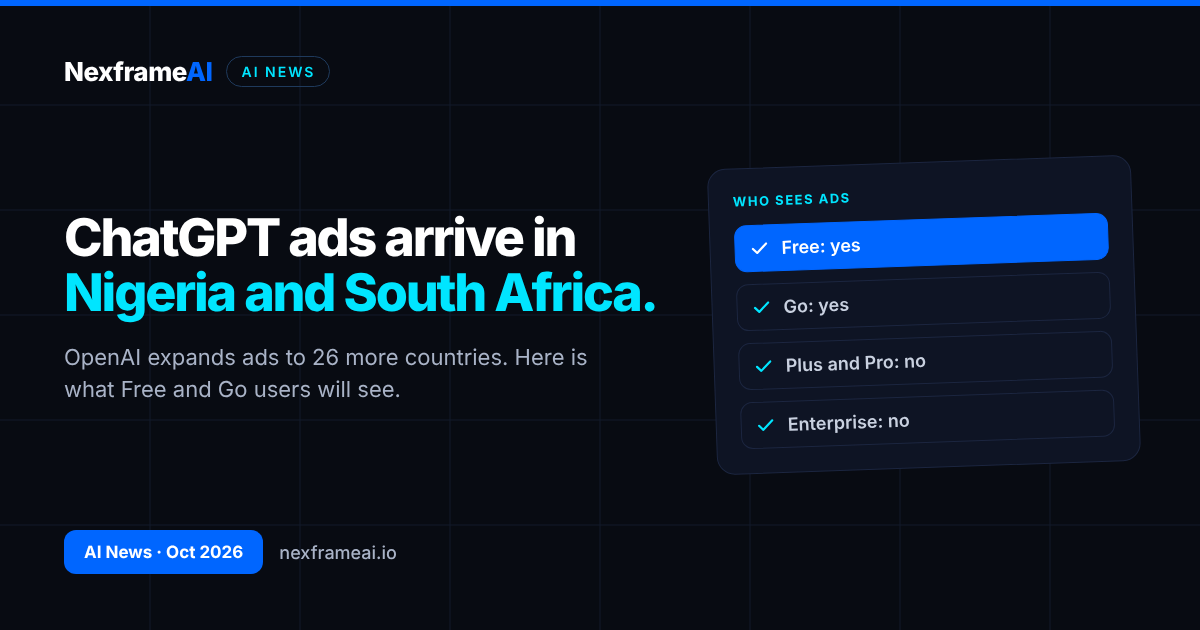
OpenAI is bringing ads in ChatGPT to 26 more countries, and Nigeria and South Africa are among them. Here is what the expansion means for Free and Go users, what OpenAI has and has not confirmed, and what Nigerian businesses can do if they want to advertise.
On 21 October 2026, OpenAI announced: "Today, we're expanding ChatGPT Ads to 26 additional countries." The company said the move takes ChatGPT advertising to 89 countries in total, just over eight months after ads first launched. Nigeria and South Africa are named in the announcement, making them the clearest African markets confirmed so far.
What Happened: Ads in ChatGPT Expand to 26 Countries
OpenAI's announcement is short and focused on scale. It confirms that ChatGPT Ads, which started in a smaller group of markets, are now rolling out to 26 additional countries. Alongside Nigeria and South Africa, the countries OpenAI names include Serbia, Ukraine, Cambodia, Bangladesh and Pakistan. In Latin America, it names Argentina, Chile, Colombia and Peru, and says 14 Latin American countries are part of the expansion in all.
OpenAI did not publish the full list of 26 countries on the announcement page. Instead, it refers to "more markets across Europe, the Middle East, Africa, and Asia". Kenya, Ghana and Egypt, three other large African markets, are not mentioned. That does not mean they are excluded, only that OpenAI has not named them.
The company framed advertising as a way of paying for broad access. In its words: "Advertising helps support free and low-cost access to ChatGPT for people around the world."
The Details
Here is a summary of what OpenAI has confirmed and what remains unclear.
Topic | What OpenAI said |
|---|---|
New countries | 26, including Nigeria and South Africa |
Total countries with ads | 89 |
When ads first launched | "Just over eight months ago" |
Plans that show ads | Free and Go only |
Ad-free plans | Plus, Pro and Enterprise |
Advertiser access | Self-serve through OpenAI's Ads Manager, or through tech partners |
Coming next | New ad formats, objectives, buying options and measurement |
Privacy | Conversations kept private from advertisers; customer data not sold |
Labelling | Ads clearly labelled and separate from ChatGPT's answers |
Which plans get ads
OpenAI was direct on this point: "Ads will appear only on the Free and Go plans. Plus, Pro, and Enterprise subscriptions will remain ad-free." Go is the low-cost tier that sits between Free and Plus, with higher limits than the free plan. It launched in India in August 2025 and has since expanded widely.
Privacy commitments
OpenAI repeated its core privacy promise: "we keep conversations private from advertisers and do not sell customer data." It also said that "Ads in ChatGPT are clearly labeled and separate from ChatGPT's answers", meaning an advert should never be dressed up as part of the AI's response.
What OpenAI has not said
Several practical questions are still open:
Start date in Nigeria and South Africa. The announcement says the expansion begins "today", but it does not say whether every user in each country will see ads immediately or whether the rollout is gradual.
The full country list. Only some of the 26 countries are named.
Local pricing. OpenAI has not announced local naira or rand pricing for Go or Plus as part of this news.
Ad formats for new markets. OpenAI says new formats are coming but has not described them in detail.
We will update our coverage if OpenAI publishes more.
Why It Matters
For years, the biggest AI chatbots in Africa were either free with tight limits or paid in US dollars, which is expensive for many people after currency swings. Advertising is OpenAI's attempt to keep a free and low-cost tier running at scale. The company's own framing makes clear that ads are meant to subsidise access rather than replace subscriptions.
For Nigerian users, the expansion is a sign that OpenAI now sees the country as a commercial market, not only a source of users. Advertising requires local demand from brands, local payment options for advertisers and enough engaged users to make campaigns worthwhile. Nigeria's inclusion suggests OpenAI believes all three are present or close.
It also changes the relationship between users and the product. When a service is paid for by advertising, users reasonably ask what data shapes the ads they see and whether the answers are influenced. OpenAI's statements address both points directly: conversations are private from advertisers, and ads are separate from answers. Those are commitments users can hold the company to. As our guide to the hidden costs of free AI tools explains, "free" software is always paid for somehow, whether through limits, data or advertising, and it helps to know which trade-off you are making.
There is a wider African angle too. Debates about who controls AI, where data lives and how much African users pay for foreign digital services are growing. Our coverage of Nigeria's proposal to pool Africa's AI computing power shows how policymakers are thinking about the same dependence from the infrastructure side.
What It Means for You
If you use ChatGPT Free or Go in Nigeria
Expect to start seeing sponsored content at some point, if you are not already. Based on OpenAI's description, they should appear as clearly labelled sponsored content kept apart from the answer itself, not woven into it. Your chats should work as before.
A few practical habits help:
Read the label. If something is marked as sponsored, treat it like any other advert. Compare prices and check the seller before you pay.
Do not confuse an ad with advice. If you ask for the best phone under a certain budget, the answer and any ad nearby are separate things. Make your decision from the answer and your own checks.
Be careful with links that ask for payment or personal details. Scammers often copy the look of legitimate adverts on other platforms. Our guide to spotting AI job scams and fake recruiters explains warning signs that apply to dodgy offers in general.
If you are a student, job seeker or creator
Many of our readers use ChatGPT Free for coursework, CV drafts, cover letters and content ideas. Ads should not change how those tasks work, but they add one more thing to keep an eye on.
Students: if you are researching a topic, keep a clear line between the answer, your own sources and anything sponsored. An advert for a tutoring service or a course is not a reference you can cite.
Job seekers: expect to see offers related to training, certification or job platforms if you ask career questions. Some may be useful; check any paid course or "guaranteed placement" offer carefully before you pay.
Creators: if you use ChatGPT to plan content, ads for tools and services may appear. Judge them on reviews and free trials, not on where you saw them.
How to tell an ad from an answer
OpenAI says ads are clearly labelled. In practice, look for three things: a label such as "sponsored" or "ad", visual separation from the main reply, and a brand name or link that you did not ask for. If you are ever unsure, treat anything ambiguous as an advert until you have checked it yourself.
Check your privacy controls
OpenAI says conversations stay private from advertisers, but you still have choices about how ads are personalised. Open ChatGPT's settings and look for the section on ads or personalisation. Our explainer on ChatGPT ads targeting and how to turn it off walks through what each control does. Settings names can change between app updates, so if you cannot find something, check the latest version of the app.
It is also worth reviewing what you share in chats generally. Avoid pasting bank details, BVN, passwords or full ID numbers into any AI tool, whatever plan you are on.
Should you upgrade to avoid ads?
Only Plus, Pro and Enterprise are ad-free, so moving from Free to Go will not remove ads. If ads are the only reason you are thinking about paying, consider whether the other benefits of Plus are worth it to you. For many students and casual users, the free or Go tier with ads will be perfectly usable.
Our comparison of ChatGPT Go vs Plus sets out the differences in limits and features, and our guide to free vs paid AI plans helps you decide whether any subscription is worth it. Check the current price in your app, since OpenAI has not announced new local pricing with this news. If you pay by card in dollars, remember your bank's exchange rate and any card charges will affect the final naira amount.
There is also the option of using another assistant. Gemini and Claude both have free tiers, and you can switch between tools depending on the task. Ads in one product are not a reason to abandon it, but they are a reason to know your alternatives.
If you run a Nigerian business
This is the more interesting change for many readers. OpenAI says advertisers in the newly added countries can buy ads through OpenAI's Ads Manager, a self-serve platform, or through tech partners. That means a Lagos fashion brand, an Abuja training provider or a Port Harcourt logistics company could, in principle, run campaigns that appear to ChatGPT users.
Before you spend money, keep these points in mind:
Start small. A new advertising channel has no local track record yet. Test with a modest budget and measure enquiries or sales, not just impressions.
Know your offer. People using ChatGPT are often researching or comparing. Clear pricing, delivery details and a simple next step matter more than clever copy.
Watch for new tools. OpenAI says new ad formats, objectives, buying options and measurement are coming. Early advertisers may find the options limited at first.
Keep your claims honest. An ad that overpromises will be judged harshly by users who can ask ChatGPT about your product in the next breath.
Do not neglect the basics. Strong product descriptions, a working WhatsApp line and good reviews will still decide whether a click becomes a customer.
Our guide to AI for marketing covers practical, low-cost ways to grow a small business with AI, whether or not you decide to try ChatGPT advertising.
What to Watch Next
Several things will show how this rollout plays out in Nigeria and South Africa:
When ads actually appear. Watch for reports from Nigerian and South African users about when sponsored content starts showing up and what it looks like.
The full list of countries. If OpenAI publishes it, we will know whether Kenya, Ghana, Egypt or other African markets are included.
Local pricing. Any move towards naira or rand pricing for Go or Plus would change the upgrade decision for many readers.
Advertiser tools. OpenAI has promised new formats, objectives, buying options and measurement. How quickly these arrive will determine whether small African businesses find the channel useful.
Trust and labelling in practice. The commitment that ads are clearly labelled and separate from answers will be tested as more advertisers join.
Other AI news this week underlines how fast the rules are shifting. OpenAI also said on 23 October that it will no longer train its most capable models on the live internet, and Google's updated privacy policy, effective 16 October, lets Gmail and Photos data inform personalisation, including ads, if users connect it to its Personal Intelligence feature, which Google says is not available in Nigeria.
Final Thoughts
Ads in ChatGPT were always likely to reach Nigeria once OpenAI committed to an ad-supported free tier. What matters now is how they are delivered. OpenAI has made clear promises: ads only on Free and Go, clear labels, separation from answers and no sale of customer data. Users should hold the company to those commitments, check their privacy settings and treat sponsored content with the same care they would anywhere else online.
For most people, nothing about how you use ChatGPT needs to change. If ads bother you, compare the paid plans carefully before upgrading. If you run a business, treat the new advertising channel as an experiment, not a shortcut, and start small.
Frequently Asked Questions
Are ads in ChatGPT now live in Nigeria?
OpenAI announced on 21 October 2026 that it is expanding ads to 26 additional countries, including Nigeria and South Africa. It has not given a specific start date for each market, so some users may see ads before others.
Which ChatGPT plans show ads?
Only Free and Go. OpenAI said Plus, Pro and Enterprise subscriptions will remain ad-free.
Will upgrading to ChatGPT Go remove ads?
No. Go is one of the two plans that show ads. You would need Plus, Pro or Enterprise for an ad-free experience.
Can advertisers read my ChatGPT conversations?
OpenAI says it keeps conversations private from advertisers and does not sell customer data. You can also review your ads and personalisation settings in ChatGPT.
Will ads change ChatGPT's answers?
OpenAI says ads are clearly labelled and kept separate from ChatGPT's answers. Treat anything marked as sponsored as an advert, and make decisions based on the answer and your own checks.
Are Kenya and Ghana included in the expansion?
OpenAI has not named Kenya, Ghana or Egypt. The company did not publish the full list of 26 countries, so their status is unclear.
Can Nigerian businesses advertise on ChatGPT?
OpenAI says advertisers in the newly added countries can buy ads through its self-serve Ads Manager or through tech partners. Start with a small test budget and measure real results.
Comments (0)
Sign in to post a comment.
- Be the first to comment.