ChatGPT Go vs Plus: Which Plan Is Worth It in 2026?
ChatGPT Go vs Plus compared for 2026: models, limits, ads, deep research and Codex, plus a simple way to decide which plan is worth paying for in Nigeria.
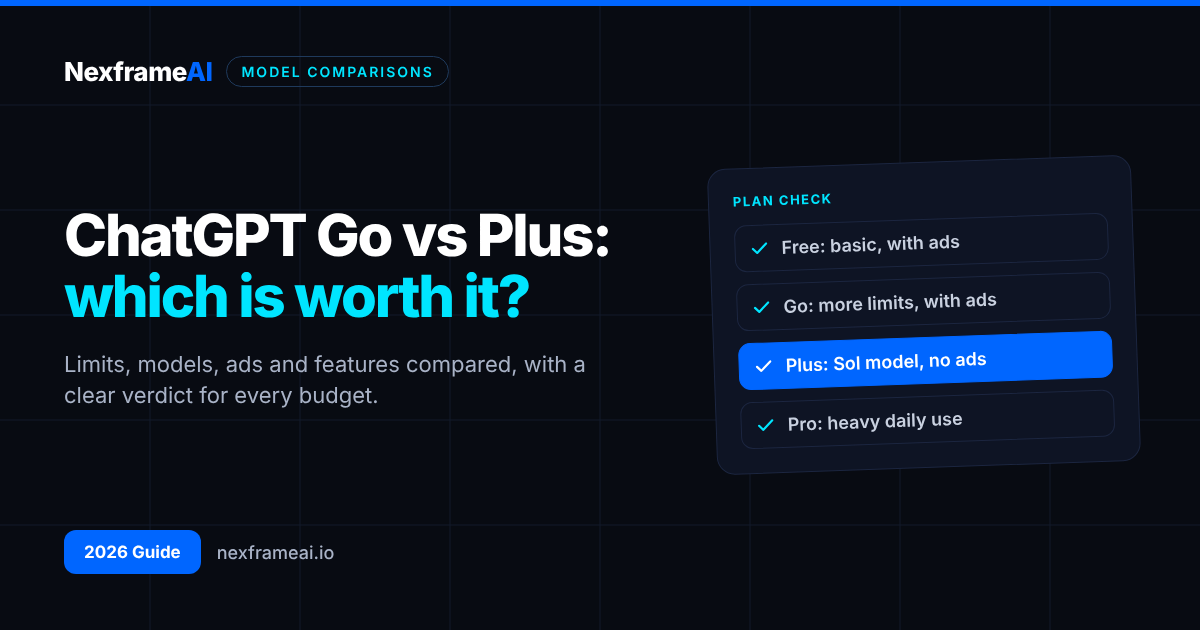
You use ChatGPT most days, the free plan keeps running out at the worst moments, and now there are two paid options sitting next to each other in the upgrade screen. ChatGPT Go is the cheaper one. ChatGPT Plus costs more but promises the stronger GPT-6 Sol model. Which one actually makes sense for you?
The question got more pressing this month. On 21 October 2026, OpenAI expanded ChatGPT ads to 26 more countries, including Nigeria and South Africa, and confirmed that ads appear only on the Free and Go plans. That changes the ChatGPT Go vs Plus decision for many readers.
In this guide, we compare the two plans feature by feature, explain who each one suits, walk through a worked example from Lagos and Ibadan, and give you a simple test to decide whether upgrading is worth your money.
What Is ChatGPT Go?
ChatGPT Go is OpenAI's low-cost paid plan. It launched in India in August 2025 and then expanded widely. OpenAI's help centre now says Go is available in all countries where ChatGPT is supported.
Think of Go as "Free, but with more room". According to OpenAI's help centre and pricing page, Go gives you:
Higher limits than Free for messages that use tools, file uploads, image creation and data analysis.
Longer memory and context, so ChatGPT remembers more about you and your conversations.
Projects and scheduled tasks for organising work and setting reminders or recurring jobs.
Think mode for harder questions, powered by the lighter Luna model.
Limited access to deep research, Codex and ChatGPT Work on desktop.
What Go does not give you matters just as much. OpenAI's help centre states plainly that Go does not include the Sol model, and legacy models are not included either. Go also shows ads.
What Is ChatGPT Plus?
ChatGPT Plus is the long-standing individual subscription, and in 2026 it sits between Go and the much more expensive Pro plans. OpenAI's pricing page describes it as everything in Go, plus:
Advanced reasoning with GPT-6 Sol, OpenAI's stronger model, with Instant, Medium and High thinking levels.
Expanded limits for messages, uploads and image creation.
Expanded deep research, memory and context.
Custom GPTs, listed as included.
Expanded Codex, OpenAI's coding agent.
ChatGPT Work on desktop, web and mobile.
Early access to new features.
No ads. OpenAI says Plus, Pro and Enterprise remain ad-free.
ChatGPT Go vs Plus at a Glance
Here is a side-by-side summary based on OpenAI's pricing page and help centre as of late October 2026. Limits change often, so treat this as a guide rather than a contract.
Feature | ChatGPT Go | ChatGPT Plus |
|---|---|---|
Main model | Luna (lighter model) | GPT-6 Sol |
Thinking levels | Instant and Think (Luna) | Instant, Medium, High (Sol) |
Everyday text chats | Unlimited, with abuse safeguards | Expanded |
Uploads and image creation | More than Free | Expanded beyond Go |
Memory and context | Longer than Free | Expanded beyond Go |
Deep research | Limited | Expanded |
Codex (coding agent) | Limited | Expanded |
ChatGPT Work | Limited, desktop | Desktop, web and mobile |
Projects and scheduled tasks | Included | Included |
Custom GPTs | Subject to feature availability | Included |
Legacy models | Not included | Check your app |
Ads | Yes | No |
Billing | Monthly only | Monthly |
Price | Check your app | Check your app |
About prices: we have not listed figures because OpenAI's prices vary by country, and the help centre notes that purchases are usually in US dollars, with local currency billing in a limited number of countries. Open ChatGPT, tap your profile, then Upgrade plan, to see the exact price for your account and region. In most regions, Plus costs noticeably more than Go.
The Differences That Actually Matter
A table makes the plans look similar. In daily use, five differences decide which one suits you.
1. Model Quality
This is the biggest gap. Plus gives you GPT-6 Sol, which OpenAI launched in early October as its stronger model, with higher thinking levels for complex work. Go stays on the lighter Luna model, even in Think mode.
For everyday tasks such as drafting a WhatsApp message, rewriting an email or explaining a concept, you may barely notice the difference. For long documents, tricky maths, multi-step reasoning, careful coding or analysis that needs to be right, Sol is usually more reliable. Our Claude vs ChatGPT vs Gemini comparison explains how these model tiers stack up against rivals.
No model is perfect, though. Both plans can still produce confident mistakes, so read our guide on what AI hallucination is before trusting either with anything important.
2. Ads
On Free and Go, you may see ads below or beside ChatGPT's answers. OpenAI says ads are clearly labelled and separate from answers, that conversations are kept private from advertisers and that it does not sell customer data. Our news report on ChatGPT ads arriving in Nigeria and South Africa covers what changes for Free and Go users, and our earlier explainer on how ChatGPT ad targeting works and how to turn it off shows which controls you have.
If you find ads distracting, or you use ChatGPT for client work and prefer a cleaner screen, that alone may push you towards Plus.
3. Deep Research and Agents
Deep research, where ChatGPT spends time browsing and compiling a cited report, is limited on Go and expanded on Plus. The same applies to Codex and ChatGPT Work. If you rely on these tools weekly for research, reports or coding, Go's limits will probably frustrate you.
4. Limits on Heavy Days
Both plans offer unlimited everyday text chat, subject to abuse safeguards. The difference shows up when you upload many files, create lots of images or run data analysis. Go gives you more than Free; Plus gives you more than Go. OpenAI does not publish exact numbers, so the practical test is whether you keep hitting limits on Go.
5. Payment Flexibility
Go is billed monthly and, according to OpenAI's help centre, does not support annual billing or prepaying several months. You can cancel anytime. If you downgrade from Plus to Go, there is no refund; your Plus plan stays active until the end of the billing cycle, then switches to Go.
Who Should Choose ChatGPT Go?
Go is a sensible choice if you:
Use ChatGPT daily for everyday tasks such as writing, studying, translation and quick research.
Keep hitting Free limits on uploads or image creation, but rarely need deep research.
Are on a tight budget and want more than Free without paying Plus prices.
Do not mind ads, or understand how to manage ad personalisation.
Many students and early-career professionals will find Go covers 80 to 90 per cent of what they need. That is our estimate, not an OpenAI figure, but it reflects how most people use ChatGPT: lots of short, everyday tasks.
Who Should Choose ChatGPT Plus?
Plus is worth it if you:
Do complex work where accuracy matters: data analysis, long reports, technical writing or coding.
Use deep research regularly for clients, coursework or business decisions.
Use Codex or ChatGPT Work as part of your job.
Want an ad-free experience, especially when sharing your screen with clients.
Earn money from your ChatGPT output, so a few saved hours a month cover the cost.
For example, if you use ChatGPT to clean spreadsheets and build formulas, the stronger reasoning in Plus can save real time. Our guide to ChatGPT for Excel shows the kind of work where that difference becomes obvious.
Worked Example: Chiamaka in Lagos and Tolu in Ibadan
Chiamaka is a freelance content writer in Lagos. She writes blog posts and product descriptions for four clients, uses deep research to gather background for long articles, and often shares her screen on client calls.
She opens the upgrade screen and sees both prices in US dollars. To estimate the naira cost, she multiplies by about 1,550, since roughly US$1 is about ₦1,550 in October 2026. So every US$10 is roughly ₦15,500. She also checks that her naira card's international spending limit covers the charge, because some Nigerian bank cards cap foreign transactions.
Then she runs a simple value test. If Plus saves her even two hours a month on research and editing, and she charges clients the naira equivalent of a few dollars an hour, the upgrade pays for itself. Add the ad-free screen for client calls, and Plus is the clear choice for her.
Tolu is a 300-level economics student in Ibadan. He uses ChatGPT to explain lecture notes, quiz himself before tests and draft emails to lecturers. He hits Free limits when he uploads past questions and slides, but he has never used deep research and does not code.
For Tolu, Go makes more sense. It lifts the upload and memory limits that annoy him, costs less than Plus and covers his everyday study tasks. He accepts the ads, turns off ad personalisation in his settings and double-checks important answers against his textbooks.
The lesson: the right plan depends on what you do with ChatGPT, not on which one sounds more powerful.
A Simple Test Before You Pay
Use this three-question check:
In the last two weeks, did you hit Free limits more than twice? If not, stay on Free for now.
Do you need deep research, Codex, or the strongest reasoning for paid or graded work at least weekly? If yes, choose Plus.
Do ads bother you, or appear in front of clients? If yes, lean towards Plus.
If you answered yes only to the first question, Go is probably enough. You can always upgrade later, and because Go is monthly, you are not locked in.
Getting More From Whichever Plan You Choose
Before you upgrade, make sure you are using the plan you already have well. Many people pay for more power when what they really need is better habits.
Use Projects. Keep each course, client or long-running task in its own project, with the files and instructions it needs. This saves you from repeating context and makes answers more consistent.
Set up memory carefully. Tell ChatGPT your role, your writing style and the formats you like. Review what it has saved from time to time and delete anything outdated or private.
Use scheduled tasks. Both plans include them. A weekly reminder to review your budget or a daily study prompt can be more useful than a bigger model.
Write clearer prompts. Give context, an example and the exact format you want. A well-structured prompt on Go often beats a vague one on Plus.
Our guide to hidden ChatGPT features most people never use covers more of these tools in detail.
Common Mistakes to Avoid
Paying for Plus without using its extra features. If you never use deep research, Codex or the higher thinking levels, you are paying for power you do not need.
Assuming Go gets the same model as Plus. It does not. Go runs on the lighter Luna model, and OpenAI's help centre is clear that Sol is not included.
Ignoring billing details. Check the currency, your card's international limits and whether local currency billing is offered in your country before subscribing.
Forgetting to cancel unused subscriptions. Set a reminder a few days before renewal and review whether you actually used the plan.
Treating any plan as always right. Better models make fewer mistakes, not zero mistakes. Verify facts, figures and citations, whichever plan you use.
Comparing only ChatGPT plans. Claude and Gemini both have free and paid tiers with different strengths. Look at the wider market before committing.
Final Thoughts
The ChatGPT Go vs Plus decision comes down to depth versus everyday volume. Go is a solid, cheaper upgrade for students and casual users who want more room than Free and can live with ads. Plus is for people who need GPT-6 Sol's stronger reasoning, regular deep research, Codex or an ad-free screen, especially if ChatGPT helps you earn money.
Start with the cheapest plan that removes your real frustrations, review it after a month and upgrade only when the extra features would clearly pay for themselves. If you are still deciding whether to pay for AI at all, our guide on whether free vs paid AI plans are worth a subscription walks you through the wider decision across ChatGPT, Claude and Gemini.
Frequently Asked Questions
What is the main difference between ChatGPT Go and Plus?
The model. Plus gives you GPT-6 Sol with higher thinking levels, while Go uses the lighter Luna model. Plus also has expanded deep research, Codex and ChatGPT Work access, and no ads.
Does ChatGPT Go have ads?
Yes. OpenAI said on 21 October 2026 that ads appear only on the Free and Go plans, and that Plus, Pro and Enterprise remain ad-free.
How much does ChatGPT Go cost in Nigeria?
Prices vary by country and can change, so check the price shown in your ChatGPT app under Upgrade plan. Charges are usually in US dollars; multiply by roughly ₦1,550 per dollar for an October 2026 estimate.
Can I use GPT-6 Sol on ChatGPT Go?
No. OpenAI's help centre states that Go does not include Sol. You need Plus or a higher plan.
Is ChatGPT Go good for students?
For most students, yes. It raises the limits on uploads, images and memory that frustrate Free users. Students who need heavy research or coding help may prefer Plus.
Can I switch from Plus to Go?
Yes. According to OpenAI's help centre, your Plus plan stays active until the end of the billing cycle and then moves to Go. There is no refund for the unused part of Plus.
Can I pay for ChatGPT Go annually?
Not at the moment. OpenAI's help centre says Go is billed monthly, and annual billing or prepaying several months is not supported.
Comments (0)
Sign in to post a comment.
- Be the first to comment.