Google Unveils Gemini 4 Carbon, Its Strongest Model, for Cyber Defenders First
Gemini 4 Carbon is Google's strongest model, built for cyber defence. Here are the benchmarks, the price, who gets it first and what it means for Nigeria.
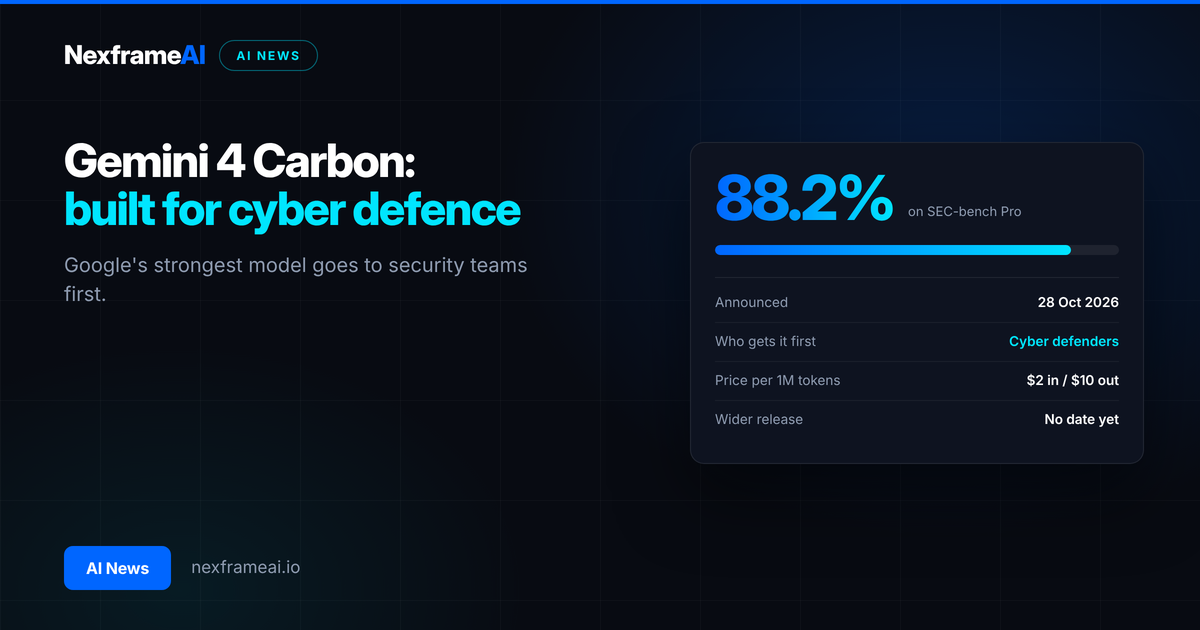
On 28 October 2026, Google announced Gemini 4 Carbon, which it calls its strongest model yet, with "state-of-the-art cybersecurity and long horizon capabilities". You can't use it today unless you work for one of a small group of approved cyber defence teams, because Google is releasing it to defenders first and to everyone else later.
That's an unusual way to launch a flagship model. In this article you'll get the facts Google has published, what the numbers mean in plain English, what Gemini 4 Carbon will cost when it opens up, and what all of this means if you build software, run IT for a business, or just use Gemini from Lagos, Abuja or Nairobi.
What Happened
Google DeepMind published the announcement on the Google blog. The post was written by Koray Kavukcuoglu, SVP at Google DeepMind and Chief AI Architect at Google. It arrived just two weeks after Gemini 4 Argon, the model that reached the Gemini app in mid-October. If you missed that launch, our explainer on what Gemini 4 Argon means for Gemini app users covers it.
Carbon is not a replacement for Argon in the app you use every day. It's a separate, more capable model that Google has tuned heavily for security work and for long tasks that run over hours or even days. Google says internal teams have watched Carbon keep working for days on multi-step engineering jobs, such as tracking down the root cause of a bug in a huge codebase and then writing the fix.
The release plan is the headline. According to Google:
From launch week, Carbon is available only to "a subset of cyber defenders".
Access will widen gradually to more trusted partners through Google's Fairwind Program, which already has more than 650 partners globally.
Developers, businesses and ordinary users will get it "coming soon". Google has not given a date.
Google also said it takes part in the US government's voluntary pre-release model testing process. In other words, government testers get to look at the model before the wider public does.
Why It Matters
For most of the last two years, AI labs have shipped their best models to everyone on the same day. Carbon breaks that pattern on purpose. The reasoning is simple: a model that is very good at finding and fixing security holes is, by definition, also good at finding them for the wrong reasons. Giving defenders a head start means banks, hospitals, telecoms firms and governments can patch their systems before attackers get a tool of the same strength.
You've already seen a preview of why this matters. Not long ago, AI tools helped uncover two long-hidden flaws in PHP, the language that still runs a huge share of the web (we covered it in AI found two 20-year-old PHP flaws). Carbon is Google saying, in effect, "we can now do this kind of work much faster, so we're handing it to the people who fix things first".
There's a second reason it matters. Google claims Carbon now sits at number one on the Artificial Analysis Intelligence Index, a widely watched leaderboard that combines many tests into one score. If that holds up, it puts Google back at the top of the general model race, not just the security niche. Other roundups suggest the gap is tiny, though, and that rival models from OpenAI and Anthropic still lead on some coding tests. Treat "strongest" as Google's claim, not a settled fact.
The Details: Gemini 4 Carbon Benchmarks, Safety and Price
Here's what Google published, grouped so it's easier to read. Every figure below comes from Google's own announcement unless we say otherwise.
General intelligence
Artificial Analysis Intelligence Index v5.0: first place with a score of 59, according to Google. Roundups of the same index have reported Claude Opus 5.5 at 58 and GPT-6 Astra at 57, so the lead is a single point.
WebDev Arena: up 89 Elo points to fourth place, at 1768. This is a public ranking where people vote on which model built the better web page.
Cybersecurity
SEC-bench Pro (finding vulnerabilities): 88.2%, which Google describes as state of the art.
ExploitGym (exploiting vulnerabilities): 54.8%, a new state of the art according to Google.
CWE-bench (patching): 71.0%.
Secure code: more than twice the success rate of Argon at writing secure code, on Google's internal tests.
Chrome team test: Google says its Chrome team found Carbon more than 10 times better than "another lab's large frontier model" at producing high-quality patches. Google didn't name the other model.
One important footnote: Google says the cybersecurity results were measured without guardrails. That means the test version could do things the public version may refuse to do.
Safety and honesty
Google spent a lot of the post on safety, which makes sense for a model this capable at security work. It reports:
Prompt injection: a 0.0% attack success rate on Gray Swan's indirect prompt-injection benchmark, down from 0.7% for Argon. Prompt injection is when hidden text in a web page or file tricks an AI into following someone else's instructions.
Cheating on tests: on Terminal-Bench 4.0, successful cheating fell to 0.0% and cheating attempts to 0.4%, while accuracy went up.
Misalignment alerts: high-severity alerts in live coding dropped by almost 80%, on internal data.
Making things up: unsupported claims cut by roughly half compared with Argon.
Overreach and under-service: overreach (doing more than you asked) down 26%, and under-service (doing less than you asked) down 29%.
Google says Carbon also checks sources and flags conflicts before acting when your instructions are unclear. That's a good habit for any AI agent, and it echoes what we recommend in is agentic coding safe for production code?.
Price
Gemini 4 Carbon API pricing | Per 1 million input tokens | Per 1 million output tokens |
|---|---|---|
Introductory price (same as Argon) | $2 | $10 |
After the introductory period | $4 | $20 |
Cached input | 95% off the input price | n/a |
At roughly ₦1,350 to ₦1,400 to the dollar (an estimate based on late-October rates; check today's rate), the introductory price works out to about ₦2,700 to ₦2,800 per million input tokens and ₦13,500 to ₦14,000 per million output tokens. Google hasn't said how long the introductory period lasts.
If tokens are new to you, our guide to what an LLM is and how it reads text explains them simply. A million tokens is roughly 750,000 words, so most small projects use far less.
What we still don't know
Google hasn't published a public API model ID or a context window figure for Carbon, according to reports. There's also no date for the consumer release and no list of countries.
What It Means for You
How much Carbon affects you right now depends on who you are. Let's take it group by group.
If you use the Gemini app
Nothing changes yet. If you pay for Google AI Pro or Ultra, you're on Gemini 4 Argon, which is already a big step up. Free users are on Gemini 3.5 Flash Lite. When Carbon reaches consumers, it will probably appear as a new option in the model picker first, but Google hasn't confirmed how or when. If you're deciding which assistant to pay for this year, our Claude vs ChatGPT vs Gemini decision guide is still the place to start.
If you're a developer
You can't call Carbon from the API yet. What you can do is prepare. Carbon's launch is a loud signal that AI-powered attacks and AI-powered defence are both getting faster. If you ship apps that use AI, read how to secure AI features in your app and fix the basics: input checks, limited permissions for AI agents, and logging.
If you build quickly with AI assistants, the same lesson applies. Our step-by-step vibe coding workflow includes a security review stage before you ship, and that stage matters more every month.
One more practical step: list the open-source libraries your app depends on and keep them updated. When models like Carbon reach more defenders, expect a wave of newly reported flaws in popular packages, followed by a wave of patches. Teams that update quickly will be fine. Teams that leave a three-year-old dependency untouched are the ones attackers will find first, whether those attackers use AI or not.
If you work in a Nigerian bank, telco or agency
This is where the African angle gets interesting. Google's Fairwind page lists who gets priority:
governments and national cyber authorities
critical infrastructure: healthcare, telecommunications, energy and financial networks
core technology platforms
academic labs doing defensive benchmarking, which can apply
Google names no countries and no regional restrictions. Our reading (not Google's statement) is that a Nigerian bank, a mobile network operator, a payments company or a national agency could in principle apply. The route Google gives is to contact your Google Cloud account team. If you're not a Google Cloud customer, Google points you to its get-started documentation first.
Be ready for strict checks. Google says applicants go through background checks on security history and ethical record, must use user-level sign-in and phishing-resistant multi-factor authentication, and may not share or resell access. Use is limited to defensive work such as authorised threat simulation, reverse engineering and malware analysis.
A worked example: Chiamaka in Lagos
Chiamaka leads a four-person security team at a mid-sized fintech in Yaba, Lagos. Her company already uses Google Cloud. Here's a sensible plan for her this month:
Ask the account team about Fairwind. She emails the company's Google Cloud contact, explains that the firm handles payments, and asks whether it qualifies. Payments sit under "financial networks", one of Google's priority groups.
Get the paperwork ready. She gathers the security policies, the incident response plan and proof of multi-factor authentication for every engineer, because Google will check these.
Pick one real job for a pilot. She chooses the company's oldest internal service, a PHP admin panel nobody wants to touch, as the first codebase to scan if access comes through.
Budget roughly. If the team ran 20 million input tokens and 4 million output tokens in a month at the introductory price, that's about $40 plus $40, so $80. At an estimated ₦1,350 to ₦1,400 per dollar, that's roughly ₦108,000 to ₦112,000 a month, before any Google Cloud costs. After the intro period it would double.
Keep humans in the loop. Every patch Carbon suggests goes through normal code review before it reaches production.
If access doesn't come through, she hasn't lost anything. The paperwork and the pilot plan are good security practice anyway.
If you're a student or job seeker
Cybersecurity skills are about to become even more valuable, not less. Someone still has to decide what to scan, judge whether a reported flaw is real, and ship the fix safely. Google even points students to its CodeMender tool rather than Fairwind, which tells you the company sees learners as part of the picture. If you're studying computer science in Ibadan, Ile-Ife or Zaria, learning secure coding now is a smart move.
What to Watch Next
A few things will tell you how this story develops:
A consumer and developer date. Google says "coming soon". Watch the Gemini app model picker and Google AI Studio.
Independent benchmark checks. Artificial Analysis and other testers will re-run their numbers. A one-point lead can disappear quickly.
Responses from OpenAI and Anthropic. Both have strong coding models, and both have their own approaches to releasing risky capabilities.
African participation in Fairwind. If Google or partners name African banks, telcos or national CERTs (computer emergency response teams), that will be a useful sign that the programme is truly global.
The end of the introductory price. Doubling to $4 and $20 per million tokens will matter for anyone planning heavy use.
Final Thoughts
Gemini 4 Carbon is a big claim wrapped in a careful release. Google says it's the strongest model it has built, especially at finding and fixing security flaws, and it has chosen to give defenders first access instead of everyone at once. That's a responsible call, and it's one you'll probably see other labs copy.
For you, the practical takeaways are simple. If you're a regular Gemini user, nothing changes yet. If you're a developer, tighten your security basics now. And if you protect systems at a Nigerian bank, telco or agency, it's worth a conversation with your Google Cloud team about Fairwind.
Frequently Asked Questions
What is Gemini 4 Carbon?
It's Google's newest and, by its own account, strongest AI model, announced on 28 October 2026. It's tuned for cybersecurity and long tasks that run for hours or days.
Can I use Gemini 4 Carbon in Nigeria?
Not as an ordinary user yet. At launch it's limited to a subset of cyber defenders, then trusted partners through Google's Fairwind Program. Google hasn't named any excluded countries, so Nigerian organisations in priority sectors could apply through Google Cloud, but approval isn't guaranteed.
How much does it cost?
Google lists an introductory API price of $2 per million input tokens and $10 per million output tokens, rising to $4 and $20 later. That's roughly ₦2,700 to ₦2,800 and ₦13,500 to ₦14,000 at an estimated ₦1,350 to ₦1,400 per dollar.
Is Carbon better than Gemini 4 Argon?
Google says yes, especially at security work: more than twice Argon's success rate at writing secure code on internal tests, and a lower prompt-injection attack rate. Argon remains the model in the Gemini app for paid plans for now.
Is Carbon the best AI model in the world?
Google says it ranks first on the Artificial Analysis Intelligence Index v5.0 with 59. Reported scores for Claude Opus 5.5 and GPT-6 Astra are within one or two points, and rivals still lead some coding tests, so "best" depends on the task.
Why didn't Google release it to everyone?
Because a model that's very good at finding security holes could also help attackers. Giving defenders a head start lets them patch systems first.
Comments (0)
Sign in to post a comment.
- Be the first to comment.