How to Become an AI Engineer in 2026: Roadmap
Learn how to become an AI engineer in 2026 with a step-by-step roadmap: skills, projects, tools, a portfolio plan and a realistic timeline for beginners.
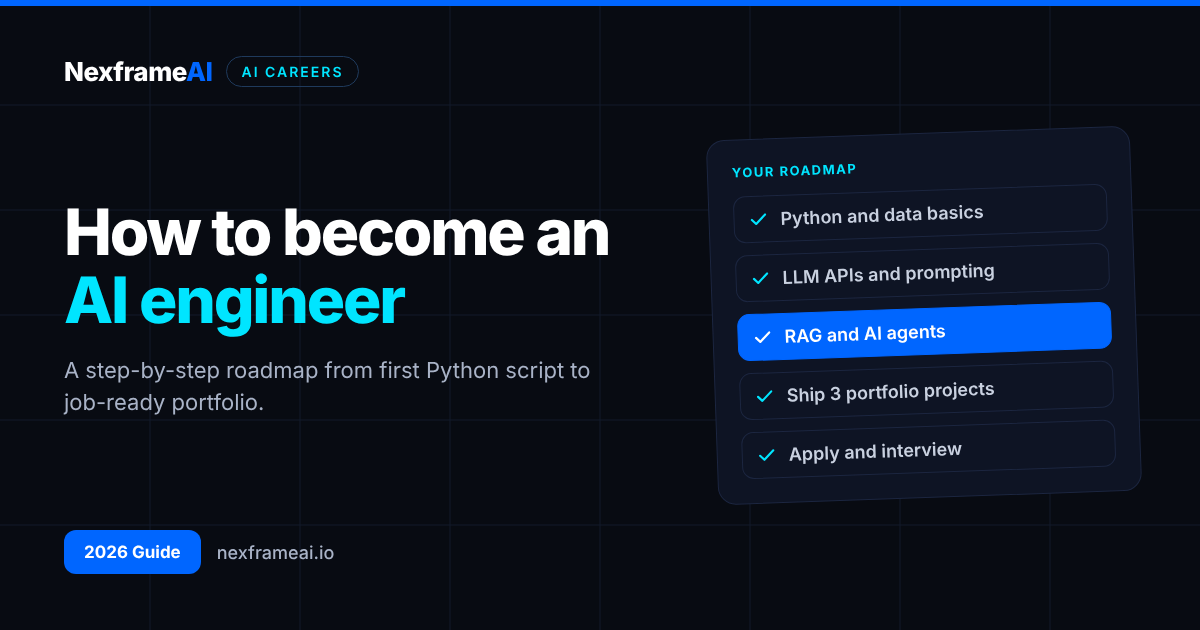
You have probably noticed that "AI engineer" now appears in job adverts that used to say "software developer". Companies want people who can take a model such as GPT-6, Claude Opus 5.5 or Gemini 4 and turn it into something useful: a support assistant, a document search tool, an internal agent that saves staff hours every week. If you are wondering how to become an AI engineer without a PhD or years of research experience, the good news is that the path is clearer in 2026 than it has ever been.
The less comfortable news is that the role is about engineering, not just prompting. You need to write code, call APIs, handle messy data, test outputs and ship software that keeps working when real users touch it.
This guide gives you a practical roadmap. We cover what AI engineers actually do, the skills that matter, an eight-step learning plan, the projects that get you hired, a worked example from Abuja, common mistakes and answers to the questions we hear most often.
What Does an AI Engineer Actually Do?
An AI engineer builds products and features on top of AI models. In most companies today, that means working with large language models (LLMs) through an API rather than training models from scratch.
A typical week might include:
Building features: wiring a model into an app so it can summarise tickets, draft replies or answer questions about company documents.
Retrieval and data work: preparing documents, splitting them into chunks, storing them in a search index and feeding the right pieces to the model.
Evaluation: writing tests that check whether the model's answers are accurate, safe and consistent, then tracking those scores as you change prompts or models.
Agents and tools: letting a model call functions, search a database or take actions, with guardrails and human approval for risky steps.
Cost and speed: choosing the right model for each task, caching results and keeping token bills under control.
Security: protecting against prompt injection, data leaks and misuse.
AI Engineer vs Machine Learning Engineer vs Data Scientist
These titles overlap, but the focus differs. A machine learning engineer usually trains, fine-tunes and deploys models, and needs deeper maths and statistics. A data scientist analyses data and builds models to answer business questions. An AI engineer sits closer to product development: you take strong existing models and make them reliable inside real software.
That is why many AI engineers come from web, backend or mobile development. If you can already build and deploy an app, you are closer than you think. If you would rather work in AI without writing code at all, our guide to AI careers without coding covers roles such as AI operations, content and training work.
The Core Skills You Need in 2026
You do not need to master everything before applying for jobs, but you do need a solid base in each of these areas.
Programming
Python is still the default language for AI work, and most libraries, examples and job adverts assume it. TypeScript/JavaScript is a strong second, because so many AI features live inside web apps. Learn one well before touching the other.
Working With Model APIs
You should be comfortable sending requests to a model API, handling responses, streaming output, using structured outputs (such as JSON) and managing errors and rate limits. Our guide on how to build your first app with an AI API is a good place to start.
Retrieval-Augmented Generation (RAG)
Most business AI products need the model to answer from the company's own information. That is what RAG does. Read our explainer on what retrieval-augmented generation is, then build a small version yourself. You will learn about embeddings, vector search, chunking and why answers go wrong when the wrong context is retrieved.
Evaluation and Reliability
This is the skill that separates hobbyists from professionals. Models make mistakes, and some of those mistakes sound perfectly confident. Understanding what AI hallucination is and why it happens will help you design tests, add citations and decide when a human must check the output.
Agents and Tool Use
In 2026, many teams are building agents that plan steps and call tools. You should understand function calling, the Model Context Protocol (MCP) at a basic level, and how to keep agents safe with limits and approvals. Our guide to what agentic coding is also shows how AI agents are changing the way engineers write software day to day.
Software Engineering Basics
Git, testing, APIs, databases, Docker and cloud deployment are not optional. Employers want people who can ship.
Enough Maths to Reason Clearly
You do not need advanced calculus to start. You do need basic statistics (averages, variance, sampling), probability and an intuition for vectors and similarity, which underpin embeddings and search.
How to Become an AI Engineer: The 8-Step Roadmap
Here is the sequence we recommend. Each step builds on the one before it, and each ends with something you can show.
Step 1: Learn Python Properly (4–8 Weeks)
Focus on functions, data structures, files, error handling and calling web APIs. Write small scripts daily. Output: three or four small scripts on GitHub, such as a CSV cleaner or a weather API caller.
Step 2: Learn Core Software Skills (4–6 Weeks)
Learn Git, build a simple REST API with a framework such as FastAPI, connect it to a database and deploy it. Output: one deployed API with a short README.
Step 3: Understand How LLMs Work (2–3 Weeks)
Learn the basics of tokens, context windows, temperature, embeddings and why models predict text rather than "know" facts. You do not need to build a transformer from scratch, but you should be able to explain the key ideas in plain English.
Step 4: Build With Model APIs (3–4 Weeks)
Build a chatbot, a summariser and a structured data extractor. Practise prompt design, structured outputs, streaming and retries. Try at least two providers so you understand their differences. Output: one small but polished AI app.
Step 5: Build a RAG Project (3–4 Weeks)
Take a real set of documents, such as university handbooks or a small business's policies, and build a question-answering tool with citations. Measure how often it answers correctly. Output: a RAG app with a simple evaluation report.
Step 6: Add Evaluation and Monitoring (2–3 Weeks)
Create a test set of 30 to 50 questions with expected answers. Score your app automatically, change one thing at a time and record what improves. Log every request so you can debug problems later.
Step 7: Build an Agent With Guardrails (3–4 Weeks)
Give a model two or three tools, such as searching a database and drafting an email, and require approval before anything is sent. Handle failures gracefully. Output: a small agent with a clear safety design.
Step 8: Ship, Document and Apply (Ongoing)
Polish your best two or three projects, write case studies explaining your decisions, and start applying. Keep building while you apply.
Roadmap Summary
Step | Focus | Rough time | What you can show |
|---|---|---|---|
1 | Python | 4–8 weeks | Small scripts on GitHub |
2 | Software basics | 4–6 weeks | Deployed REST API |
3 | How LLMs work | 2–3 weeks | Plain-English notes |
4 | Model APIs | 3–4 weeks | Polished AI app |
5 | RAG | 3–4 weeks | Q&A tool with citations |
6 | Evaluation | 2–3 weeks | Test set and scores |
7 | Agents | 3–4 weeks | Agent with approvals |
8 | Ship and apply | Ongoing | Case studies and applications |
These timings assume roughly 10 to 15 hours a week. If you already work as a developer, you can move through steps 1 and 2 much faster.
Building a Portfolio That Gets You Hired
Recruiters see dozens of identical "chat with your PDF" demos. Stand out by solving a real problem and showing your thinking.
Pick real problems. A tool that helps a pharmacy answer stock questions, or helps students search past exam guidance, is more memorable than a generic chatbot.
Show your evaluation. Include a short table showing accuracy before and after your improvements.
Explain trade-offs. Why did you choose that model? How much does each request cost? What happens when retrieval fails?
Write clean code. Hiring managers will read your repositories. Before you push anything public, run through our AI code review workflow to catch bugs, leaked API keys and messy structure.
Worked Example: Ibrahim's Nine-Month Plan in Abuja
Ibrahim is a 26-year-old backend developer in Abuja. He has two years of experience building PHP and Node.js applications for a logistics company and wants to move into AI engineering.
Months 1–2: He already knows how to code, so he spends six weeks moving from PHP to Python, rewriting two of his work utilities as practice. He studies LLM basics in the evenings.
Months 3–4: He builds a delivery-tracking assistant that answers customer questions such as "Where is my parcel?" by calling his company's (test) tracking API. He uses structured outputs so the model never invents a tracking status.
Months 5–6: He builds a RAG tool over his company's driver handbook and HR policies, with citations to the exact section. He writes a 40-question test set and improves accuracy by changing how documents are split.
Months 7–8: He adds an agent that drafts delay notifications for customers but requires a human to approve each message before sending.
Month 9: He writes three case studies, updates his CV and starts applying for remote and Lagos-based roles.
Costs (estimates): Ibrahim keeps his API spending low by using smaller models for testing. If he spends about US$10 a month on API credits, that is roughly ₦15,500 at about ₦1,550 to the dollar, or around ₦139,500 over nine months. Hosting stays on free tiers. His biggest real costs are time, data and power backup during outages.
Before applying, he runs the job descriptions he is targeting through our free skills gap checker to see which skills he still needs to highlight or learn.
Common Mistakes to Avoid
Only learning prompts. Prompting matters, but employers hire AI engineers to build software. If your portfolio is a list of clever prompts, it will not compete.
Skipping the fundamentals. Jumping straight into agent frameworks without understanding APIs, data and testing leads to fragile projects you cannot debug.
Chasing every new model. Learn the principles, build with one or two providers and switch only for a real reason.
Ignoring evaluation. "It looked fine when I tried it" is not a test. Build a test set early.
Ignoring cost and security. Leaked API keys and runaway token bills are common beginner problems. Use environment variables, set spending limits and never paste secrets into public repositories.
Waiting until you feel ready. You will never know everything. Start applying once you have two solid projects and keep learning on the job.
Getting Your First AI Engineering Job
Look beyond the exact title "AI Engineer". Roles such as "LLM engineer", "applied AI developer", "full-stack developer (AI)" and "machine learning engineer" often involve the same work.
Start where you are. If you already work as a developer, volunteer to build an AI feature at your current job.
Freelance and contract work. Small businesses increasingly want chatbots, document search and automation. A few paid projects can become strong case studies.
Remote roles. Many Nigerian and African developers work remotely for overseas companies. Be ready for time-zone overlap and clear written communication.
Prepare for interviews. Expect coding tests, system design questions ("How would you build a support assistant for 10,000 users?") and questions about evaluation and safety. Our guide on how to pass an AI job interview explains what to expect and how to prepare.
Final Thoughts
Learning how to become an AI engineer in 2026 is less about chasing credentials and more about building, testing and shipping real things. Learn Python and software basics, understand how models behave, build a RAG app and an agent with guardrails, and show your evaluation work clearly. Nine to twelve months of steady effort can take a working developer a long way.
When your projects are ready, make sure your CV tells the story well. Nexframe Resume can help you build an ATS-friendly resume and tailor it to each AI engineering job description, so your best projects are not buried on page two.
Frequently Asked Questions
Do I need a degree to become an AI engineer?
Not always. Many employers care more about what you can build than about your degree, especially for applied AI roles. A computer science or related degree helps, particularly for large companies and visa applications, but a strong portfolio and solid software skills can open doors without one.
How long does it take to become an AI engineer?
For someone starting from scratch, 12 to 18 months of consistent study is realistic. If you are already a developer, you could be job-ready in six to nine months by focusing on model APIs, RAG, evaluation and agents.
Do I need to know a lot of maths?
Not at the start. Basic statistics, probability and an intuition for vectors are enough for most applied AI engineering. Deeper maths becomes important if you move into training or research.
Which programming language should I learn first?
Python. It dominates AI tooling and examples. Learn TypeScript or JavaScript next if you want to build web-based AI products.
What is an AI engineer roadmap, and is this one enough?
An AI engineer roadmap is a sequence of skills and projects that takes you from beginner to job-ready. The eight steps in this guide cover the core of what employers ask for in 2026, but you should adjust it to the job adverts you are targeting.
Can I become an AI engineer while working full time?
Yes. Ten to fifteen hours a week is enough to make steady progress. Use weekends for projects and weekday evenings for shorter study sessions.
Will AI coding tools replace AI engineers?
AI coding tools are changing how engineers work, but someone still has to design systems, judge quality, test outputs and take responsibility for what ships. Engineers who use these tools well are in a stronger position, not a weaker one.
How much can I spend learning this in Nigeria?
You can learn most of it for free using documentation, open courses and free hosting tiers. Your main costs are data, power backup and modest API credits, which we estimate at roughly ₦10,000 to ₦30,000 a month for a careful learner, depending on usage.
Comments (0)
Sign in to post a comment.
- Be the first to comment.