Mistral Large 4 Goes Open-Weight: What It Means for Developers
Mistral AI has released the weights of Mistral Large 4, a 1-trillion-parameter model. Here's the licence, price, specs and what it means for developers.
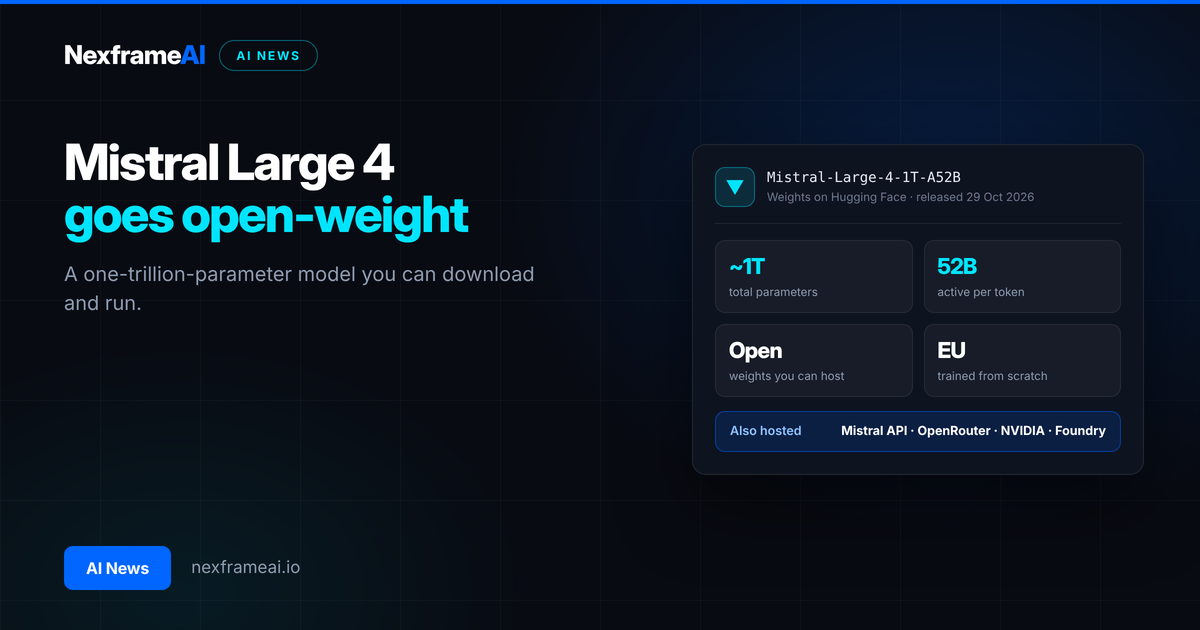
Mistral AI has released the full weights of Mistral Large 4, its flagship model of about one trillion parameters, so anyone can now download it and run it on their own hardware. The release landed in late October 2026 (widely reported on 29 October), about three weeks after the model first appeared as a paid public preview on 6 October.
This is the biggest open-weight release Mistral has made, and it sits in the same weight class as the best Chinese open models. For developers, especially those of you in Nigeria and across Africa who care about cost and control of your data, it's worth understanding exactly what you're getting and what you're not.
What Happened
In an announcement titled "Mistral Large 4 (Le Chonk) is now open weight", Mistral AI said: "We release the weights of Le Chonk, advancing the frontier of open models in agentic coding and cybersecurity." Yes, the company really has nicknamed its flagship model "Le Chonk".
The model first arrived in public preview earlier in October. Mistral's model documentation gives the release date of that preview as 6 October 2026. Since then, Mistral says it has kept training the model with reinforcement learning, and the open-weight version scores noticeably higher than the preview on the coding and security tests the company tracks.
The weights are now on Hugging Face under the name Mistral-Large-4-1T-A52B. You can also use the model without downloading anything, through Mistral's own API, Mistral Studio, OpenRouter, NVIDIA-hosted endpoints and Microsoft Foundry, according to the announcement.
Mistral's headline for the page sums up its pitch: "Built for Coders, Trusted by Defenders." In other words, it wants Mistral Large 4 to be the open model you pick for writing software and for defensive security work.
Why It Matters
Most of the very best AI models are closed. You can rent them through an app or an API, but you never get the model itself. That means you pay per use, your data travels to someone else's servers, and the provider can change the price, the rules or the model at any time.
Open-weight models flip that. Once you have the weights, the file that holds everything the model learned, you can run it where you like, fine-tune it on your own data and keep it working even if the company changes course. If you want a refresher on what those weights actually are, our plain-English guide to what an LLM is walks through it.
Until now, the strongest open models at this size have mostly come from Chinese labs such as Moonshot AI and DeepSeek, with Meta also back in the game. We covered Moonshot AI's Kimi K3 and Meta's Muse Spark open-weight model earlier this year. Mistral Large 4 gives developers a European option at the same scale. Mistral says the model was "trained from scratch on European infrastructure", which matters to governments and companies that care where their AI comes from.
There's also a sovereignty argument here. Jeff Boudier of Hugging Face is quoted in the announcement saying: "AI sovereignty isn't about choosing which API to call." That line lands well beyond Europe. For African countries trying to build their own AI capacity, having strong models you can actually own is a big part of the puzzle.
The Details
Here's what Mistral has confirmed about Mistral Large 4 across its announcement, its model documentation and its Hugging Face model card. We've only included numbers Mistral itself published.
Spec | What Mistral says |
|---|---|
Total parameters | About 1 trillion (the model documentation lists 1.05 trillion) |
Active parameters | 49 billion per token, or 52 billion counting embeddings and output layers |
Design | Mixture-of-Experts, natively multimodal (text and image input) |
Context window | 1 million tokens |
Reasoning effort | Low, medium or high (high is the default) |
Languages | "Natively fluent in 160+ languages", including every official EU language |
Licence | Mistral Ecosystem Open-Weight licence (a modified MIT licence) |
API price | $0.70 per million input tokens, $0.07 cached input, $2.10 output |
Preview date | 6 October 2026; weights released late October |
Mixture-of-Experts, explained quickly
A trillion parameters sounds impossible to run, and in full it is a lot. But Mistral Large 4 is a Mixture-of-Experts model. Instead of using every parameter for every word, it routes each piece of text to a small group of "expert" sections. Only about 49 billion parameters do the work for each token. That's why the model can be huge in knowledge but quicker and cheaper to run than its size suggests.
You still need to store the whole trillion parameters in memory, though. That's the catch we'll come back to.
The licence
The model is released under what Mistral calls its Ecosystem Open-Weight licence, described as a modified version of the MIT licence. Mistral says the model is "free to use, modify, fine-tune, and commercialize" with a single condition: if your business sells access to the model as a hosted service (what Mistral calls Model-as-a-Service), you need a separate commercial licence from Mistral.
So if you're building an app that uses Mistral Large 4 behind the scenes, you're generally fine. If you're planning to resell raw access to the model as your product, talk to Mistral first. As always, read the licence file itself on Hugging Face before you build a business on it. This isn't legal advice.
Benchmarks Mistral claims
These are Mistral's own figures, so treat them as the company's claims until independent testers catch up:
Terminal-Bench 4.0: 41%, up 13 points from the preview's 28%, which Mistral says leads open-weight models.
Artificial Analysis Coding Agent Index: 48%, which Mistral describes as effectively tied with GLM-5.3 while using 47% fewer tokens per task on average.
Cognition FrontierCode 2.0: 19.7%, top of Mistral's comparison set.
Artificial Analysis Cyber Index: 51%.
BrowseComp (web research): 84.5%.
Refusing malicious cyber requests: 96.6% on average, which Mistral says is the highest it has measured among open models.
B3 Agent Security Benchmark: 97.1% attack resistance.
Mistral also says that in human preference tests on coding, people preferred Mistral Large 4 over GLM-5.3, Kimi K3 and DeepSeek V4.1 Flash, with only Claude Opus 5.5 ranked higher among the models it tested. In short: Mistral is not claiming to beat the best closed models. It's claiming to lead or sit near the top of the open ones.
Running it yourself
The Hugging Face model card shows the model served with vLLM and SGLang, and its examples split the model across eight GPUs. Mistral also offers a quantised NVFP4 version aimed at NVIDIA's newer Blackwell GPUs, plus an NVIDIA NIM container and support in TensorRT-LLM.
Mistral doesn't publish a minimum hardware spec. As a rough estimate of our own, a trillion parameters stored at 8 bits each comes to around a terabyte of model weights, and even a 4-bit version is still hundreds of gigabytes. This is data-centre hardware, not a laptop or a gaming PC.
What It Means for You
Let's be practical. If you're a developer in Lagos, Abuja, Nairobi or Accra, "open weights" doesn't automatically mean "free" or "easy". Here's how to think about it.
API or self-hosting?
For most individual developers and small teams, the API is the sensible starting point. At $0.70 per million input tokens and $2.10 per million output tokens, Mistral Large 4 is priced well below most frontier closed models.
Take Chiamaka, a developer in Yaba building a customer support assistant for a small online fashion store. Say her app sends about 20 million input tokens and receives 5 million output tokens a month. At Mistral's listed prices that's $14 for input and $10.50 for output, so about $24.50 a month. At current exchange rates of roughly ₦1,350 to ₦1,400 to the dollar, that's an estimated ₦33,000 to ₦34,300 a month. Cached input (repeated system prompts, for example) costs a tenth of the normal input price, so she could bring that down further.
Self-hosting the full model is a different story. Renting a server with eight high-end GPUs from a cloud provider usually costs far more each month than Chiamaka will ever spend on API calls, and buying that hardware outright is out of reach for almost every startup. Check current cloud prices yourself before you plan around it, but for most of you, self-hosting a trillion-parameter model only makes sense at serious scale or when data rules force it.
If you've never called an AI API before, our guide to building your first app with an AI API gets you from zero to a working request.
Paying from Nigeria
A practical point: API access normally needs an international payment card. Many Nigerian developers run into card limits or declined foreign transactions with naira cards. A dollar card or a domiciliary account usually works better. Check that Mistral's console accepts your card and country before you build anything that depends on it. We couldn't confirm a full country list for Mistral's paid API at the time of writing.
OpenRouter is another route, since it gives you access to Mistral Large 4 alongside other models through one account. Prices on third-party platforms can differ from Mistral's own, so compare before you commit.
Data sovereignty and compliance
This is where open weights really matter for African businesses. If you're building for a bank, a hospital, a government agency or anyone handling sensitive customer data, sending that data to an overseas API can be a compliance headache under Nigeria's Data Protection Act and sector rules.
With open weights, an organisation with the right infrastructure can run Mistral Large 4 inside its own data centre or a local cloud region, so the data never leaves its control. That's the real promise. It also fits the wider push we covered when Nigeria proposed pooling Africa's AI compute: models are only useful for sovereignty if there's local hardware to run them on.
For a fuller look at the trade-offs, read our comparison of open-source vs closed AI models.
What about African languages?
Mistral says the model is "natively fluent in 160+ languages", including every official EU language. It doesn't name the other languages, and we couldn't find any statement that Yoruba, Hausa, Igbo, Swahili or other African languages are among them. Don't assume they are.
If your product depends on Nigerian languages, test it yourself. Write 20 to 30 realistic prompts in the language you need, including Pidgin and code-switching between English and a local language, and judge the replies with a fluent speaker. Fine-tuning on your own local-language data is one of the things open weights make possible, but it needs good data and real GPU time.
Who benefits locally
Startups and freelance developers: a strong, cheap API model for coding assistants, chatbots and document tools.
Banks, telcos and fintechs: a top-tier model they could, in principle, run on their own infrastructure to keep data in-house.
Universities and research labs: a big open model to study and fine-tune, if they can get access to GPUs.
Security teams: Mistral is pitching the model hard for defensive cybersecurity, from code review to finding vulnerabilities.
What to Watch Next
A few things are worth keeping an eye on over the next few weeks:
Independent benchmarks. Mistral's numbers are its own. Watch for results from independent evaluators to see how Mistral Large 4 really compares with Kimi K3, DeepSeek and the closed models.
Smaller versions. A trillion-parameter model is hard to run. Distilled or smaller variants would make it far more practical for African developers. Mistral hasn't announced any for this model.
Local hosting. Watch whether cloud providers with African regions, or local data centres, start offering Mistral Large 4 as a hosted option. That would combine the data benefits of open weights with the convenience of an API.
Language support details. If Mistral publishes the full list of 160+ languages, check it for African languages.
Licence questions. The Model-as-a-Service condition will matter for anyone reselling AI access. Expect hosting companies to clarify how they're handling it.
The pace of open-weight releases has been relentless this year. Our coverage of DeepSeek V4.1 Flash is a good reminder that today's leader can be overtaken in weeks.
Final Thoughts
Mistral Large 4 going open-weight is a genuinely big moment. It gives developers everywhere a frontier-scale model they can download, inspect, fine-tune and run under a fairly permissive licence, and it gives Europe a homegrown answer to the strong open models from China.
For most Nigerian developers, though, the right move this week is simple. Try it through the API, measure the cost in naira for your real workload, and test it on the tasks and languages your users actually need. Keep the self-hosting dream for when your scale or your clients' data rules justify the hardware. Open weights are a superpower, but only if you have somewhere to run them.
Frequently Asked Questions
Is Mistral Large 4 free?
The weights are free to download and use under Mistral's Ecosystem Open-Weight licence, including for commercial projects. Running the model, though, needs very powerful hardware. Using it through Mistral's API costs $0.70 per million input tokens and $2.10 per million output tokens, according to Mistral.
Can I run Mistral Large 4 on my laptop?
No. The model has about a trillion parameters, and Mistral's own examples run it across eight data-centre GPUs. Even compressed versions need hundreds of gigabytes of memory. Use the API or a hosted platform instead.
What is the difference between open weights and open source?
Open weights means you can download the trained model and run it. It doesn't always mean you get the training data or full training code, and the licence may include conditions. Mistral Large 4's licence, for example, asks companies selling the model as a hosted service to get a separate commercial licence.
Does Mistral Large 4 understand Yoruba, Hausa or Igbo?
Mistral says the model is fluent in more than 160 languages but doesn't list them beyond the official EU languages. We couldn't confirm support for any African language. Test it yourself with a fluent speaker before relying on it.
How much does Mistral Large 4 cost in naira?
At Mistral's API prices and roughly ₦1,350 to ₦1,400 to the dollar, a million input tokens costs an estimated ₦945 to ₦980, and a million output tokens about ₦2,835 to ₦2,940. Exchange rates move, so treat these as estimates and check the current price.
How is Mistral AI's model different from ChatGPT or Claude?
ChatGPT and Claude are closed: you can only use them through their makers' apps and APIs. Mistral Large 4 is open-weight, so you can host it yourself and keep your data in-house. On Mistral's own benchmarks, it doesn't claim to beat the top closed models, but it says it leads or is near the top among open ones.
Comments (0)
Sign in to post a comment.
- Be the first to comment.